In which of the following regions of India are you most likely to come across the ‘Great Indian Hornbill’ in its natural habitat?
Contents16
- ASand deserts of northwet India
- BHigher Himalayas of Jammu and Kashmir
- CSalt marshes of western Gujarat
- DWestern Ghats
Show answer
Answer: (D) Western Ghats
Answer: (d) Western Ghats
The Great Indian Hornbill (Buceros bicornis) is found primarily in the Western Ghats.
It is one of the largest hornbills (up to 3.5 feet long) with a distinctive large yellow beak and casque.
Found in wet evergreen and moist deciduous forests.
Status: Near Threatened (IUCN), Schedule I of Wildlife Protection Act.
Why not others?
- (a) Sand deserts - Too dry; hornbills need dense forests.
- (b) Higher Himalayas - Too cold/high altitude.
- (c) Salt marshes of Gujarat - Wrong habitat; hornbills are forest birds.
It is the state bird of Kerala and Arunachal Pradesh.
Populations declining due to deforestation and hunting.
The Great Indian Hornbill is the state bird of both Kerala and Arunachal Pradesh and is listed under Schedule I of the Wildlife Protection Act.
UPSC is testing whether students can connect specific species to their correct biogeographic zones - the Western Ghats are a biodiversity hotspot with wet evergreen forests that hornbills need.
The question eliminates habitats systematically: deserts lack forests, high Himalayas are too cold, and salt marshes are completely wrong ecosystems for forest-dwelling birds.
Great Indian Hornbill
Environment Great Indian Hornbill
Great Indian Hornbill: Habitat, Status & Conservation
Found in Western Ghats wet evergreen and moist deciduous forests
State bird of Kerala and Arunachal Pradesh
Schedule I species under Wildlife Protection Act
Near Threatened status due to deforestation and hunting
Physical Features
The Great Indian Hornbill (Buceros bicornis) is one of India's largest hornbills, reaching up to 3.5 feet in length. Its most distinctive feature is the large yellow beak with a prominent casque (helmet-like structure) on top.
Habitat & Distribution
Aspect | Details |
|---|---|
Primary Habitat | Western Ghats - wet evergreen and moist deciduous forests |
Forest Type Required | Dense canopy forests with large fruiting trees |
Altitude Range | Up to 2,000 meters in mountainous regions |
States Found | Kerala, Karnataka, Tamil Nadu, Maharashtra, Goa |
Northeast Presence | Arunachal Pradesh, Assam, Nagaland, Manipur |
Ecological Role
Seed disperser for large-seeded forest trees - crucial for forest regeneration
Indicator species - presence indicates healthy forest ecosystem
Frugivorous diet - primarily feeds on figs and other forest fruits
Nesting behavior - female seals herself in tree hollow during breeding
Species Identification

Source: Dreamstime.com — 406 Bird Great Hornbill Great Indian Hornbill Stock Photos - Free ... · www.dreamstime.com
Question Context
This question tests knowledge of species-habitat matching - understanding which ecosystems support specific wildlife. The Great Indian Hornbill requires dense tropical forests with abundant fruit trees, making the Western Ghats the only viable option among the given choices.
Desert habitats lack the dense forest canopy hornbills need for nesting and feeding
Higher Himalayas are too cold and lack tropical fruiting trees essential for hornbill survival
Salt marshes are wetland ecosystems completely unsuitable for forest-dwelling hornbills
Don't confuse with Rufous-necked Hornbill which is found more in Northeast India
Western Ghats Biodiversity
Environment Western Ghats
Western Ghats: Biodiversity Hotspot & Endemic Species
One of world's 8 biodiversity hotspots - UNESCO World Heritage Site
Extends 1,600 km from Gujarat to Kerala along western coast
Home to 40% of India's endemic species despite covering only 6% land area
Three forest types: wet evergreen, moist deciduous, dry deciduous
Geographic Extent
The Western Ghats form a mountain chain along India's western coast, intercepting monsoon winds to create high rainfall zones. This creates unique tropical forest ecosystems that support extraordinary biodiversity.
Key Wildlife Species
Species Type | Notable Examples | Conservation Status |
|---|---|---|
Large Birds | Great Indian Hornbill, Malabar Pied Hornbill | Schedule I protected |
Mammals | Nilgiri Tahr, Lion-tailed Macaque, Indian Elephant | Endangered/Vulnerable |
Reptiles | King Cobra, Malabar Pit Viper | Various protection levels |
Amphibians | Purple Frog, numerous endemic frogs | Many critically endangered |
Forest Ecosystem Types
# Western Ghats Forests
## Wet Evergreen
- High rainfall >250cm
- Dense canopy
- Great Indian Hornbill habitat
- Maximum biodiversity
## Moist Deciduous
- Moderate rainfall
- Seasonal leaf fall
- Teak forests
- Wildlife corridors
## Dry Deciduous
- Lower rainfall
- Thorny vegetation
- Eastern slopes
- Grassland patches
Geographic Location
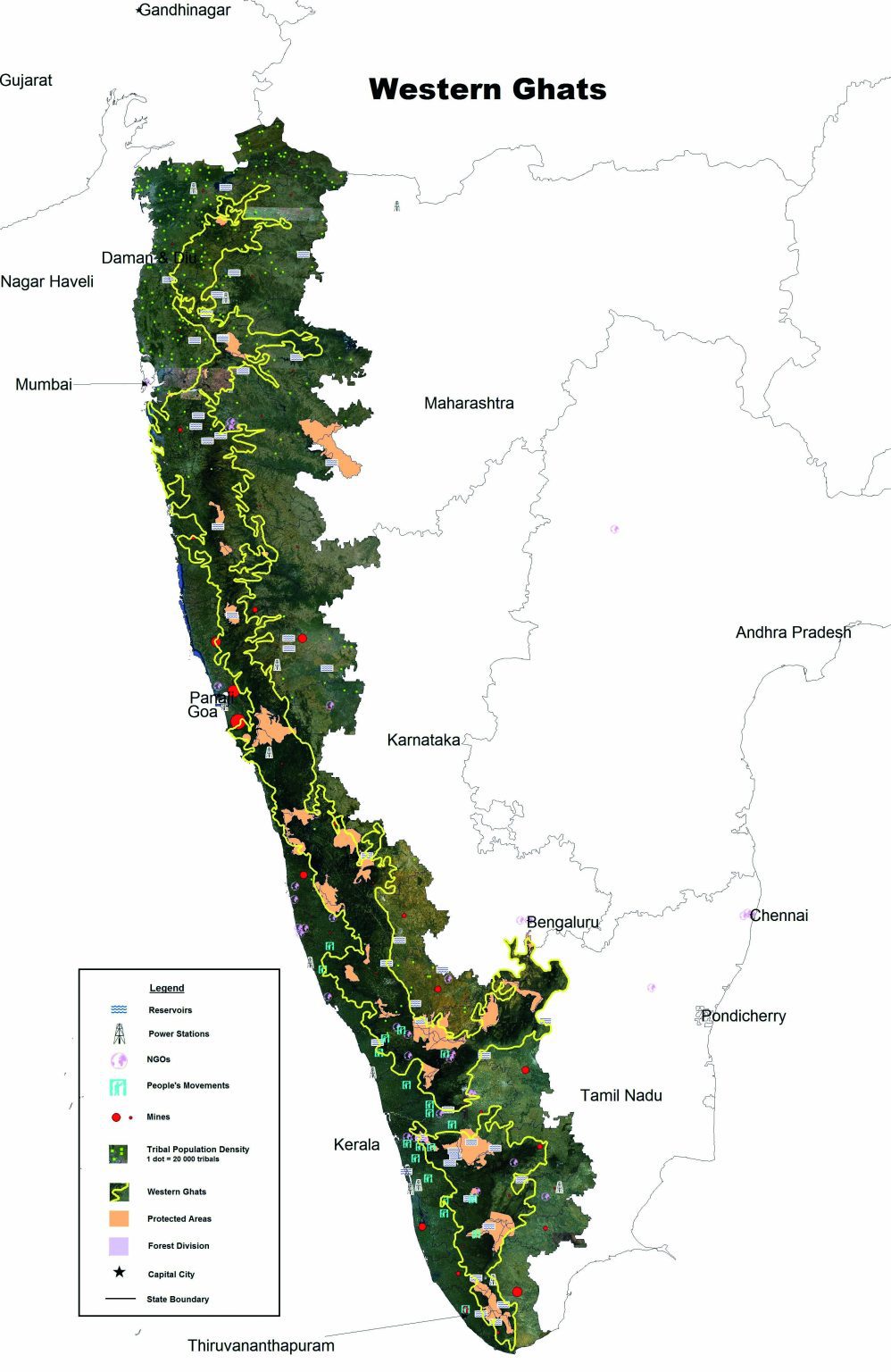
Source: ScienceIndiamag — The Living Heritage of Western Ghats – ScienceIndiamag · scienceindiamag.in
Conservation Significance
UNESCO World Heritage Site (2012) - recognized for outstanding universal value
39 protected areas including national parks and wildlife sanctuaries
Evolutionary significance - isolated ecosystems led to high endemism
Climate regulation - influences monsoon patterns for entire subcontinent
Don't confuse Western Ghats with Eastern Ghats - Western Ghats have much higher biodiversity
Biodiversity hotspot requires both high endemism AND high threat - Western Ghats qualifies for both
Not all of Western Ghats is UNESCO site - only 39 specific properties are designated
Nilgiri Biosphere Reserve is part of Western Ghats but has separate recognition
Indian Forest Ecosystems
Environment
Indian Forest Ecosystems: Types & Wildlife Distribution
India has 16 forest types classified by Champion & Seth (1968)
Tropical forests support maximum biodiversity and endemic species
Altitude and rainfall are primary factors determining forest type
Different ecosystems support specialized wildlife communities
Major Forest Types vs Wildlife
Forest Type | Climate/Location | Characteristic Wildlife | Example Species |
|---|---|---|---|
Tropical Wet Evergreen | High rainfall >200cm, Western Ghats | Large mammals, hornbills | Great Indian Hornbill, Elephant |
Tropical Dry Deciduous | Moderate rainfall, Central India | Tiger, leopard habitat | Tiger, Chital, Langur |
Temperate Forests | Himalayas 1500-3000m | Mountain wildlife | Brown Bear, Snow Leopard |
Alpine Scrub | Above 3000m, cold deserts | High altitude specialists | Bharal, Tibetan Wolf |
Mangrove Forests | Coastal deltaic regions | Aquatic-terrestrial species | Saltwater Crocodile, Fishing Cat |
Ecosystem-Species Matching
Understanding habitat requirements is crucial for UPSC questions. Each species has evolved for specific ecosystem conditions - hornbills need dense forest canopy, desert animals need water conservation, alpine species need cold tolerance.
Distribution Patterns
Western Ghats & Northeast - highest biodiversity, endemic species concentration
Central Indian forests - tiger reserves, dry deciduous dominance
Himalayan gradients - species change with altitude zones
Coastal ecosystems - mangroves, salt-tolerant species
Arid regions - specialized desert-adapted fauna
Hornbills are strictly forest birds - never found in deserts, grasslands, or wetlands
Altitude matters - many species have specific elevation ranges they cannot cross
Rainfall determines forest type - wet evergreen needs >200cm annual rainfall
Don't assume wide distribution - many Indian species are highly localized to specific ecosystems