What is/are unique about ‘Kharai camel’, a breed found in India? 1. It is capable of swimming up to three kilometres in seawater. 2. It survives by grazing on mangroves. 3. It lives in the wild and cannot be domesticated. Select the correct answer using the code given below.
Contents19
- A1 and 2 only
- B3 only
- C1 and 3 only
- D1, 2 and 3
Show answer
Answer: (A) 1 and 2 only
Answer: (a) 1 and 2 only
Statement 1 (✓ CORRECT):
Kharai camel CAN swim up to 3 km in seawater to reach mangrove islands - a remarkable feature.
Statement 2 (✓ CORRECT):
It survives by grazing on mangroves - adapted to a coastal/marine diet, unique among camels worldwide.
Statement 3 (✗ WRONG):
Kharai camel CAN be domesticated.
Pastoral communities in Kutch, Gujarat use it.
People consume its milk and sell male calves.
Key facts:
Found ONLY in Gujarat's coastal Kutch; also called 'swimming camel'; 'Kharai' comes from Gujarati word for 'salty'; threatened by mangrove destruction.
Kharai camel is the only swimming camel breed in the world, found exclusively in Gujarat's Kutch region where it grazes on mangroves and can swim up to 3 km in seawater.
The question tests whether students can distinguish between wild animals and domesticated breeds - Kharai camels are domesticated by local pastoral communities who use their milk and sell calves.
Kharai Camel - Swimming Adaptation
Environment Kharai camel swimming seawater mangroves
Kharai Camel: India's Only Swimming Camel Breed
Kharai camel can swim up to 3 km in seawater to reach mangrove islands
Only camel breed worldwide that grazes on mangroves
Found exclusively in coastal Kutch, Gujarat
Can be domesticated - used by pastoral communities for milk and breeding
Name comes from Gujarati word 'Kharai' meaning salty
What Makes It Unique
The Kharai camel is the world's only camel breed adapted to marine environments. Found only in Gujarat's coastal Kutch region, this remarkable animal has evolved unique survival strategies that distinguish it from all other camel breeds globally.
• Swimming ability: Can swim up to 3 kilometres in seawater
• Marine diet: Survives by grazing on mangrove vegetation
• Salt tolerance: Adapted to high-salinity coastal environment
Kharai vs Regular Camels
Feature | Kharai Camel | Regular Camels |
|---|---|---|
Habitat | Coastal mangroves, tidal areas | Desert, arid lands |
Swimming | Can swim 3 km in seawater | Cannot swim |
Diet | Mangrove leaves and shoots | Desert vegetation, thorny plants |
Salt tolerance | High - adapted to saline water | Moderate |
Distribution | Kutch, Gujarat only | Rajasthan, Haryana, other arid regions |
Population status | Endangered (~4,000-5,000) | Stable numbers |
Kharai Camel in Mangroves
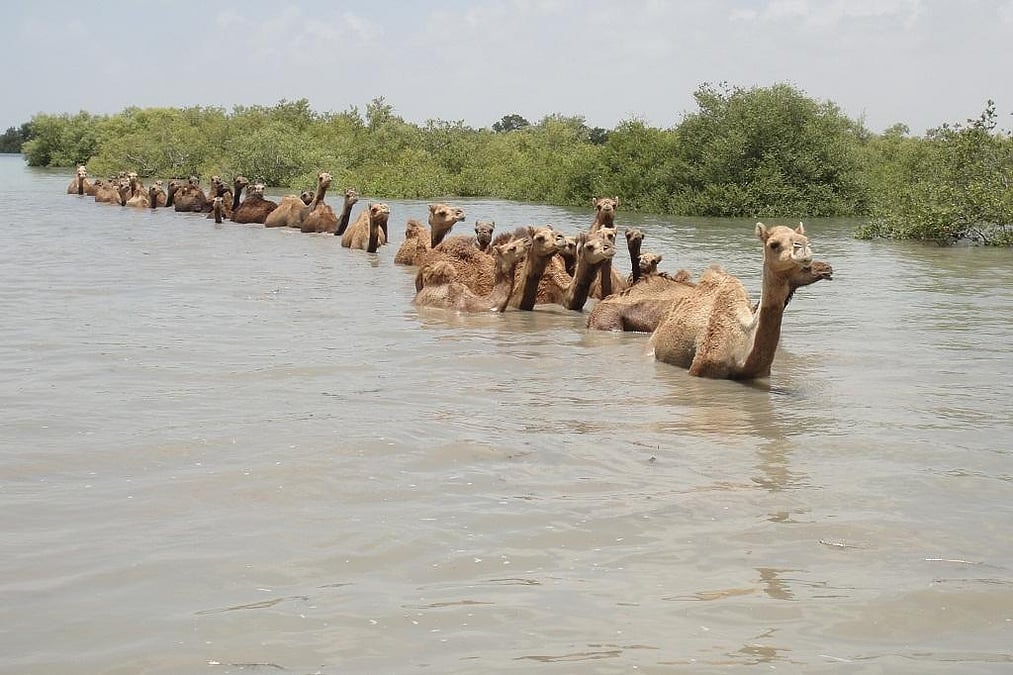
Source: Down To Earth — Save these camels of Kutch · www.downtoearth.org.in
Conservation & Human Use
Pastoral communities in Kutch domesticate and rear Kharai camels for livelihood
Milk production - Kharai camel milk is consumed locally and has medicinal properties
Male calves are sold in markets, providing income to camel herders
Threatened status due to mangrove habitat destruction and industrial development
Government initiatives include breeding programs and habitat protection measures
Trap: Statement 3 claims Kharai camels 'cannot be domesticated' - FALSE. They are domesticated by pastoral communities in Kutch
Trap: Don't confuse with Bactrian or Dromedary camels - Kharai is found only in Gujarat
Trap: Remember the 3 km swimming distance - UPSC loves testing specific numbers
Confusion: 'Kharai' means salty in Gujarati, not the camel's color or size
Mangrove Ecosystems in India
Environment mangroves
Mangrove Ecosystems: Critical Coastal Habitats
Salt-tolerant trees growing in coastal tidal areas between land and sea
India has 4,975 sq km of mangrove cover across east and west coasts
Sundarbans (West Bengal) is the largest mangrove forest in India
Provide coastal protection from cyclones, tsunamis, and erosion
What Are Mangroves
Mangroves are salt-tolerant trees and shrubs that grow in coastal intertidal zones. These unique ecosystems exist where freshwater rivers meet the sea, creating brackish water conditions. Mangrove plants have special adaptations like aerial roots, salt-filtering leaves, and viviparous seeds that germinate while still on the parent tree.
Major Mangrove Areas in India
State/UT | Mangrove Area | Key Features | Important Species |
|---|---|---|---|
West Bengal | Largest - Sundarbans | UNESCO World Heritage Site | Royal Bengal Tiger, Spotted Deer |
Gujarat | 1,103 sq km | Kutch coast, supports Kharai camel | Flamingos, Wild Ass |
Andhra Pradesh | Godavari, Krishna deltas | Second largest on east coast | Fishing cats, Otters |
Tamil Nadu | Pichavaram, Muthupet | Backwater tourism | Migratory birds |
Odisha | Bhitarkanika | Saltwater crocodiles | Olive Ridley turtles nearby |
Maharashtra | Mumbai, Ratnagiri | Urban mangroves under threat | Flamingos in Mumbai |
Mangrove Adaptations
# Mangrove Adaptations
## Salt Management
- Salt-excluding roots
- Salt-secreting leaves
- Salt storage in bark
## Breathing
- Pneumatophores (aerial roots)
- Lenticels for gas exchange
## Reproduction
- Viviparous seeds
- Float and disperse by water
- Establish quickly in mud
## Root System
- Prop roots for stability
- Buttress roots
- Cable roots
India's Mangrove Distribution
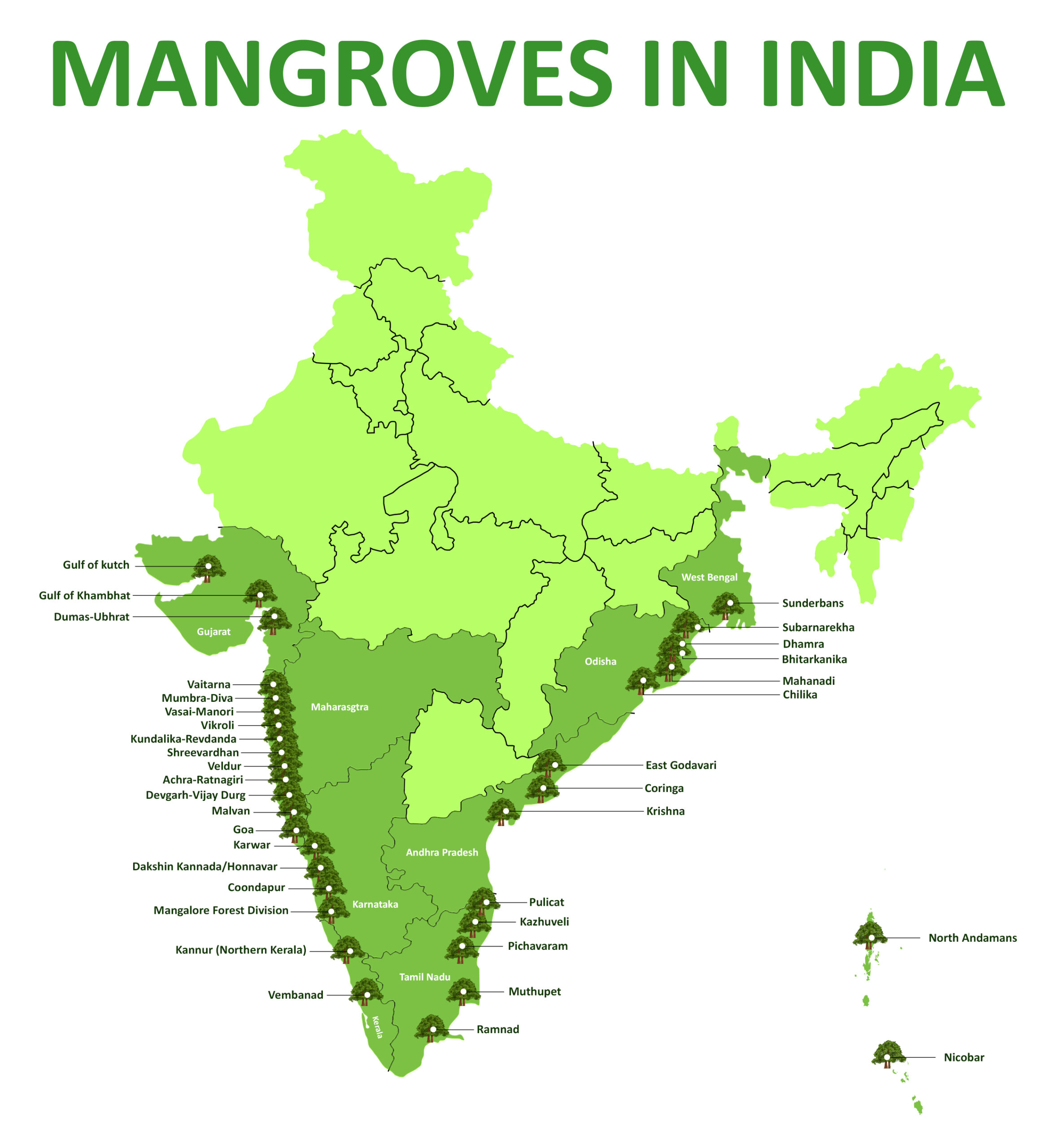
Source: StudyIQ — Mangrove Forest in India 2026: Latest Data, Maps, States and ... · www.studyiq.com
Trap: Mangroves grow in brackish water (mix of fresh and salt), not pure seawater
Confusion: Sundarbans is the largest, but Gujarat has significant mangrove area supporting unique species
Trap: Mangroves are trees and shrubs, not marine algae or seagrass
Remember: Kharai camel connection - Gujarat's Kutch mangroves support this unique breed
Camel Breeds in India
Environment
Indian Camel Breeds: Diversity & Distribution
India has 9 recognized camel breeds adapted to different regions
Kharai is the only breed adapted to marine/coastal environment
Most breeds are found in Rajasthan - the camel state of India
Total camel population in India is approximately 2.5 lakh animals
Camel Diversity in India
India is home to diverse camel breeds, each adapted to specific geographic and climatic conditions. While most breeds are desert-adapted and found in arid regions of Rajasthan, the Kharai camel stands out as the world's only marine-adapted camel breed, exclusively found in Gujarat's coastal areas.
Major Indian Camel Breeds
Breed | Region | Key Features | Special Adaptation |
|---|---|---|---|
Kharai | Gujarat (Kutch) | Swimming, mangrove grazing | Marine environment |
Bikaneri | Rajasthan (Bikaner) | Large size, good milk yield | Desert transport |
Jaisalmeri | Rajasthan (Jaisalmer) | Hardy, drought resistant | Extreme desert conditions |
Marwari | Rajasthan (Jodhpur) | Medium size, multipurpose | Semi-arid regions |
Kachchhi | Gujarat (mainland) | Different from Kharai | Arid plains |
Mewari | Rajasthan (Udaipur) | Smaller, agile | Hilly terrain |
Jalori | Rajasthan | Racing camels | Speed and endurance |
Sindhi | Rajasthan | Cross-border breed | Desert trading routes |
Conservation Challenges
Declining population - camel numbers have dropped by 20% in the last decade
Mechanization - tractors and trucks replacing camels for transport and agriculture
Habitat loss - desert areas being converted for agriculture and industries
Genetic erosion - crossbreeding leading to loss of pure breed characteristics
Climate change - changing rainfall patterns affecting traditional grazing areas
Key distinction: Kharai (marine) vs Kachchhi (terrestrial) - both from Gujarat but different breeds
Trap: Don't assume all Indian camels are from Rajasthan - Kharai is Gujarat-exclusive
Remember: Kharai = swimming camel, other breeds cannot swim
Population trend: Indian camel numbers are declining, not increasing
Gujarat's Unique Biodiversity
Environment
Gujarat's Endemic Species & Conservation Areas
Gujarat hosts India's only wild Asiatic lions and Kharai camels
Kutch region is biodiversity hotspot with unique marine-terrestrial ecosystems
4 National Parks and multiple wildlife sanctuaries protect diverse habitats
Great Rann of Kutch supports migratory birds and desert wildlife
Gujarat's Ecological Significance
Gujarat is ecologically unique due to its diverse landscapes - from coastal mangroves and salt marshes to arid deserts and deciduous forests. The state's Kutch region particularly stands out for its endemic species and specialized ecosystems that support animals found nowhere else in India.
Gujarat's Key Protected Areas
Protected Area | Type | Key Species | Unique Feature |
|---|---|---|---|
Gir National Park | National Park | Asiatic Lion (only wild population) | Lions outside Africa |
Marine National Park | National Park | Corals, dolphins, dugongs | First marine park in India |
Wild Ass Sanctuary | Wildlife Sanctuary | Indian Wild Ass (Khur) | Largest population globally |
Kutch Desert WLS | Wildlife Sanctuary | Desert cats, foxes, reptiles | Desert ecosystem |
Nalsarovar | Bird Sanctuary | Migratory waterfowl | Ramsar wetland site |
Shoolpaneshwar | Wildlife Sanctuary | Leopards, sloth bears | Satpura hills extension |
Gujarat's Endemic Species
# Gujarat Endemics
## Mammals
- Asiatic Lion (Gir only)
- Kharai Camel (Kutch only)
- Indian Wild Ass (largest population)
## Marine Life
- Dugongs
- Whale sharks
- Coral reefs
- Green sea turtles
## Birds
- Greater Flamingo
- Houbara Bustard
- Migratory waterfowl
## Ecosystems
- Mangrove forests
- Salt marshes
- Desert grasslands
- Coral reefs
Kutch Ecosystem
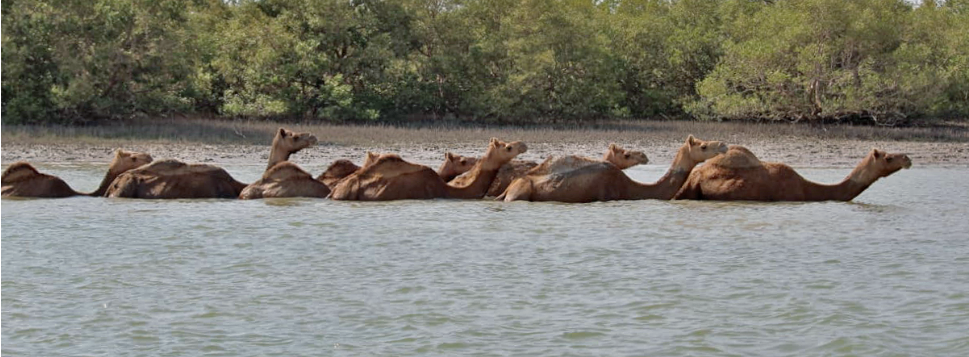
Source: Vikalp Sangam — Swimming camels, mangrove islands of Kachchh face mounting ... · vikalpsangam.org
Trap: Asiatic Lions are in Gir (Gujarat), not Ranthambore (Rajasthan) - don't confuse locations
Remember: Gujarat = only state with both wild lions and swimming camels
Confusion: Wild Ass Sanctuary is for Indian Wild Ass (Khur), not African wild ass
Key fact: Marine National Park was India's first marine protected area