With reference to 'dugong', a mammal found in India, which of the following statements is/are correct? 1. It is a herbivorous marine animal. 2. It is found along the entire coast of India. 3. It is given legal protection under Schedule I of the Wildlife (Protection) Act, 1972. Select the correct answer using the codes given below.
Contents16
- A1 and 2
- B2 only
- C1 and 3
- D3 only
Show answer
Answer: (C) 1 and 3
Statement 1 is correct:
The dugong (also called the 'sea cow') is a herbivorous marine mammal that feeds almost exclusively on seagrass.
It grazes on underwater seagrass beds, which is why healthy seagrass ecosystems are critical for dugong survival.
It is the only strictly marine herbivorous mammal.
Statement 2 is incorrect:
Dugongs are NOT found along the entire coast of India.
Their distribution is limited to specific areas with suitable seagrass habitats — primarily the Gulf of Mannar, Palk Bay (between India and Sri Lanka), the Gulf of Kutch, and the Andaman and Nicobar Islands.
They need sheltered, shallow coastal waters with abundant seagrass, which are not available along the entire Indian coastline.
Statement 3 is correct:
The dugong is listed under Schedule I of the Wildlife (Protection) Act, 1972, which gives it the highest level of legal protection in India.
Killing or capturing a dugong carries severe penalties.
The dugong is also classified as Vulnerable on the IUCN Red List.
Answer: 1 and 3.
Memory aid:
Dugong = Sea cow = eats seagrass (herbivore) = Schedule I protection = found only in specific coastal pockets, not everywhere.
The dugong is the only strictly marine herbivorous mammal in the world, feeding exclusively on seagrass beds in shallow coastal waters.
Dugongs are found only in specific Indian coastal areas with seagrass habitats - Gulf of Mannar, Palk Bay, Gulf of Kutch, and Andaman & Nicobar Islands, not along the entire coastline.
The question tests whether students can distinguish between species with limited geographic distribution versus those found across broader coastal areas.
Dugong: Marine Mammal Characteristics
Environment dugong herbivorous marine animal sea cow
Dugong: The Only Marine Herbivorous Mammal
Dugong is the only strictly marine herbivorous mammal, feeding exclusively on seagrass
Also called 'sea cow' due to its grazing behavior
Found in shallow coastal waters with seagrass beds
Listed as Vulnerable on IUCN Red List
What Makes Dugongs Unique
The dugong (Dugong dugon) is often called the 'sea cow' because it grazes underwater like cattle graze on land. Unlike dolphins or whales that eat fish, dugongs are the only marine mammals that are completely herbivorous.
Key Dugong Facts
Aspect | Details |
|---|---|
Diet | 100% seagrass - mainly Halophila and Halodule species |
Size | 2.5-3 meters long, up to 400 kg |
Lifespan | Up to 70 years |
Reproduction | Single calf every 3-6 years |
Swimming | Slow swimmer, 2-10 km/hr |
Breathing | Surfaces every 1-6 minutes to breathe |
Dugong Grazing
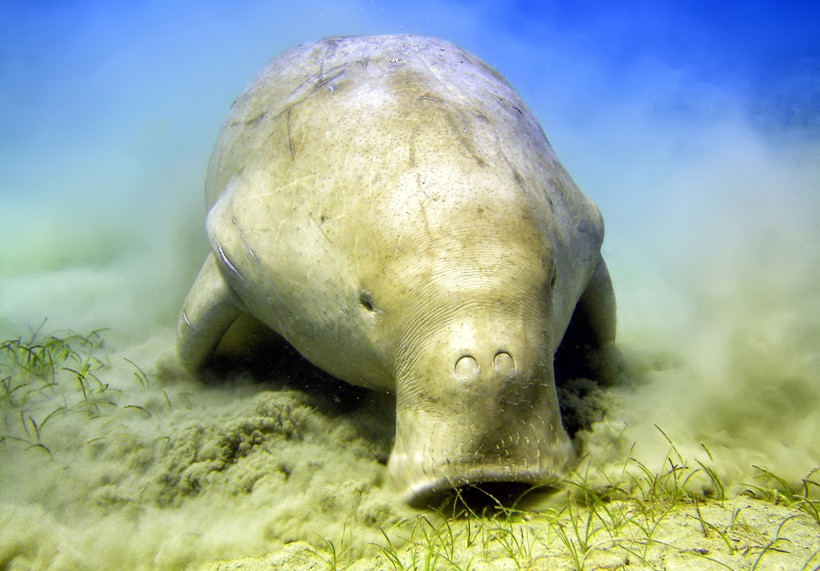
Source: about animals — Dugong (Dugong dugon) | about animals · www.aboutanimals.com
Trap: Don't confuse dugong with manatee - manatees are found in rivers/estuaries, dugongs are strictly marine
Trap: 'Sea cow' refers to dugong being herbivorous, not its appearance
Memory aid: Dugong = Diet of seagrass = Definitely marine
Dugong Distribution in India
Environment found along the entire coast of India
Dugong Distribution: Limited Coastal Pockets Only
Dugongs are NOT found along entire Indian coast - only in specific areas
Main locations: Gulf of Mannar, Palk Bay, Gulf of Kutch, Andaman & Nicobar
Need shallow waters with seagrass beds - not available everywhere
Why Limited Distribution
Dugongs need very specific habitat conditions - shallow, sheltered coastal waters with abundant seagrass meadows. Most of India's coastline lacks these conditions, limiting dugongs to only four main areas.
Dugong Locations in India
Location | State/UT | Population Estimate | Key Features |
|---|---|---|---|
Gulf of Mannar | Tamil Nadu | ~150-200 | Marine National Park, richest seagrass beds |
Palk Bay | Tamil Nadu | ~50-100 | Between India-Sri Lanka, shallow waters |
Gulf of Kutch | Gujarat | ~50 | Marine National Park, limited population |
Andaman & Nicobar | A&N Islands | Unknown | Remote areas, less studied |
Dugong Range Map
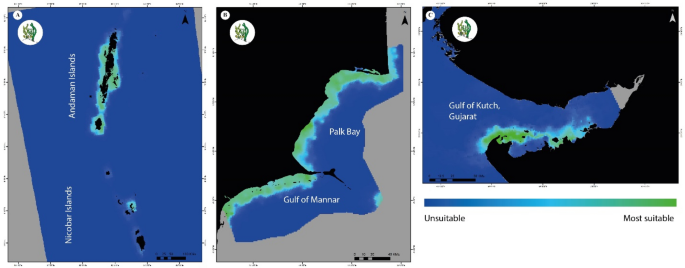
Source: Nature — Spatial prioritization of dugong habitats in India can ... · www.nature.com
Major Trap: Statement says 'entire coast of India' - this is FALSE. Dugongs need seagrass, which exists only in specific pockets
Remember: Gulf of Mannar has the largest dugong population in India
Trick: If question asks about 'entire coast' for any marine species, be suspicious - most have limited ranges
Wildlife Protection Act Schedule I
Environment Schedule I Wildlife (Protection) Act, 1972
Schedule I: Highest Wildlife Protection in India
Schedule I gives highest protection under Wildlife Protection Act 1972
Dugong is listed in Schedule I - correct statement
Killing Schedule I animals carries 3-7 years imprisonment
Schedule I Protection Level
The Wildlife (Protection) Act, 1972 has six schedules. Schedule I provides the absolute protection to the most endangered species. Dugong's inclusion reflects its vulnerable conservation status.
WLP Act Schedules Comparison
Schedule | Protection Level | Penalty | Examples |
|---|---|---|---|
Schedule I | Absolute protection | 3-7 years + fine | Tiger, Elephant, Dugong, Snow Leopard |
Schedule II | High protection | 3-7 years + fine | Leopard, Himalayan Bear, Monkey |
Schedule III | Protected species | 2-3 years + fine | Chital, Blue Bull, Hyena |
Schedule IV | Protected species | 3 years + fine | Falcons, Kingfisher, Magpie |
Schedule I Key Features
Absolute prohibition on hunting, killing, or capturing
No exceptions - even for crop protection or self-defense
Habitat protection also mandated for Schedule I species
International trade banned under CITES Appendix I for most species
Court permission required even for scientific research
Easy mark: Dugong in Schedule I is a direct fact - Statement 3 is correct
Pattern: UPSC often asks Schedule I status of flagship species like Tiger, Elephant, Dugong
Don't confuse: Schedule I = absolute protection, Schedule V = vermin (can be hunted)
Marine Herbivorous Mammals Globally
Environment herbivorous marine animal
Sirenians: The Only Marine Plant Eaters
Sirenians are the only marine herbivorous mammals - dugongs and manatees
Dugong is strictly marine, manatees live in rivers/coastal waters
All other marine mammals are carnivorous (whales, dolphins, seals)
Unique Feeding Niche
Among thousands of marine mammal species, only the Sirenian family evolved to eat plants. This makes dugongs and manatees extremely specialized and vulnerable to habitat loss.
Sirenian Species Comparison
Species | Habitat | Distribution | Diet | Tail Shape |
|---|---|---|---|---|
Dugong | Strictly marine | Indo-Pacific (including India) | Seagrass only | Forked/dolphin-like |
West Indian Manatee | Coastal/rivers | Caribbean, Florida | Seagrass + freshwater plants | Round/paddle-like |
Amazonian Manatee | Freshwater only | Amazon River | Freshwater plants | Round/paddle-like |
West African Manatee | Rivers/coast | West Africa | Mixed aquatic plants | Round/paddle-like |
Marine Mammal Feeding Types
# Marine Mammals by Diet
## **Herbivorous**
- Dugong (seagrass)
- Manatees (aquatic plants)
## **Fish Eaters**
- Dolphins
- Porpoises
- Seals
- Sea Lions
## **Krill/Plankton**
- Baleen Whales
- Blue Whale
- Humpback Whale
## **Large Prey**
- Sperm Whale (squid)
- Killer Whale (mammals)
- Leopard SealKey distinction: Dugong = marine only, Manatee = rivers/estuaries
Remember: Dugong has forked tail, manatees have round tail
UPSC pattern: May ask about 'only marine herbivorous mammal' - answer is dugong