Consider the following: 1. Star tortoise 2. Monitor lizard 3. Pygmy hog 4. Spider monkey Which of the above are naturally found in India?
Contents17
- A1, 2 and 3 only
- B2 and 3 only
- C1 and 4 only
- D1, 2, 3 and 4
Show answer
Answer: (A) 1, 2 and 3 only
Star tortoise (1) — found in India, mainly in dry scrublands and forests of Gujarat, Rajasthan, Tamil Nadu, Andhra Pradesh, and Karnataka.
It is popular in the illegal pet trade.
Monitor lizard (2) — found in India.
Several species of monitor lizards (like the Bengal Monitor and Water Monitor) are native to India, found across various habitats.
They are protected under the Wildlife Protection Act.
Pygmy hog (3) — found in India.
It is the world's smallest and rarest wild pig, found only in the grasslands of Assam (mainly Manas National Park area).
It is critically endangered.
Spider monkey (4) — NOT found in India.
Spider monkeys live in tropical climates, specifically in the evergreen forests of Central and South America (from Mexico to Brazil).
They are a New World primate and have no natural presence in India or Asia.
So 1, 2, and 3 are naturally found in India, but not 4.
Star tortoise, monitor lizard, and pygmy hog are all protected under India's Wildlife Protection Act due to threats from illegal trade and habitat loss.
Spider monkeys are New World primates found only in Central and South America, never in Asia, making this a classic biogeography trap.
UPSC tests whether students can distinguish between Old World species (Asia/Africa) and New World species (Americas) in fauna questions.
Star Tortoise in India
Environment Star tortoise
Star Tortoise: Distribution, Habitat & Conservation Status
Indian Star Tortoise found naturally in dry scrublands of Gujarat, Rajasthan, Tamil Nadu, Andhra Pradesh, Karnataka
Popular target for illegal pet trade due to distinctive shell patterns
Protected under Wildlife Protection Act with strict penalties for possession
Natural Distribution
The Indian Star Tortoise (Geochelone elegans) is endemic to the Indian subcontinent, thriving in arid and semi-arid regions. Its distinctive star-shaped shell patterns make it highly sought after in illegal wildlife markets.
State-wise Presence
State | Primary Habitat | Conservation Status |
|---|---|---|
Gujarat | Dry scrublands, rocky areas | Declining due to trade |
Rajasthan | Desert margins, thorny forests | Moderate populations |
Tamil Nadu | Dry deciduous forests | Fragmented populations |
Andhra Pradesh & Karnataka | Scrublands, grasslands | Trade pressure high |
Not to be confused with other tortoise species like Aldabra Giant Tortoise (found in Seychelles)
Star tortoise is terrestrial — don't confuse with marine turtle species
Illegal pet trade is a major threat — possession without permits is punishable
Monitor Lizards in India
Environment Monitor lizard
Monitor Lizards: Native Species & Protection Status
Multiple monitor lizard species naturally found across India in diverse habitats
Bengal Monitor and Water Monitor are the most common species
All monitor lizards protected under Wildlife Protection Act
Native Species
India hosts several monitor lizard species (Varanus genus) that have adapted to various ecosystems from forests to wetlands. They are important predators in their food chains.
Major Indian Monitor Species
Species | Common Name | Primary Habitat | Distribution |
|---|---|---|---|
Varanus bengalensis | Bengal Monitor | Forests, grasslands, human settlements | Throughout India |
Varanus salvator | Water Monitor | Wetlands, rivers, mangroves | Eastern & Southern India |
Varanus flavescens | Yellow Monitor | Riverine areas, floodplains | Northern India |
Varanus griseus | Desert Monitor | Arid regions, deserts | Rajasthan, Gujarat |
Monitor lizards are native to India — don't confuse with Komodo Dragon (Indonesia only)
Water Monitor can grow very large but is different from Saltwater Crocodile
All monitor species are protected — hunting or trade is illegal
Pygmy Hog Conservation
Environment Pygmy hog
Pygmy Hog: World's Smallest Wild Pig & Conservation Efforts
World's smallest and rarest wild pig found only in Assam grasslands
Critically Endangered with primary habitat in Manas National Park area
Successful conservation breeding program has increased population
Endemic Status
The Pygmy Hog (Porcula salvania) is endemic to the tall grasslands of Assam and represents one of India's most endangered mammals. Adult males weigh only 6-10 kg, making them the world's smallest wild pig species.
Conservation Details
Aspect | Details |
|---|---|
IUCN Status | Critically Endangered |
Primary Habitat | Tall grasslands of Manas National Park region |
Current Population | Estimated 200-300 individuals |
Main Threats | Habitat loss, grassland burning, hunting |
Conservation Program | Pygmy Hog Conservation Programme with breeding centers |
Habitat Range
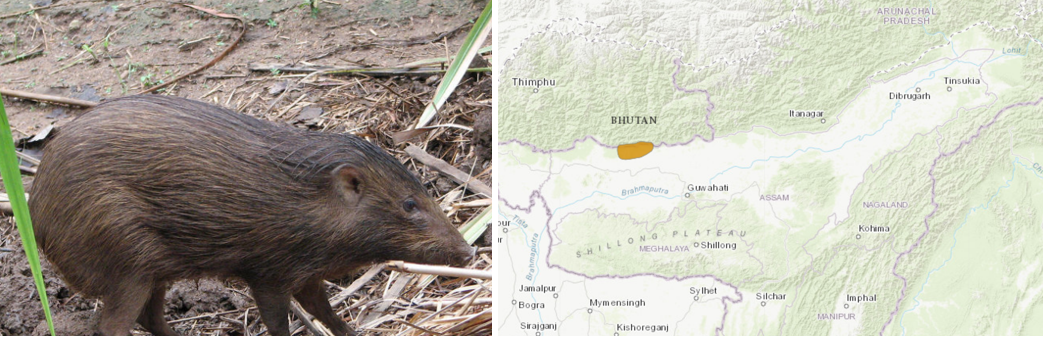
Source: PMF IAS — Pygmy Hog (Porcula salvinia/Sus salvanius) - PMF IAS · www.pmfias.com
World's smallest wild pig — don't confuse size with other small mammals
Found only in Assam — not in other Northeastern states
Grassland specialist — not a forest species like most other pigs
Spider Monkey Geography
Environment Spider monkey
Spider Monkeys: New World Primates NOT Found in India
Spider monkeys are New World primates found only in Central & South America
Range from Mexico to Brazil in tropical evergreen forests
No spider monkey species naturally occur in India or Asia
Geographic Distribution
Spider monkeys (Ateles genus) are exclusively New World primates inhabiting the canopies of tropical rainforests from southern Mexico through Central America to the Amazon Basin. They evolved in isolation from Old World primates.
Primate Distribution Comparison
Primate Group | Geographic Region | Example Species | Found in India? |
|---|---|---|---|
New World Primates | Central & South America | Spider Monkey, Howler Monkey | No |
Old World Primates | Africa & Asia | Langur, Macaque, Baboon | Yes |
Prosimians | Madagascar, Africa, Asia | Lemur, Loris | Yes (Loris) |
Natural Range

Source: Wildlife Nomads — 12 Surprising Spider Monkey Facts | The 'Thumb-Less' Geniuses · www.wildlifenomads.com
Spider monkeys are NOT found in India — this is the trap in the question
Don't confuse with Indian primates like Langur, Macaque, or Loris
New World vs Old World distinction is crucial for primate biogeography questions
Indian Primate Species
Environment
Native Primate Species of India: Old World Monkeys & Prosimians
India has 15+ primate species including Langurs, Macaques, and Lorises
All Indian primates belong to Old World group, not New World
Hoolock Gibbon is India's only ape species
Indian Primate Classification
# Indian Primates
## **Langurs** (Leaf Monkeys)
- Hanuman Langur
- Nilgiri Langur
- Golden Langur
- Capped Langur
## **Macaques**
- Rhesus Macaque
- Bonnet Macaque
- Long-tailed Macaque
- Assamese Macaque
## **Apes**
- Hoolock Gibbon (Northeast only)
## **Prosimians**
- Slender Loris
- Slow Loris
Endemic vs Widespread Species
Species | Status | Primary Distribution | Conservation |
|---|---|---|---|
Golden Langur | Endemic | Assam-Bhutan border | Endangered |
Nilgiri Langur | Endemic | Western Ghats | Vulnerable |
Lion-tailed Macaque | Endemic | Western Ghats rainforests | Endangered |
Hoolock Gibbon | Endemic | Northeast India | Endangered |
Rhesus Macaque | Widespread | Throughout India | Least Concern |
No New World primates like Spider Monkey, Howler Monkey in India
Hoolock Gibbon is India's only ape — not a monkey
Lion-tailed Macaque is endemic to Western Ghats — not found elsewhere