Consider the following: 1. Black-necked crane 2. Cheetah 3. Flying squirrel 4. Snow leopard Which of the above are naturally found in India?
Contents16
- A1, 2 and 3 only
- B1, 3 and 4 only
- C2 and 4 only
- D1, 2, 3 and 4
Show answer
Answer: (B) 1, 3 and 4 only
Naturally found in India:
Black-necked crane (statement 1) — found in Ladakh and Arunachal Pradesh (breeds in Ladakh's high-altitude wetlands).
Flying squirrel (statement 3) — several species found in Indian forests (e.g., Indian giant flying squirrel).
Snow leopard (statement 4) — found in the high Himalayas of Ladakh, Himachal Pradesh, and Uttarakhand.
Cheetah (statement 2) — was declared extinct in India in 1952. While a reintroduction programme was being discussed (and eventually happened in 2022 at Kuno National Park), at the time of this 2012 exam, cheetahs were NOT naturally found in India.
Answer: 1, 3 and 4 only.
India lost its last wild cheetah in 1952, making it the only large carnivore to go extinct in India after independence.
The question tests knowledge of current vs. historical natural distribution - cheetahs were once native but extinct by 2012, while reintroduction only began in 2022.
Students must distinguish between species that are currently naturally found versus those that existed historically or were later reintroduced.
Black-necked Crane in India
Environment Black-necked crane
Black-necked Crane: India's High-Altitude Resident
Naturally found in Ladakh and Arunachal Pradesh
Breeds in high-altitude wetlands above 3,000m
State bird of Jammu & Kashmir
Listed under Schedule I of Wildlife Protection Act
The Black-necked crane is India's only high-altitude crane species, perfectly adapted to the harsh Himalayan environment. UPSC tests this species because it represents India's unique alpine biodiversity.
Distribution & Habitat
Region | Status | Key Sites | Altitude Range |
|---|---|---|---|
Ladakh | Breeding resident | Tso Kar, Hanle Valley | 3,000-5,000m |
Arunachal Pradesh | Winter visitor | Sangti Valley, Zemithang | 2,500-4,000m |
Sikkim | Occasional visitor | High-altitude lakes | Above 3,500m |
Breeding Habitat
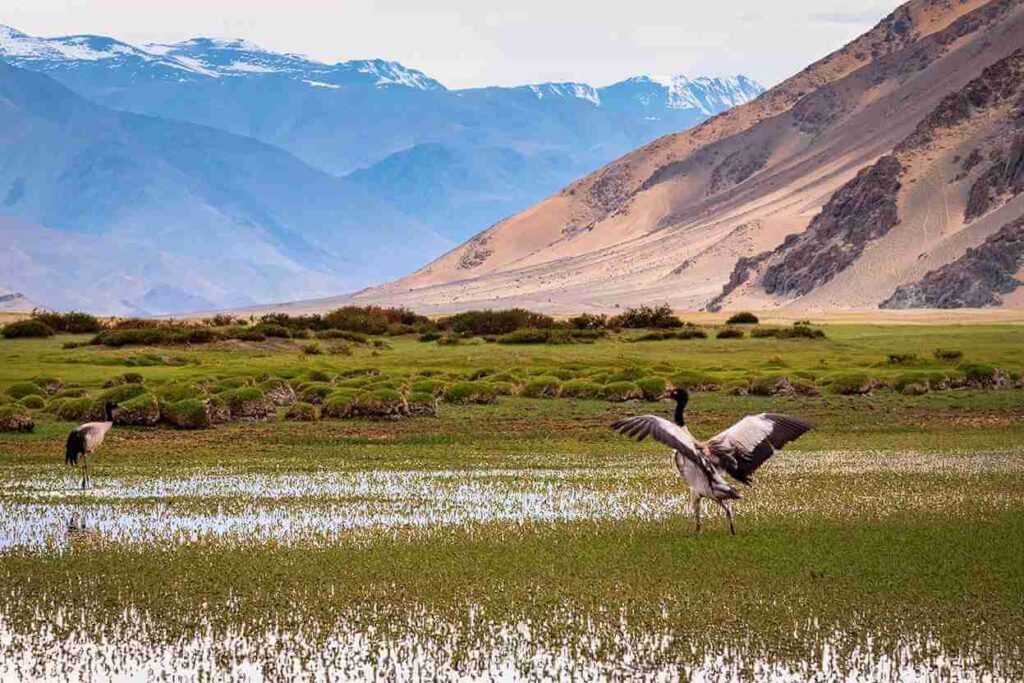
Source: Eka Experiences — Black-Necked Crane - The State Bird of Ladakh that brings Good ... · ekaxp.in
Don't confuse with Sarus crane — that's India's tallest bird but found in plains
Ladakh is the key breeding ground — Arunachal Pradesh is mainly wintering area
This is the only crane species that breeds at high altitudes in India
Cheetah Extinction in India
Environment Cheetah
Cheetah: From Extinction to Reintroduction
Declared extinct in India in 1952
Last cheetah shot in Surguja, Chhattisgarh in 1947
African cheetahs introduced at Kuno NP in 2022
Only large carnivore to go extinct in independent India
The cheetah became India's first major extinction case after independence, making it a critical example for conservation policy. UPSC frequently tests this timeline because it represents both conservation failure and recent restoration efforts.
Cheetah Timeline in India
%%{init: {"flowchart": {"wrappingWidth": 460}}}%%
flowchart TD
  s1["`**Pre-1947**
**Asiatic cheetahs** found across Indian grasslands and scrublands`"]
  s2["`**1947**
Last wild cheetah killed in **Surguja, Chhattisgarh**`"]
  s3["`**1952**
Cheetah officially declared **extinct in India**`"]
  s4["`**2022**
**8 African cheetahs** introduced at Kuno National Park, Madhya Pradesh`"]
  s1 --> s2
  s2 --> s3
  s3 --> s4
Cheetah Reintroduction Programme
Aspect | Details | Key Facts |
|---|---|---|
Location | Kuno National Park, MP | 740 sq km, grassland habitat |
Source | Namibia & South Africa | African cheetah subspecies |
Timeline | Started September 2022 | 50-year action plan |
Goal | Self-sustaining population | Target: 35+ cheetahs by 2047 |
1952 is the extinction year — don't confuse with 1947 (last sighting)
African cheetahs introduced, not Asiatic — Iran has the only remaining Asiatic population
For 2012 question: cheetahs were NOT naturally found in India at that time
Flying Squirrel Species in India
Environment Flying squirrel
Flying Squirrels: India's Gliding Mammals
5 species of flying squirrels found in India
Indian giant flying squirrel is the largest species
Found in Western Ghats and Northeast forests
Glide using patagium — skin membrane between limbs
Flying squirrels are nocturnal gliding mammals that represent India's unique arboreal biodiversity. They don't actually fly but glide between trees using a stretched skin membrane called patagium.
Flying Squirrel Species in India
Species | Size | Distribution | Status |
|---|---|---|---|
Indian Giant Flying Squirrel | Largest (1-1.8 kg) | Western Ghats, Central India | Near Threatened |
Red Giant Flying Squirrel | Large (1-2.5 kg) | Northeast India | Near Threatened |
Spotted Giant Flying Squirrel | Medium | Himalayas, Northeast | Least Concern |
Hairy-footed Flying Squirrel | Small | Kashmir, Himachal Pradesh | Least Concern |
Particolored Flying Squirrel | Small | Northeast hills | Least Concern |
Key Characteristics
# Flying Squirrels
## Anatomy
- Patagium (gliding membrane)
- Large eyes (nocturnal)
- Flat tail (steering)
## Habitat
- Dense forest canopy
- Tall trees for gliding
- Hollow tree nests
## Behavior
- Nocturnal activity
- Herbivorous diet
- Glide up to 100m
## Conservation
- Forest loss threat
- Schedule II protection
- Indicator speciesThey glide, not fly — no powered flight like bats
Indian giant flying squirrel is different from giant squirrel (Malabar giant squirrel)
Found in dense forests — not urban or open habitats
Snow Leopard in India
Environment Snow leopard
Snow Leopard: Ghost of the High Himalayas
Found in Ladakh, Himachal Pradesh, Uttarakhand, Sikkim
Lives at 3,000-5,500m altitude
Population: 400-700 individuals in India
Schedule I species, state animal of Ladakh
The snow leopard is India's apex high-altitude predator, perfectly adapted to the harsh Himalayan environment. It's a trans-boundary species shared with 11 other countries across Central Asian mountains.
Snow Leopard in Indian States
State | Population Estimate | Key Protected Areas | Altitude Range |
|---|---|---|---|
Ladakh | 200+ (highest) | Hemis NP, Changthang WLS | 3,500-5,500m |
Himachal Pradesh | 50-70 | Great Himalayan NP, Kibber WLS | 3,000-5,200m |
Uttarakhand | 20-25 | Nanda Devi NP | 3,500-4,500m |
Sikkim | 5-10 | Khangchendzonga NP | 4,000-5,000m |
Arunachal Pradesh | 5-15 | Tawang region | 3,500-4,800m |
Himalayan Habitat
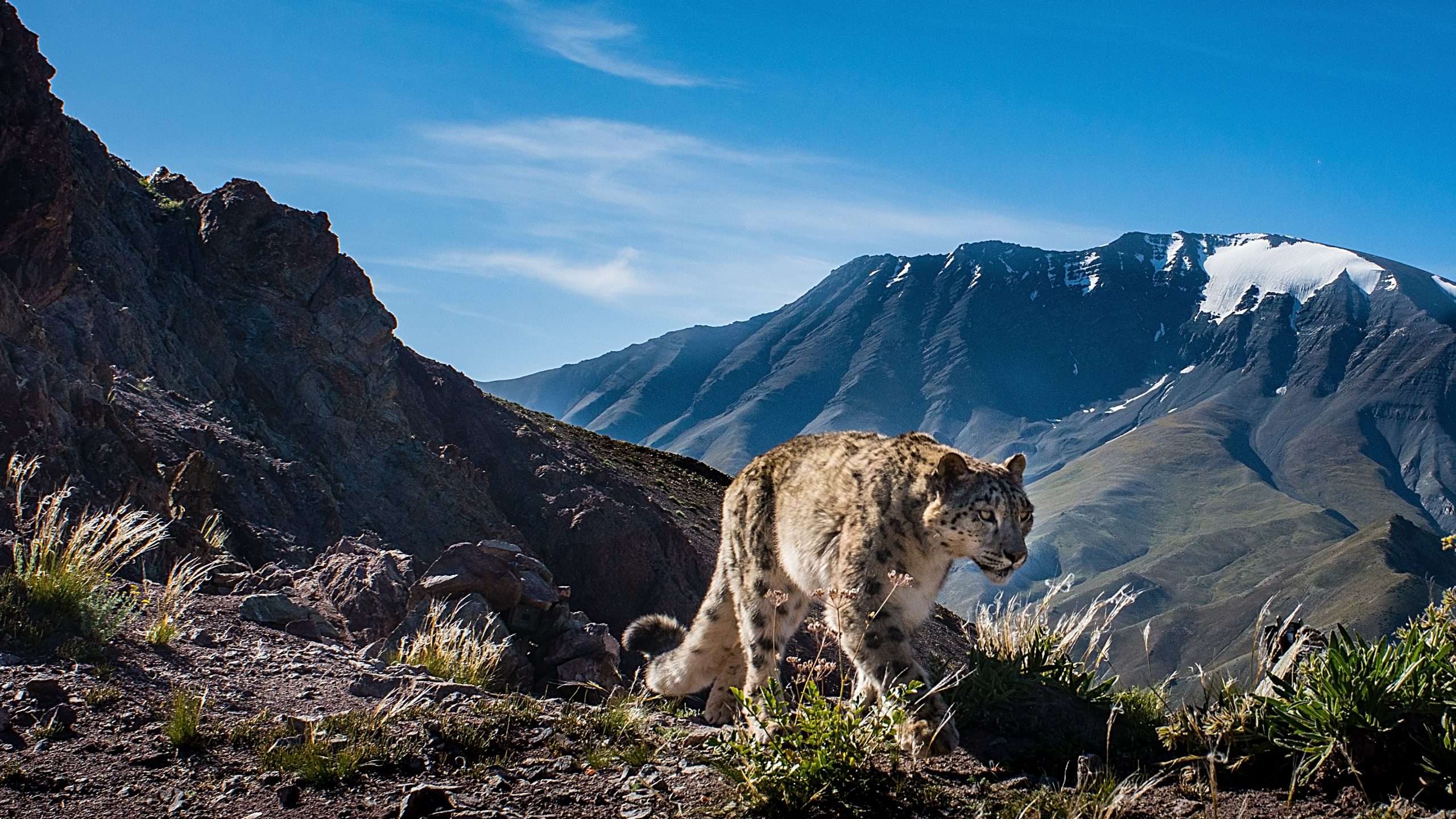
Source: Dreamland Trek and Tour Ladakh — How to Spot The Snow Leopards in Ladakh · www.dreamladakh.com
Conservation Challenges
Human-wildlife conflict — livestock predation leads to retaliatory killing
Climate change — warming temperatures push habitats higher up mountains
Prey depletion — blue sheep and ibex populations declining due to grazing pressure
Infrastructure development — roads and mining fragment habitat corridors
Ladakh has the highest population — not Himachal Pradesh or Uttarakhand
Lives at 3,000m+ altitude — much higher than other big cats
It's the state animal of Ladakh, not Jammu & Kashmir as a whole
Wildlife Protection Act Schedules
Environment
Wildlife Protection Act: Species Classification System
Schedule I — highest protection, absolute prohibition on hunting
6 schedules classify species by protection level
Wildlife Protection Act 1972 — India's main wildlife law
Penalties range from ₹10,000 to ₹25 lakh based on schedule
The Wildlife Protection Act 1972 classifies species into six schedules based on their conservation status and protection needs. Higher schedule numbers mean stricter protection and severe penalties for violations.
Wildlife Protection Schedules
Schedule | Protection Level | Examples | Key Features |
|---|---|---|---|
Schedule I | Absolute protection | Tiger, elephant, snow leopard, black-necked crane | No hunting/trade, life imprisonment possible |
Schedule II | High protection | Assam macaque, Himalayan black bear | No hunting except under special circumstances |
Schedule III | Protected species | Chital, sambhar, wild boar | Closed season hunting possible with license |
Schedule IV | Protected species | Falcons, turtle species | Similar to Schedule III |
Schedule V | Vermin species | Common crow, fruit bat, mice | Can be hunted/killed |
Schedule VI | Cultivation species | No species currently listed | For specified plant species |
Question Context
Black-necked crane and snow leopard are Schedule I species — maximum protection
Flying squirrels are Schedule II — high protection but not absolute
Cheetah would have been Schedule I if present — now reintroduced species have special status
UPSC often asks which schedule a particular species belongs to
Schedule I = highest protection — don't assume Schedule VI is highest
Schedule V species are vermin — can be legally killed
Not all endangered species are Schedule I — some rare species are in Schedule II