Government of India encourages the cultivation of 'sea buckthorn'. What is the importance of this plant? 1. It helps in controlling soil erosion and in preventing desertification 2. It is a rich source of biodiesel 3. It has nutritional value and is well-adapted to live in cold areas of high altitudes 4. Its timber is of great commercial value Which of the statements given above is/are correct?
Contents13
- A1 only
- B2, 3 and 4 only
- C1 and 3 only
- D1, 2, 3 and 4
Show answer
Answer: (C) 1 and 3 only
Sea buckthorn is a shrub found in cold, arid regions like Ladakh and Himachal Pradesh.
Statement 1 correct — its extensive root system helps prevent soil erosion and desertification.
Statement 3 correct — it is highly nutritious (rich in Vitamin C, antioxidants) and is naturally adapted to cold, high-altitude areas (up to 4,500m).
Statement 2 is wrong — while sea buckthorn oil has various uses, it is NOT a significant source of biodiesel.
Statement 4 is wrong — sea buckthorn is a small shrub, NOT a timber-producing tree. The government promotes it for ecological restoration and nutritional security in border areas.
Answer: 1 and 3 only.
Sea buckthorn is promoted by the government for ecological restoration in cold desert regions like Ladakh and Himachal Pradesh, where it prevents soil erosion and provides nutrition.
The question tests whether students can distinguish between shrubs (like sea buckthorn) and trees - shrubs do not produce commercial timber, which eliminates statement 4.
Students must know that biodiesel comes from specific oil-rich plants like jatropha, not from every plant that produces oil - sea buckthorn oil has medicinal uses but is not a biodiesel source.
Sea Buckthorn Plant
Environment sea buckthorn
Sea Buckthorn: High-Altitude Wonder Plant & UPSC Traps
Sea buckthorn is a shrub (not tree) found in cold, arid regions up to 4,500m altitude
Government promotes it for soil erosion control and nutritional security in border areas
Rich in Vitamin C and antioxidants but NOT a biodiesel source
Found mainly in Ladakh and Himachal Pradesh in India
Sea buckthorn (Hippophae rhamnoides) is a thorny shrub that thrives in some of India's harshest environments. The Government of India actively promotes its cultivation for ecological restoration and nutritional security in border regions.
Key Characteristics
Aspect | Details | UPSC Relevance |
|---|---|---|
Plant Type | Thorny shrub (1-4m height) | NOT a timber tree |
Habitat | Cold, arid regions up to 4,500m | Ladakh, Himachal, Uttarakhand |
Root System | Extensive, deep roots | Prevents soil erosion |
Nutritional Value | Vitamin C (15x more than oranges) | Nutritional security in harsh areas |
Biodiesel Potential | Oil present but NOT biodiesel source | Common UPSC trap |
Sea Buckthorn Habitat
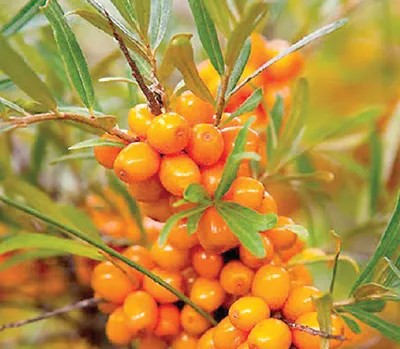
Source: RACE IAS — Sea buckthorn · raceias.com
Government Promotion Reasons
Ecological restoration: Fixes nitrogen in soil and prevents desertification in border areas
Border area development: Provides livelihood opportunities in remote Himalayan regions
Nutritional security: Berries are processed into juices, jams, and health products
Climate resilience: Extremely hardy plant that survives temperatures down to -40°C
Soil conservation: Dense root network binds soil on steep mountain slopes
Trap: Statement 2 confuses sea buckthorn oil with biodiesel - it has oil but is NOT a biodiesel source
Trap: Statement 4 treats it as timber tree - sea buckthorn is a small shrub, not timber-producing
Memory aid: Think 'buckthorn = shrub + nutrition + soil binding' - NOT 'tree + fuel'
Common error: Assuming all government-promoted plants are for biofuel - sea buckthorn is for ecology + nutrition
Soil Erosion Control Methods
Environment soil erosion desertification
Soil Erosion Control: Biological Methods & Plant Selection
Root systems of plants are the most effective biological method for soil binding
Plants with extensive, deep roots prevent both water and wind erosion
Nitrogen-fixing plants also improve soil fertility while binding it
Biological soil erosion control uses vegetation to bind soil particles and prevent their removal by wind or water. This is especially crucial in cold deserts like Ladakh where conventional agriculture is difficult.
Plant-Based Erosion Control
Method | How It Works | Best For | Examples |
|---|---|---|---|
Deep root systems | Roots anchor soil layers | Steep slopes, loose soil | Sea buckthorn, Vetiver |
Ground cover | Leaves protect soil surface | Flat areas, gentle slopes | Grasses, low shrubs |
Nitrogen fixation | Enriches soil + binds it | Degraded/poor soils | Leguminous shrubs |
Windbreaks | Reduces wind velocity | Open, windy areas | Tree/shrub barriers |
Why Sea Buckthorn Works
Extensive root network: Spreads both deep and wide, creating soil matrix
Drought tolerance: Survives in areas too harsh for other erosion-control plants
Multi-benefit: Combines soil binding with nutrition and economic value
Cold adaptation: Works in high-altitude regions where other methods fail
Biodiesel Source Plants
Environment biodiesel
Biodiesel Source Plants: Actual vs Confused Options
Jatropha and Pongamia are India's main biodiesel source plants
Biodiesel plants need high oil content (>30%) and easy oil extraction
Sea buckthorn has oil but is NOT economically viable for biodiesel
Biodiesel production requires plants with high oil content that can be economically extracted and converted. India focuses on non-edible oil plants to avoid food vs fuel competition.
Major Biodiesel Plants in India
Plant | Oil Content | Growing Regions | Government Status | Key Feature |
|---|---|---|---|---|
Jatropha | 30-40% | Rajasthan, Gujarat | Actively promoted | Grows on wasteland |
Pongamia (Karanj) | 25-35% | Coastal areas | National mission | Salt tolerant |
Mahua | 35-50% | Central India | Traditional use | Tribal areas |
Neem | 20-30% | Pan-India | Secondary source | Pest control co-benefit |
Sea buckthorn | Oil present | High altitudes | NOT for biodiesel | Nutritional use only |
Major trap: Any plant with oil ≠ biodiesel source - economic viability matters
Sea buckthorn confusion: Has oil but promoted for nutrition/ecology, not fuel
Remember: Government promotes sea buckthorn for soil + food, Jatropha for fuel
High Altitude Plants of India
Environment cold areas high altitudes
High Altitude Vegetation: Adaptations & Distribution in India
Alpine vegetation (3,000-4,500m) includes shrubs and hardy perennials
Plants adapt through small leaves, deep roots, and waxy coating
Ladakh and Himachal have unique cold desert vegetation
High altitude vegetation in India faces extreme cold, low oxygen, intense UV radiation, and short growing seasons. Plants develop special adaptations to survive above 3,000m elevation.
Altitudinal Vegetation Zones
Zone | Altitude Range | Vegetation Type | Key Species | Adaptations |
|---|---|---|---|---|
Montane | 1,500-3,000m | Coniferous forests | Deodar, Fir, Spruce | Needle leaves, conical shape |
Alpine | 3,000-4,500m | Shrubs, herbs | Sea buckthorn, Juniper | Cushion growth, deep roots |
Nival | Above 4,500m | Sparse vegetation | Mosses, lichens | Extreme cold tolerance |
Cold Adaptation Strategies
Morphological: Small, thick leaves reduce water loss and wind damage
Physiological: Antifreeze compounds in cell fluids prevent ice formation
Reproductive: Short flowering period synchronized with brief summer
Root system: Deep, extensive roots for stability and nutrient access
Alpine Vegetation Zones

Source: Shutterstock — Vector Illustration High-altitude Zones Himalayas Flat Stock ... · www.shutterstock.com