What is blue carbon?
Contents16
- ACarbon captured by oceans and coastal ecosystems
- BCarbon sequestered in forest biomass and agricultural soils
- CCarbon contained in petroleum and natural gas
- DCarbon present in atmosphere
Show answer
Answer: (A) Carbon captured by oceans and coastal ecosystems
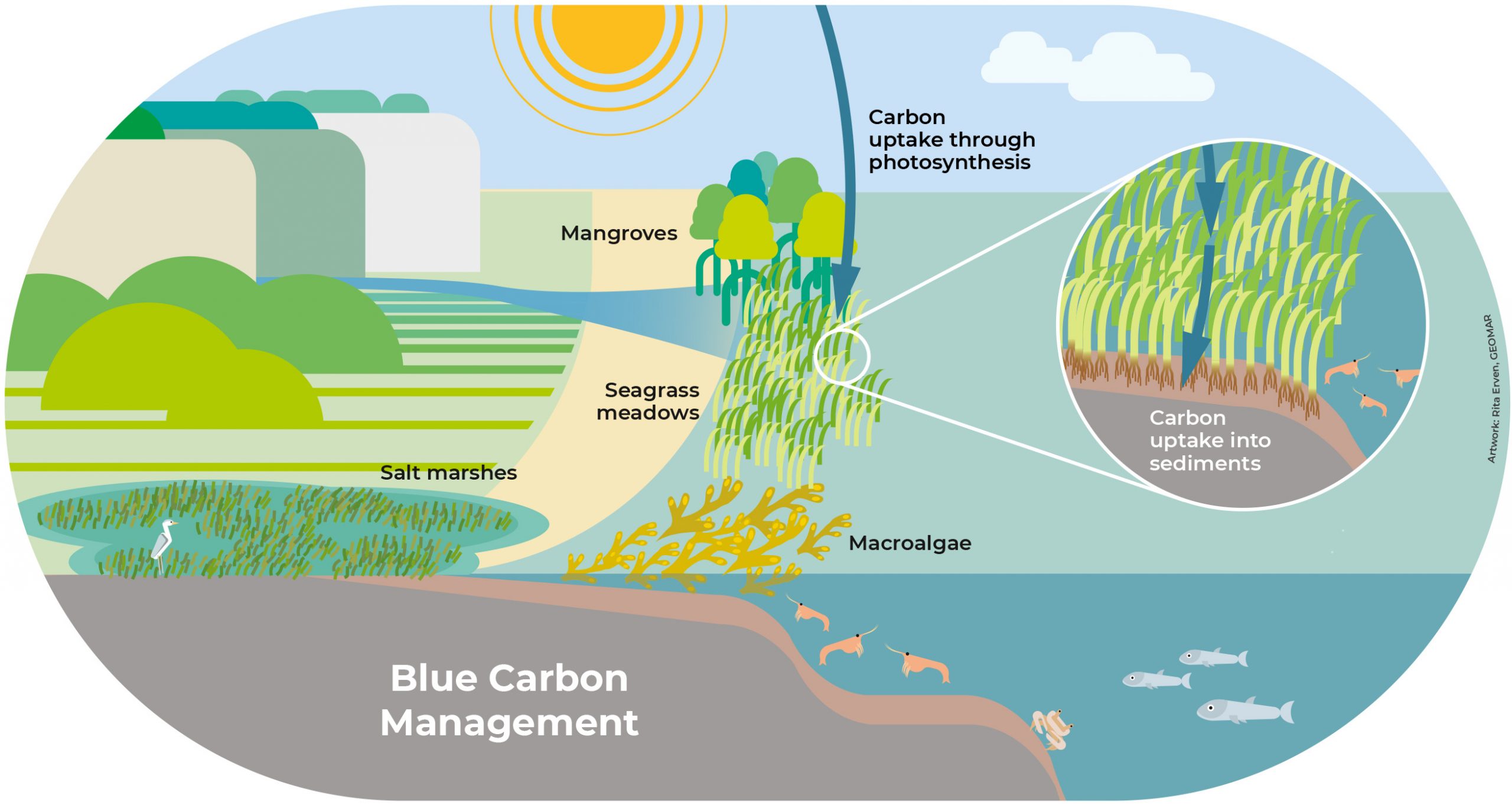
Blue carbon is the carbon captured and stored by the world's oceans and coastal ecosystems — specifically by seagrasses, mangroves, and salt marshes.
These coastal systems act as 'carbon sinks,' absorbing CO2 from the atmosphere.
Despite being much smaller in area than forests, they sequester carbon at a much faster rate and can store it for millions of years.
Option (b) describes 'green carbon' (forests and soil).
Option (c) describes fossil fuels.
Option (d) is just atmospheric carbon.
Answer: (a).
Coastal ecosystems like mangroves, seagrasses, and salt marshes sequester carbon 10 times faster than terrestrial forests despite covering much smaller areas.
Blue carbon became prominent in climate policy around 2019-2021 as countries began including coastal ecosystem restoration in their climate commitments under the Paris Agreement.
The question tests whether students can distinguish between blue carbon (coastal ecosystems), green carbon (forests), and fossil carbon (petroleum/gas).
Blue Carbon
Environment blue carbon
Blue Carbon: Coastal Carbon Sequestration & UPSC Context
Blue carbon = carbon captured by oceans and coastal ecosystems (mangroves, seagrasses, salt marshes)
Coastal systems sequester carbon faster than forests despite smaller area
Distinct from green carbon (forests) and fossil carbon (petroleum/gas)
Can store carbon for millions of years in sediments
What is Blue Carbon
Blue carbon refers to carbon dioxide captured and stored by marine and coastal ecosystems. Unlike terrestrial forests, these aquatic systems trap carbon in both their biomass and underlying sediments, creating long-term carbon storage that can persist for millennia.
Blue Carbon Ecosystems
Ecosystem | Carbon Storage Rate | Key Features | Global Coverage |
|---|---|---|---|
Mangroves | High | Store carbon in roots, trunk, and sediment | Tropical coastlines |
Seagrass Meadows | Very High | Trap carbon in leaves and root systems | Shallow coastal waters |
Salt Marshes | High | Dense root networks in anaerobic mud | Temperate coastlines |
Why Blue Carbon Matters
Coastal ecosystems cover <2% of ocean area but provide 50% of carbon burial in marine sediments
10x faster carbon sequestration rate compared to terrestrial forests per unit area
Carbon remains stored in anaerobic sediments where decomposition is extremely slow
Critical for climate change mitigation and coastal protection from storms
Major focus of UNFCCC and Paris Agreement discussions on nature-based solutions
Carbon Classification
# Carbon Types in Climate Science
## **Blue Carbon**
- Oceans
- Mangroves
- Seagrasses
- Salt Marshes
## **Green Carbon**
- Forests
- Agricultural Soils
- Grasslands
- Terrestrial Biomass
## **Brown/Black Carbon**
- Fossil Fuels
- Coal
- Petroleum
- Natural Gas
## **Atmospheric Carbon**
- CO2
- Methane
- Greenhouse Gases
Blue Carbon Storage
Source: OceanNETs — Blue carbon management – OceanNETs · www.oceannets.eu
India's Blue Carbon Potential
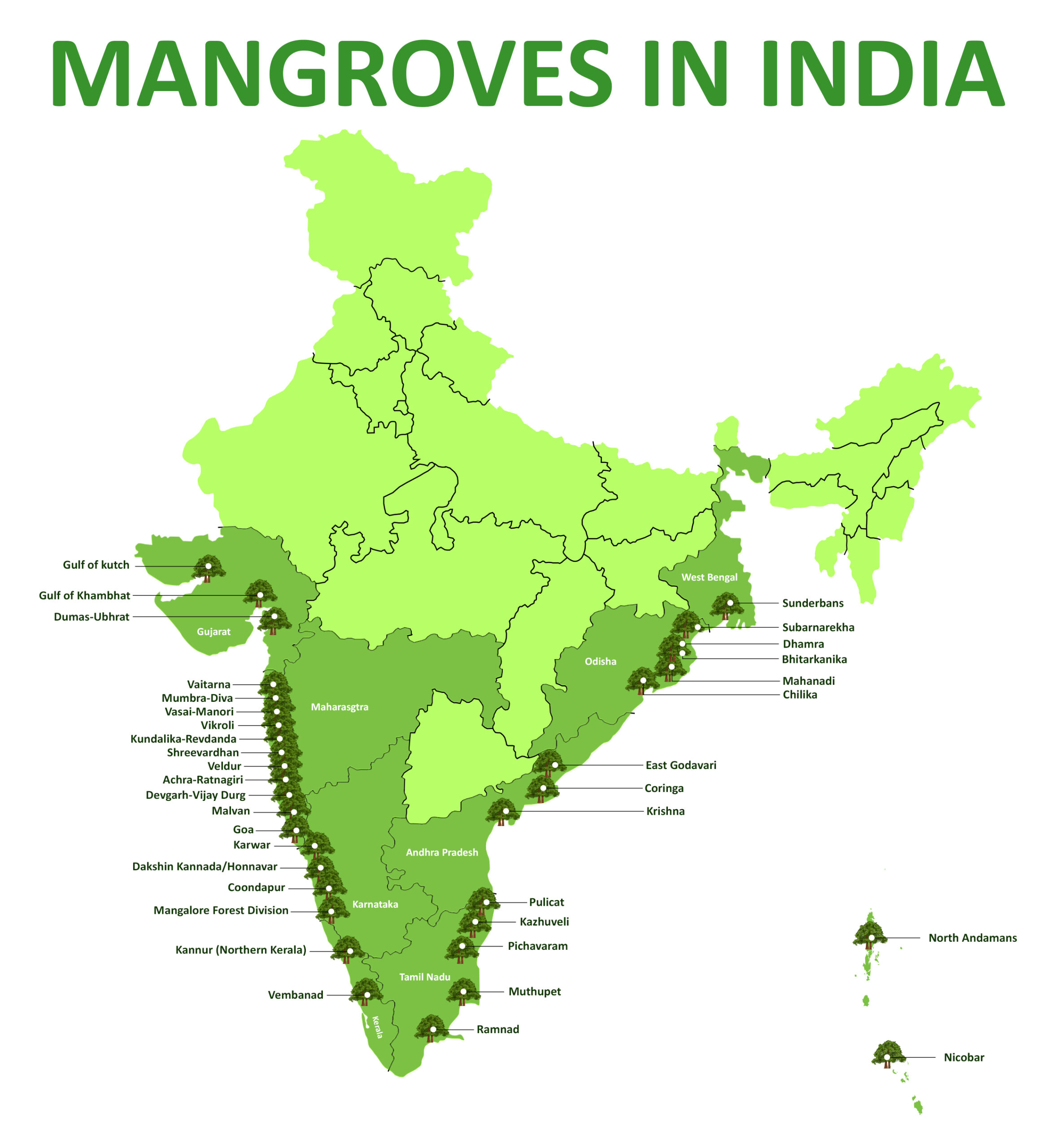
India has significant blue carbon assets along its 7,500 km coastline. Key areas include:
Sundarbans (West Bengal) - world's largest mangrove forest
Pichavaram and Point Calimere (Tamil Nadu) - extensive mangrove systems
Gulf of Mannar - seagrass meadows and coral-associated ecosystems
Chilika Lake (Odisha) - coastal lagoon with salt marsh vegetation
Green vs Blue confusion: Green carbon = forests/terrestrial, Blue carbon = marine/coastal ecosystems
Fossil fuel trap: Brown/black carbon refers to fossil fuels, not atmospheric carbon
Storage duration: Blue carbon stores for millions of years, not just decades like some terrestrial systems
Area vs efficiency: Blue carbon ecosystems are small in area but high in sequestration rate
Carbon Sequestration Classification
Environment
Types of Carbon in Climate Science: Green, Blue, Brown & Atmospheric
Four main carbon categories: Blue (coastal), Green (terrestrial), Brown (fossil), Atmospheric (gases)
Each type has different storage duration and sequestration mechanisms
UPSC tests confusion between blue and green carbon most frequently
Carbon Classification Comparison
Carbon Type | Location/Source | Storage Duration | Key Examples | UPSC Relevance |
|---|---|---|---|---|
Blue Carbon | Marine & coastal ecosystems | Millions of years | Mangroves, seagrasses, salt marshes | High - coastal management |
Green Carbon | Terrestrial ecosystems | Decades to centuries | Forests, agricultural soils, grasslands | Very High - REDD+, afforestation |
Brown/Black Carbon | Fossil fuel deposits | Geological timescales | Coal, petroleum, natural gas | Medium - energy transition |
Atmospheric Carbon | Air/atmosphere | Variable (cycles) | CO2, CH4, other GHGs | High - climate targets |
Sequestration Mechanisms
Blue carbon: Stored in anaerobic sediments below coastal vegetation - decomposition nearly stops
Green carbon: Stored in wood biomass and soil organic matter - releases when disturbed
Brown carbon: Pre-sequestered over millions of years - releases when burned as fuel
Atmospheric carbon: Active cycling between air, oceans, and land - target for reduction
Permanence ranking: Blue > Brown > Green > Atmospheric (most to least stable storage)
Policy Framework Context
Understanding carbon types is crucial for UNFCCC mechanisms. REDD+ focuses on green carbon from deforestation. Blue carbon gained recognition post-2015 as nature-based climate solution. NDCs (Nationally Determined Contributions) under Paris Agreement increasingly include both blue and green carbon targets.
Wrong pairing: Don't confuse blue carbon with forest biomass - that's green carbon
Fossil fuel category: Petroleum/natural gas are brown carbon, not atmospheric carbon
Storage confusion: Blue carbon has longest storage duration, green carbon is medium-term
Ecosystem mix-up: Agricultural soils store green carbon, not blue carbon
Coastal Ecosystems in India
Environment
India's Coastal Blue Carbon Ecosystems & Conservation
India has 7,500 km coastline with significant blue carbon potential
Sundarbans is world's largest mangrove forest spanning India-Bangladesh
Major blue carbon sites: Gujarat, Tamil Nadu, West Bengal, Odisha
Protected under Coastal Regulation Zone (CRZ) notifications
Major Blue Carbon Sites in India
State | Ecosystem Type | Key Sites | Protection Status |
|---|---|---|---|
West Bengal | Mangroves | Sundarbans National Park | World Heritage Site, Biosphere Reserve |
Tamil Nadu | Mangroves + Seagrass | Pichavaram, Point Calimere, Gulf of Mannar | National Parks, Marine Biosphere Reserve |
Gujarat | Mangroves + Salt Marsh | Marine National Park Jamnagar, Kutch | National Park, Sanctuary |
Odisha | Coastal Lagoon | Chilika Lake, Bhitarkanika | Ramsar Sites, National Park |
Kerala | Backwaters + Mangroves | Vembanad, Kumarakom | Ramsar Site, Bird Sanctuary |
Sundarbans Ecosystem
# Sundarbans Complex
## **Geography**
- 10,000 sq km total
- India: 4,200 sq km
- Bangladesh: 6,000 sq km
- Ganges-Brahmaputra Delta
## **Biodiversity**
- Royal Bengal Tiger
- Ganges River Dolphin
- Saltwater Crocodile
- 120+ fish species
## **Blue Carbon Value**
- Massive carbon storage
- Tidal flow systems
- Pneumatophore roots
- Sediment trapping
## **Threats**
- Sea level rise
- Cyclones
- Human encroachment
- Pollution
India's Coastal Ecosystems
Source: StudyIQ — Mangrove Forest in India 2026: Latest Data, Maps, States and ... · www.studyiq.com
Conservation Challenges
Coastal development pressure - ports, industries, aquaculture expansion threatening mangrove areas
Climate change impacts - sea level rise, increased cyclone intensity, temperature changes
Pollution loads - industrial effluents, plastic waste, oil spills affecting coastal water quality
Legal protection gaps - CRZ violations, inadequate enforcement in remote coastal areas
Community dependence - fishing communities rely on these ecosystems for livelihoods