Which one of the following regions of India has a combination of mangrove forest, evergreen forest and deciduous forest?
Contents14
- ANorth Coastal Andhra Pradesh
- BSouth-West Bengal
- CSouthern Saurashtra
- DAndaman and Nicobar Islands
Show answer
Answer: (D) Andaman and Nicobar Islands
The Andaman and Nicobar Islands are uniquely blessed with a combination of ALL THREE forest types mentioned in the question.
(1) Mangrove forests — found extensively along the coastlines and creeks of the islands, especially in the low-lying tidal areas. The islands have some of India's finest mangrove ecosystems.
(2) Tropical evergreen forests — found in the interior hilly regions of the islands that receive heavy rainfall (over 3000 mm annually). The dense canopy, tall trees, and year-round greenness are characteristic features.
(3) Tropical deciduous forests — found in areas with slightly lower rainfall or on slopes, where trees shed their leaves seasonally.
No other option has this combination:
- North Coastal Andhra Pradesh mainly has dry deciduous and scrub forests with some mangroves along the coast, but lacks dense evergreen forests.
- South-West Bengal (Sundarbans area) has extensive mangroves but not true evergreen forests.
- Southern Saurashtra (Gujarat) is arid/semi-arid with thorn forests and scrubland, and no evergreen forests at all.
The islands' unique position — tropical latitude, heavy rainfall, island geography with both coastal and hilly terrain — allows all three forest types to coexist in a relatively small area.
The Andaman and Nicobar Islands are the only region in India where mangrove, evergreen, and deciduous forests coexist due to their unique combination of heavy rainfall, varied topography, and extensive coastline.
UPSC is testing whether students understand that forest types depend on specific climate and terrain combinations, not just regional location - islands can have more diverse ecosystems than mainland coastal areas.
Andaman & Nicobar Forest Types
Environment Andaman and Nicobar Islands mangrove forest evergreen forest deciduous forest
Andaman & Nicobar Islands: Unique Tri-Forest Ecosystem
Only region in India with mangrove + evergreen + deciduous forests together
Heavy rainfall >3000mm supports evergreen forests in interior hills
Coastal tidal areas have extensive mangrove ecosystems
Tropical latitude and island geography create diverse microclimates
The Andaman and Nicobar Islands are India's only region combining all three major forest types in one geographical area. This unique combination results from the islands' tropical location, heavy monsoon rainfall, and diverse topography ranging from coastal plains to interior hills.
Three Forest Types in A&N Islands
Forest Type | Location | Rainfall/Conditions | Key Features |
|---|---|---|---|
Mangrove Forests | Coastlines & tidal creeks | Salt-tolerant, tidal zones | Some of India's finest mangrove ecosystems |
Evergreen Forests | Interior hills | 3000mm annual rainfall | Dense canopy, year-round greenness, tall trees |
Deciduous Forests | Slopes & moderate rainfall areas | Seasonal rainfall patterns | Trees shed leaves seasonally |
A&N Islands Forest Distribution
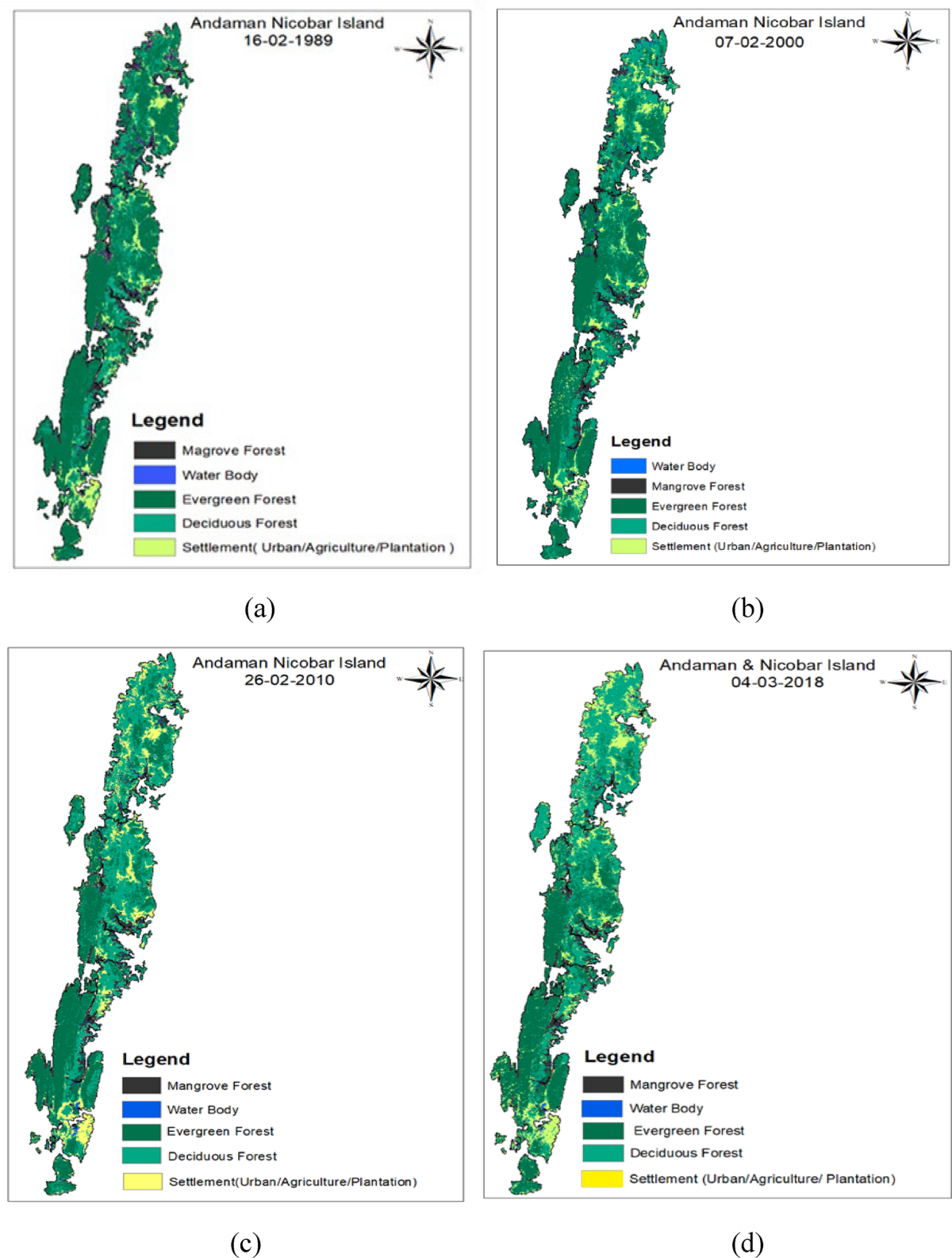
Source: Springer Nature — Mapping and valuation of ecosystem services of mangroves: a detailed study from the Andaman island | Landscape and Ecological Engineering | Springer Nature Link · link.springer.com
Why This Combination Exists
Island geography creates varied microclimates within small area
Southwest monsoon brings >3000mm rainfall to support evergreen forests
Extensive coastline with tidal creeks perfect for mangrove ecosystems
Elevation gradient from sea level to hills supports different forest types
Trap: Other coastal states have mangroves but lack the evergreen forest component due to lower rainfall
Trap: Sundarbans (South-West Bengal) has extensive mangroves but no true evergreen forests
Trap: Southern Saurashtra is arid/semi-arid - no evergreen forests possible
Confusion: Don't mix up deciduous with semi-evergreen - A&N has both evergreen AND deciduous
Mangrove Forest Distribution in India
Environment mangrove forest
India's Mangrove Ecosystems: Distribution & Characteristics
Sundarbans (West Bengal) - world's largest mangrove forest
Andaman & Nicobar - finest mangrove ecosystems in India
Found along east and west coasts in tidal areas
Salt-tolerant trees adapted to tidal submersion
Mangrove forests are salt-tolerant ecosystems found along India's coastlines in tidal areas. They require specific conditions: tidal influence, brackish water, and muddy substrates rich in organic matter.
Major Mangrove Areas in India
Region | State | Key Features | Notable Species |
|---|---|---|---|
Sundarbans | West Bengal | World's largest, Royal Bengal Tiger habitat | Heritiera fomes, Excoecaria |
Andaman & Nicobar | A&N Islands | Pristine ecosystem, high diversity | Rhizophora, Bruguiera |
Bhitarkanika | Odisha | Saltwater crocodile sanctuary | Avicennia, Sonneratia |
Pichavaram | Tamil Nadu | Backwater tourism, dense creek network | Rhizophora apiculata |
Mangrove Adaptations
Pneumatophores - aerial roots for breathing in waterlogged soil
Salt excretion through specialized leaves and bark
Viviparous seeds - germinate while attached to parent tree
Buttress roots provide stability in soft muddy substrate
Trap: Not all coastal areas have mangroves - need tidal influence and brackish water
Confusion: Mangroves ≠ coastal vegetation - many coasts have scrub or deciduous forests
Trap: Southern Saurashtra coast is too arid for mangrove development
Tropical Evergreen Forests
Environment evergreen forest
Tropical Evergreen Forests: India's Rainforest Ecosystems
Require >200cm (2000mm) annual rainfall with no dry season
Found in Western Ghats, Northeast India, and Andaman & Nicobar
Dense canopy with multiple layers, evergreen throughout year
High biodiversity with endemic species
Tropical evergreen forests are India's rainforest ecosystems requiring heavy rainfall >2000mm annually with minimal dry season. Trees remain green year-round due to constant moisture availability.
Evergreen Forest Distribution
Region | Rainfall | Key Characteristics | Important Species |
|---|---|---|---|
Western Ghats | 2500mm | Windward slopes, mist forests | Dipterocarpus, Hopea, Mesua |
Northeast India | 3000mm | Assam, Meghalaya hills | Shorea, Artocarpus, Ficus |
Andaman Islands | 3000mm | Island endemic species | Dipterocarpus, Terminalia |
Nilgiri Hills | 2000mm | Shola forests in valleys | Litsea, Syzygium, Elaeocarpus |
Forest Structure
Emergent layer - tallest trees >45m height
Canopy layer - dense crown cover, main photosynthesis zone
Understory - shade-tolerant smaller trees and shrubs
Forest floor - minimal sunlight, rich organic matter
Trap: Evergreen ≠ coniferous - tropical evergreens are broad-leaved, not needle-leaved
Critical: Need >2000mm rainfall - areas with less rainfall cannot support true evergreen forests
Trap: North Coastal Andhra Pradesh has <1000mm rainfall - insufficient for evergreens
Tropical Deciduous Forests
Environment deciduous forest
Tropical Deciduous Forests: India's Monsoon Forests
Most widespread forest type in India covering ~78% of forest area
Rainfall range: 100-200cm annually with distinct dry season
Trees shed leaves during dry season to conserve water
Two types: Moist deciduous (>100cm) and Dry deciduous (75-100cm)
Tropical deciduous forests are India's dominant forest type, adapted to monsoon climate with distinct wet and dry seasons. Trees shed leaves during the dry season to reduce water loss through transpiration.
Deciduous Forest Types
Type | Rainfall | Distribution | Key Species |
|---|---|---|---|
Moist Deciduous | 100-200cm | Central India, Eastern Ghats foothills | Sal, Teak, Bamboo, Mahua |
Dry Deciduous | 75-100cm | Rajasthan, Gujarat, MP, Deccan | Khair, Palas, Amaltas, Tendu |
Deciduous Forest Distribution
# Tropical Deciduous Forests
## Central India Belt
- Madhya Pradesh
- Chhattisgarh
- Jharkhand
- Sal forests
## Western India
- Rajasthan
- Gujarat
- Maharashtra
- Teak forests
## Eastern Ghats
- Andhra Pradesh
- Telangana
- Odisha foothills
Seasonal Adaptations
Leaf shedding during November-April dry season reduces water loss
Deep root systems to access groundwater during dry months
Fire-resistant bark - many species adapted to natural fires
Rapid leaf growth with onset of monsoon rains