Acid rain is caused by the pollution of environment by
Contents12
- Acarbon dioxide and nitrogen
- Bcarbon monoxide and carbon dioxide
- Cozone and carbon dioxide
- Dnitrous oxide and sulphur dioxide
Show answer
Answer: (D) nitrous oxide and sulphur dioxide
Acid rain is caused primarily by two pollutants:
Sulphur dioxide (SO₂) and Nitrogen oxides (NOₓ — including nitrous oxide/N₂O and nitrogen dioxide/NO₂).
These gases are released mainly by burning fossil fuels (coal, petroleum) in power plants, vehicles, and industries.
When SO₂ and NOₓ rise into the atmosphere, they react with water vapour, oxygen, and other chemicals to form sulphuric acid (H₂SO₄) and nitric acid (HNO₃).
These acids mix with rain, snow, or fog and fall as 'acid rain'.
Option (a) — CO₂ and nitrogen don't form strong acids.
CO₂ does form weak carbonic acid in rain, but this is natural and not what we call 'acid rain'.
Option (b) — CO and CO₂ are air pollutants but not the primary cause of acid rain.
Option (c) — ozone and CO₂ are not the primary cause either.
Option (d) correctly identifies nitrous oxide and sulphur dioxide as the culprits.
Sulphur dioxide and nitrogen oxides from burning fossil fuels react with atmospheric water to form sulphuric and nitric acids that fall as acid rain.
The trap is that carbon dioxide forms only weak carbonic acid naturally, while SO₂ and NOₓ create the strong acids that define environmental acid rain.
Acid Rain Formation & Mechanism
Environment acid rain sulphur dioxide nitrous oxide
Acid Rain: Formation Process & Primary Pollutants
Acid rain forms when SO₂ and NOₓ react with water vapor to create sulfuric and nitric acids
Primary sources: coal-burning power plants and vehicle emissions
Normal rain pH is 5.6, acid rain pH drops below 5.0
Damages forests, buildings, aquatic ecosystems, and human health
What is Acid Rain
Acid rain occurs when atmospheric sulfur dioxide (SO₂) and nitrogen oxides (NOₓ) chemically transform into acids and fall as precipitation. Unlike normal rain which is slightly acidic due to natural CO₂, acid rain has significantly lower pH and causes environmental damage.
Acid Rain Formation Process
%%{init: {"flowchart": {"wrappingWidth": 460}}}%%
flowchart TD
  s1["`**Emission**
**SO₂** and **NOₓ** released from fossil fuel burning`"]
  s2["`**Atmospheric Transport**
Gases rise and travel through atmosphere`"]
  s3["`**Chemical Reaction**
React with **water vapor** and **oxygen** to form acids`"]
  s4["`**Acid Formation**
**H₂SO₄** (sulfuric acid) and **HNO₃** (nitric acid) created`"]
  s5["`**Precipitation**
Acids mix with rain, snow, or fog and fall to earth`"]
  s1 --> s2
  s2 --> s3
  s3 --> s4
  s4 --> s5
Primary vs Secondary Pollutants
Pollutant | Type | Source | Role in Acid Rain |
|---|---|---|---|
SO₂ (Sulfur Dioxide) | Primary | Coal burning, smelting | Forms sulfuric acid (H₂SO₄) |
NOₓ (Nitrogen Oxides) | Primary | Vehicle emissions, power plants | Forms nitric acid (HNO₃) |
H₂SO₄ (Sulfuric Acid) | Secondary | SO₂ + atmospheric reactions | Main component of acid rain |
HNO₃ (Nitric Acid) | Secondary | NOₓ + atmospheric reactions | Secondary component of acid rain |
Acid Rain Chemistry
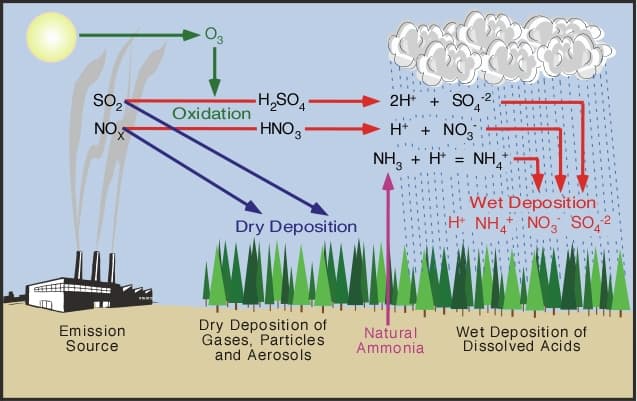
Source: Fiveable — Acid Rain Formation and Effects | Environmental Chemistry ... · fiveable.me
CO₂ forms only weak carbonic acid - this is natural rain acidity, not harmful 'acid rain'
Carbon monoxide (CO) is a deadly gas but doesn't form acids in atmosphere
Ozone is a pollutant but doesn't directly cause acid rain formation
Don't confuse nitrous oxide (N₂O) with nitrogen dioxide (NO₂) - both are NOₓ gases that cause acid rain
Atmospheric Pollutants & Properties
Environment carbon dioxide carbon monoxide ozone
Major Atmospheric Pollutants: Sources & Environmental Effects
CO₂ is main greenhouse gas but only forms weak acids naturally
CO is toxic gas from incomplete combustion - deadly but doesn't form acids
O₃ at ground level is harmful pollutant, beneficial in stratosphere
Only SO₂ and NOₓ are primary acid rain precursors
Key Atmospheric Pollutants Comparison
Pollutant | Main Sources | Primary Effect | Role in Acid Rain |
|---|---|---|---|
CO₂ (Carbon Dioxide) | Fossil fuel burning, respiration | Greenhouse effect, global warming | Forms weak carbonic acid naturally |
CO (Carbon monoxide) | Incomplete combustion | Toxic - binds to hemoglobin | No role in acid rain |
O₃ (Ozone) | Photochemical reactions | Respiratory damage, smog | No role in acid rain |
SO₂ (Sulfur Dioxide) | Coal burning, oil refining | Acid rain formation | Primary acid rain precursor |
NOₓ (Nitrogen Oxides) | Vehicle emissions, power plants | Acid rain and smog | Primary acid rain precursor |
Why Other Options Are Wrong
Carbon dioxide naturally makes rain slightly acidic (pH 5.6) but this is normal, not harmful acid rain
Carbon monoxide is a silent killer that prevents oxygen transport but has no acid-forming properties
Ozone pollution creates respiratory problems and photochemical smog but doesn't generate acids
Nitrogen gas (N₂) is inert and makes up 78% of atmosphere - doesn't react to form acids
Don't assume all air pollutants cause acid rain - only SO₂ and NOₓ are primary causes
CO₂ is the biggest climate concern but NOT an acid rain creator
Ground-level ozone vs stratospheric ozone have opposite effects - ground level is harmful
Incomplete combustion produces CO; complete combustion produces CO₂
Environmental Impacts of Acid Rain
Environment
Acid Rain Impacts: Ecosystems, Infrastructure & Human Health
Kills forests by leaching nutrients from soil and damaging leaves
Makes lakes and rivers too acidic for fish and aquatic life
Corrodes buildings, monuments, and metal structures
Worsens respiratory problems in humans
Acid Rain Impact Categories
# Acid Rain Impacts
## Forest Ecosystems
- Soil acidification
- Nutrient leaching
- Tree mortality
- Reduced growth
## Aquatic Systems
- Lake acidification
- Fish kills
- Algae changes
- Food chain disruption
## Built Environment
- Stone corrosion
- Metal damage
- Paint degradation
- Monument decay
## Human Health
- Respiratory issues
- Asthma worsening
- Skin irritation
- Eye problems
India's Acid Rain Concerns
Taj Mahal marble yellowing partly attributed to sulfur dioxide from nearby industries
Northeast India receives acid rain due to coal burning and industrial emissions
Thermal power plants using high-sulfur coal are major SO₂ contributors
Mumbai and Delhi show acid rain episodes during heavy industrial activity periods
Forest Damage

Source: USGS.gov — Forest affected by acid rain | U.S. Geological Survey · www.usgs.gov