With reference to food chains in ecosystems, consider the following statements: 1. A food chains illustrates the order in which a chain of organisms feed upon each other. 2. Food chains are found within the populations of a species. 3. A food chain illustrates the numbers of each organism which are eaten by others. Which of the statements given above is/are correct?
Contents16
- A1 only
- B1 and 2 only
- C1, 2 and 3
- DNone
Show answer
Answer: (A) 1 only
Statement 1 is correct — a food chain is the sequence of 'who eats whom' in a biological community (ecosystem) to obtain nutrition.
For example:
Grass → Grasshopper → Frog → Snake → Eagle.
It shows the ORDER of feeding relationships.
Statement 2 is wrong — food chains are NOT found within a single species' population.
A food chain by definition involves MULTIPLE species at different trophic levels (producers, primary consumers, secondary consumers, etc.).
Feeding relationships within one species' population would be cannibalism, not a food chain.
Statement 3 is wrong — a food chain does NOT illustrate the NUMBERS of each organism eaten.
It only shows the SEQUENCE/ORDER of feeding, not quantities.
The concept of numbers at each level is shown by an 'Ecological Pyramid of Numbers', which is a different concept.
So only statement 1 is correct.
Food chains show the sequence of feeding relationships between different species in an ecosystem, forming the foundation for understanding energy flow and nutrient cycling.
UPSC tests whether students can distinguish between food chains (showing feeding sequence), food webs (showing complex feeding relationships), and ecological pyramids (showing numbers, biomass, or energy at each level).
Food Chains: Definition & Structure
Environment food chains order chain of organisms feed upon each other
Food Chains: Basic Structure & Key Characteristics
Food chain shows sequence of feeding — who eats whom in an ecosystem
Always involves multiple species at different trophic levels
Shows order only, not quantities or numbers
Example: Grass → Grasshopper → Frog → Snake → Eagle
What is a Food Chain
A food chain is the linear sequence showing 'who eats whom' in a biological community to obtain nutrition. It illustrates the order of feeding relationships between different species in an ecosystem.
• Unidirectional flow: Energy flows from producers to top consumers
• Multiple species: Always involves different organisms at various levels
• Sequential feeding: Each organism feeds on the previous level
Trophic Levels in Food Chains
Trophic Level | Organisms | Role | Example |
|---|---|---|---|
T1 - Producers | Plants, Algae | Make own food via photosynthesis | Grass, Phytoplankton |
T2 - Primary Consumers | Herbivores | Feed on producers | Grasshopper, Rabbit |
T3 - Secondary Consumers | Small carnivores | Feed on herbivores | Frog, Small fish |
T4 - Tertiary Consumers | Large carnivores | Feed on small carnivores | Snake, Large fish |
T5 - Apex Predators | Top carnivores | No natural predators | Eagle, Lion |
Classic Terrestrial Food Chain
%%{init: {"flowchart": {"wrappingWidth": 460}}}%%
flowchart TD
  s1["`****Grass** (Producer)**
Converts sunlight to chemical energy via photosynthesis`"]
  s2["`****Grasshopper** (Primary Consumer)**
Herbivore feeding on grass`"]
  s3["`****Frog** (Secondary Consumer)**
Carnivore feeding on grasshopper`"]
  s4["`****Snake** (Tertiary Consumer)**
Carnivore feeding on frog`"]
  s5["`****Eagle** (Apex Predator)**
Top carnivore feeding on snake`"]
  s1 --> s2
  s2 --> s3
  s3 --> s4
s4 --> s5Trap: Food chains do NOT exist within a single species population — they need multiple species
Trap: Food chains show sequence/order, NOT quantities — numbers are shown by ecological pyramids
Trap: Don't confuse food chain (linear) with food web (interconnected network)
Confusion: Food chain ≠ Food web — chain is one pathway, web shows multiple interconnected pathways
Food Chains vs Population Interactions
Environment populations of a species within the populations
Why Food Chains Cannot Exist Within Single Species
Food chains require multiple species — never within one species population
Intraspecific interactions occur within species, interspecific between species
Feeding within same species = cannibalism, not food chain
Intraspecific vs Interspecific Interactions
Type | Definition | Examples | Role in Food Chain |
|---|---|---|---|
Intraspecific | Within same species | Competition, Cannibalism, Territoriality | Not part of food chains |
Interspecific | Between different species | Predation, Parasitism, Mutualism | Forms food chains |
Why Statement 2 is Wrong
Food chains by definition involve trophic levels — different feeding positions occupied by different species
A population contains individuals of the same species — cannot form different trophic levels
Energy transfer in food chains occurs between species, not within species
Feeding relationships within a species population would be cannibalism or competition, not a food chain
UPSC Trap: 'Food chains within populations' sounds plausible but violates the basic definition
Key Distinction: Population = same species, Food chain = multiple species
Remember: Trophic levels require different species with different feeding habits
Ecological Pyramids & Quantitative Representation
Environment numbers of each organism eaten by others
Ecological Pyramids: Numbers, Biomass & Energy
Food chains show sequence only, ecological pyramids show quantities
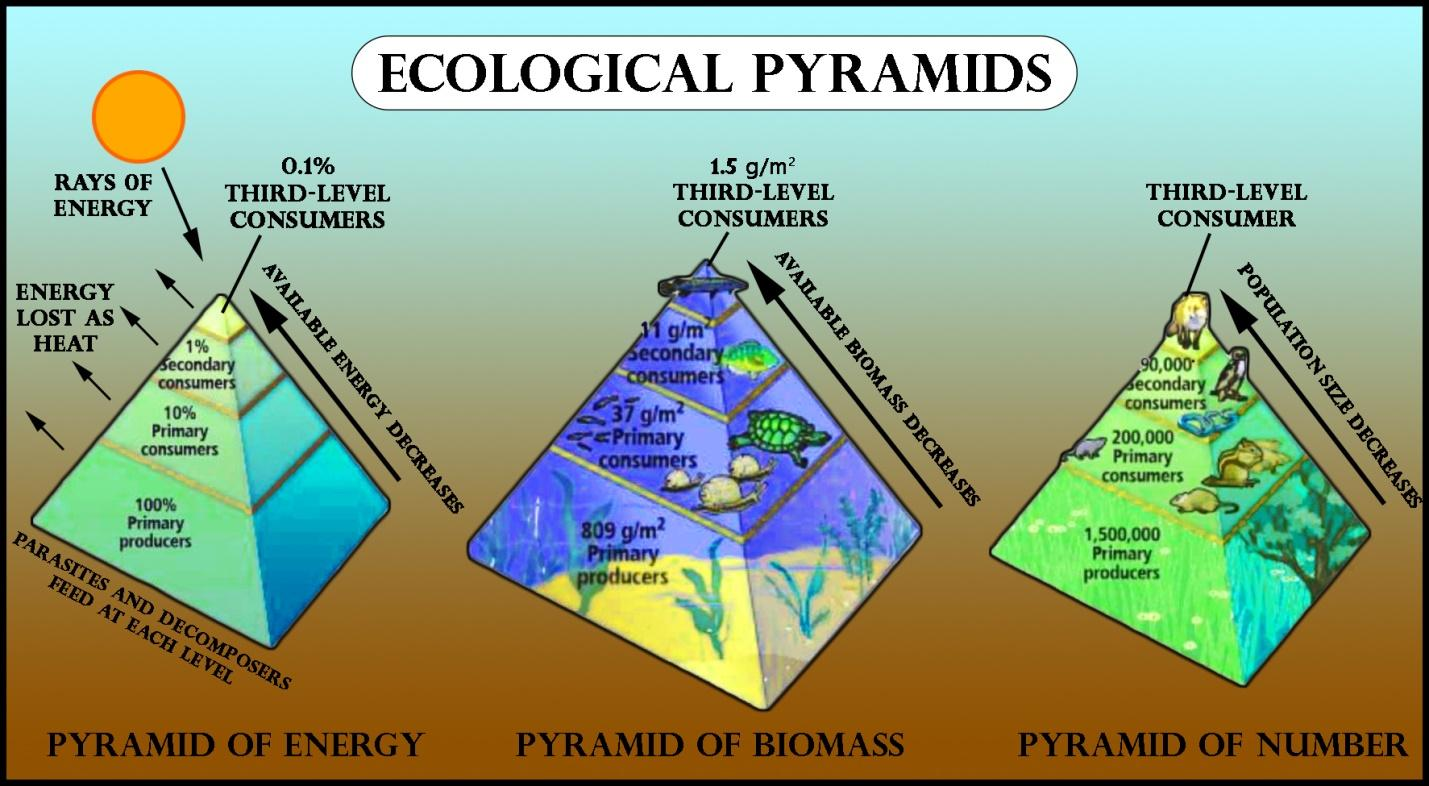
Pyramid of Numbers shows organism count at each trophic level
Pyramid of Biomass shows total living matter at each level
Pyramid of Energy shows energy flow — always upright
Key Difference from Food Chains
While food chains show only the sequence of feeding (who eats whom), ecological pyramids provide quantitative data about ecosystems. Statement 3 in the question incorrectly attributes the function of ecological pyramids to food chains.
Types of Ecological Pyramids
Pyramid Type | What it Measures | Shape | Example |
|---|---|---|---|
Numbers | Count of organisms | Usually upright, can be inverted | 1 tree → 1000 insects → 10 birds |
Biomass | Total living matter (kg/m²) | Usually upright, can be inverted | Producers > Herbivores > Carnivores |
Energy | Energy flow (kJ/m²/year) | Always upright | 10% energy transfer rule |
Why Numbers Vary in Pyramids
Upright pyramid: Large number of small producers support fewer, larger consumers
Inverted pyramid: One large producer (tree) supports many small consumers (insects)
Energy pyramid never inverts due to 10% rule — only 10% energy transfers to next level
Parasitic food chains often show inverted pyramids of numbers
Ecological Pyramid Diagrams
Source: Vedantu — Ecological Pyramids: Types, Examples & Diagrams Explained · www.vedantu.com
Major Trap: Food chains do NOT show quantities — that's the job of ecological pyramids
Statement 3 Trap: Confuses food chain function with pyramid of numbers function
Remember: Chain = sequence, Pyramid = quantity
Food Webs vs Food Chains
Environment
Food Webs: Complex Interconnected Feeding Networks
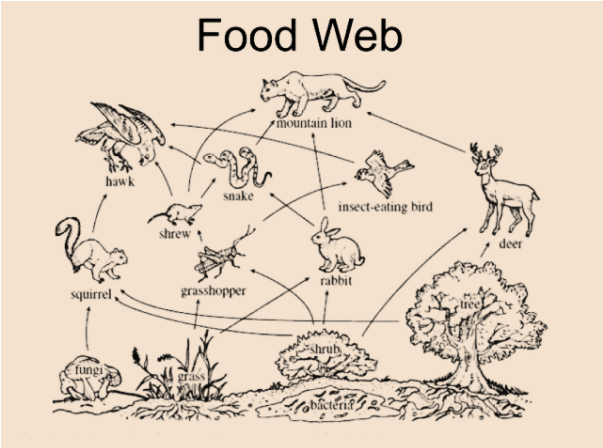
Food web = multiple interconnected food chains in an ecosystem
Food webs show realistic feeding complexity, food chains show simplified pathways
Most organisms feed at multiple trophic levels — shown in webs, not chains
Food Chain vs Food Web Comparison
Aspect | Food Chain | Food Web |
|---|---|---|
Structure | Linear sequence | Interconnected network |
Pathways | Single feeding pathway | Multiple feeding pathways |
Realism | Simplified representation | More realistic |
Organism roles | One trophic level per organism | Multiple trophic levels possible |
Ecosystem stability | Less stable | More stable due to alternatives |
Why Food Webs are More Realistic
Omnivores feed at multiple trophic levels — cannot be shown in simple food chains
Alternative food sources provide ecosystem stability when one species declines
Seasonal variations in diet create complex feeding relationships
Decomposers connect to all trophic levels, creating web-like structure
Food Web Structure
Source: Vedantu — Food Web Explained: Diagrams, Examples & Ecosystem Energy · www.vedantu.com