The "Red Data Books" published by the International Union for Conservation of Nature and Natural Resource (IUCN) contain lists of 1. Endemic plant and animal species present in the biodiversity hotspots. 2. Threatened plant and animal species. 3. Protected sites for conservation of nature and natural resources in various countries. Select the correct answer using the codes given below:
Contents16
- A1 and 3
- B2 only
- C2 and 3
- D3 only
Show answer
Answer: (B) 2 only
The IUCN Red Data Books have ONE specific purpose: to list threatened (endangered) plant and animal species worldwide.
They categorize species by threat level — Extinct, Critically Endangered, Endangered, Vulnerable, etc.
Statement 1 is wrong because Red Data Books don't specifically list endemic species of biodiversity hotspots — they cover threatened species globally regardless of hotspot location.
Statement 3 is wrong because listing protected sites is done by other databases (like the World Database on Protected Areas), not Red Data Books.
Simple memory trick:
Red = Danger = Threatened species.
That's all the Red Data Book is about.
IUCN Red Data Books serve as the global standard for categorizing species by extinction risk, directly influencing conservation policies and funding worldwide.
The question tests whether students confuse Red Data Books with other IUCN databases like the World Database on Protected Areas or biodiversity hotspot inventories.
IUCN Red Data Books
Environment Red Data Books IUCN threatened
IUCN Red Data Books: Purpose & Classification System
IUCN Red Data Books list only threatened plant and animal species worldwide
Published by International Union for Conservation of Nature (IUCN)
Red = Danger = Threatened species — simple memory trick
Uses 9 threat categories from Extinct to Least Concern
The IUCN Red Data Books serve one specific purpose: cataloguing threatened species globally by their extinction risk. Think of them as the world's official 'danger list' for plants and animals.
IUCN Threat Categories
Category | Code | Status | Example |
|---|---|---|---|
Extinct | EX | No living individuals | Dodo |
Critically Endangered | CR | Extremely high extinction risk | Amur Leopard |
Endangered | EN | High extinction risk | Asian Elephant |
Vulnerable | VU | High risk of endangerment | Polar Bear |
Near Threatened | NT | Close to qualifying for threatened | Jaguar |
Least Concern | LC | Lower risk of extinction | Brown Rat |
Key Features
Global scope — covers species worldwide, not limited to specific regions or hotspots
Scientific assessment — based on population size, decline rate, and geographic range
Regular updates — species status reviewed periodically as new data emerges
Policy influence — guides international conservation agreements and funding priorities
Question Connection
This 2011 question tested whether students confuse Red Data Books with other IUCN tools. Only Statement 2 was correct — Red Data Books list threatened species, nothing else.
Trap: Confusing Red Data Books with World Database on Protected Areas (which lists protected sites)
Trap: Thinking Red Data Books focus on endemic species in hotspots — they cover all threatened species globally
Trap: Mixing up IUCN tools — Red Data Books ≠ Protected Areas Database ≠ Biodiversity Hotspot Lists
Biodiversity Hotspots & Endemic Species
Environment Endemic biodiversity hotspots
Biodiversity Hotspots & Endemic Species: Concepts & Criteria
Biodiversity hotspots are regions with high endemic species and severe habitat loss
Endemic species exist naturally in only one specific geographic area
India has 4 hotspots: Western Ghats, Eastern Himalayas, Indo-Burma, Sundaland
36 global hotspots identified, covering 2.4% of Earth's surface
Biodiversity hotspots are conservation priority areas identified by extremely high numbers of endemic species combined with severe habitat loss. These regions concentrate unique life forms found nowhere else on Earth.
Hotspot Criteria vs Endemic Species
Concept | Definition | Key Requirement | Example |
|---|---|---|---|
Biodiversity Hotspot | Conservation priority region | ≥1,500 endemic plant species + ≥70% habitat loss | Western Ghats |
Endemic Species | Species restricted to one area | Natural occurrence in single location only | Nilgiri Tahr (Western Ghats only) |
Native Species | Naturally occurring in region | Can occur in multiple regions naturally | Asian Elephant (multiple countries) |
Introduced Species | Brought by human activity | Non-natural occurrence | Eucalyptus in India |
India's Biodiversity Hotspots
# India's 4 Biodiversity Hotspots
## Western Ghats
- Karnataka
- Kerala
- Tamil Nadu
- Goa
- Maharashtra
- 5000+ endemic plants
## Eastern Himalayas
- Sikkim
- Darjeeling
- Arunachal Pradesh
- Bhutan border
- Orchid diversity
## Indo-Burma
- Northeast India
- Myanmar border
- Mizoram
- Manipur
- Nagaland
## Sundaland
- Nicobar Islands only
- Great Nicobar
- Tropical rainforests
- Island endemism
Global Hotspot Distribution
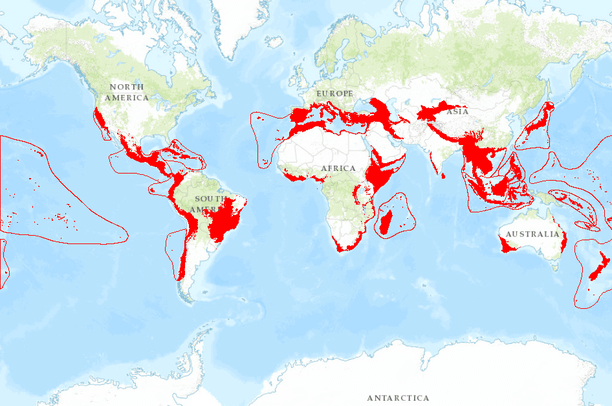
Source: Data Basin — Biodiversity Hotspots Revisited, Conservation International ... · databasin.org
Trap: Thinking Red Data Books list endemic species of hotspots — they list threatened species globally
Trap: Confusing endemic (one location only) with native (naturally occurring, can be in multiple locations)
Trap: Forgetting Sundaland hotspot includes only Nicobar Islands from India, not Andamans
Protected Areas & Conservation Databases
Environment Protected sites
Protected Areas Databases & Classification Systems
World Database on Protected Areas (WDPA) lists protected sites globally
UNESCO World Heritage Sites are separate cultural/natural heritage list
Red Data Books do NOT list protected sites — different database entirely
IUCN categorizes protected areas into 6 categories (I-VI)
Protected areas databases catalog conservation sites by management objectives and legal status. This is completely separate from Red Data Books, which only list threatened species.
IUCN Protected Area Categories
Category | Name | Purpose | Example in India |
|---|---|---|---|
Category I | Strict Nature Reserve | Scientific research only | Valley of Flowers National Park |
Category II | National Park | Ecosystem protection + tourism | Jim Corbett National Park |
Category III | Natural Monument | Specific natural feature | Lonar Lake |
Category IV | Habitat/Species Management Area | Active conservation management | Bharatpur Bird Sanctuary |
Category V | Protected Landscape | Landscape + traditional use | Nanda Devi Biosphere Reserve |
Category VI | Sustainable Resource Use | Sustainable natural resource use | Pachmarhi Biosphere Reserve |
Conservation Database Types
# Conservation Databases
## Species Lists
- IUCN Red Data Books
- CITES Appendices
- National Red Lists
- Endemic Species Lists
## Protected Areas
- World Database on Protected Areas
- UNESCO World Heritage Sites
- Ramsar Wetlands
- Biosphere Reserves
## Habitat Maps
- Biodiversity Hotspots
- Ecoregions
- Key Biodiversity Areas
- Important Bird Areas
India's Protected Area Network
104 National Parks and 566 Wildlife Sanctuaries as of 2023
18 Biosphere Reserves under UNESCO MAB Programme
40+ UNESCO World Heritage Sites (natural + cultural combined)
75+ Ramsar Wetlands of international importance
Trap: Thinking Red Data Books list protected sites — that's done by WDPA, not Red Data Books
Trap: Confusing National Parks (Category II) with Wildlife Sanctuaries (usually Category IV)
Trap: Mixing UNESCO World Heritage Sites with IUCN Protected Area Categories — different systems
IUCN Organization & Functions
Environment International Union for Conservation of Nature IUCN
IUCN: Structure, Functions & Global Conservation Role
IUCN = International Union for Conservation of Nature and Natural Resources
Three main tools: Red List, Protected Areas Database, Conservation Standards
Founded in 1948, headquartered in Gland, Switzerland
World's largest environmental network with 1400+ member organizations
The International Union for Conservation of Nature (IUCN) is the global authority on nature conservation status. It brings together governments, NGOs, and scientists to assess species and ecosystems worldwide.
IUCN's Major Conservation Tools
Tool | Purpose | Content | Users |
|---|---|---|---|
IUCN Red List | Species threat assessment | Threatened species by extinction risk | Governments, researchers, conservationists |
World Database on Protected Areas | Protected areas tracking | Global protected areas by category | Protected area managers, planners |
IUCN Red List of Ecosystems | Ecosystem threat assessment | Threatened ecosystems and habitats | Ecosystem managers, policymakers |
Conservation Standards | Project effectiveness | Best practices for conservation projects | Conservation practitioners, NGOs |
IUCN Structure
# IUCN Organization
## Members
- Government agencies
- NGOs
- Indigenous organizations
- Academic institutions
## Commissions
- Species Specialist Groups
- Protected Areas
- Environmental Law
- Ecosystem Management
## Regional Offices
- Asia
- Africa
- Europe
- Americas
- Oceania
## Key Programs
- Red List assessments
- Protected area support
- Policy development
- Capacity building
IUCN's India Connection
Ministry of Environment & Forests is India's government member since 1969
Wildlife Institute of India collaborates on Red List assessments for Indian species
IUCN Asia Regional Office based in Bangkok covers India programs
Joint projects on Western Ghats, Eastern Himalayas, and marine conservation
Trap: Confusing IUCN (conservation organization) with UNEP (UN environment program)
Trap: Thinking IUCN only does Red Data Books — it also manages protected areas database and ecosystem assessments
Memory aid: IUCN = I Understand Conservation of Nature — covers species AND habitats