Vultures which used to be very common in Indian countryside some years ago are rarely seen nowadays. This is attributed to
Contents18
- AThe destruction of their nesting sites by new invasive species.
- BA drug used by cattle owners for treating their diseased cattle.
- CScarcity of food available to them.
- DA widespread, persistent and fatal disease among them.
Show answer
Answer: (B) A drug used by cattle owners for treating their diseased cattle.
India's vulture population crashed by over 97% since the 1990s.
The cause was identified as Diclofenac — a non-steroidal anti-inflammatory drug (NSAID) widely used by cattle owners to treat sick and injured livestock.
When vultures fed on carcasses of cattle treated with diclofenac, the drug caused kidney failure and death in vultures (visceral gout).
This was NOT caused by habitat loss, food scarcity, or a natural disease.
The drug was banned for veterinary use in India in 2006, and vulture conservation breeding programmes were started.
The drug Meloxicam was recommended as a vulture-safe alternative.
India's vulture population crashed by over 97% since the 1990s due to diclofenac, a veterinary drug that causes kidney failure when vultures eat treated cattle carcasses.
Diclofenac was banned for veterinary use in 2006 and replaced with vulture-safe meloxicam, making this a key wildlife conservation case study.
The question tests whether students know the specific cause rather than assuming generic threats like habitat loss or disease.
Vulture Population Decline in India
Environment Vultures Indian countryside drug used by cattle owners
India's Vulture Crisis: Diclofenac & Conservation Response
Diclofenac (cattle painkiller) caused 97% vulture population crash since 1990s
Drug causes kidney failure in vultures feeding on treated cattle carcasses
Banned for veterinary use in 2006, Meloxicam is vulture-safe alternative
Conservation breeding programs started to recover vulture populations
The Crisis Scale
India faced one of the fastest wildlife population collapses in recorded history. Vulture populations crashed by over 97% from the 1990s onwards, transforming a once-common countryside bird into a critically endangered species.
Cause Analysis
Factor | Reality | Impact on Vultures |
|---|---|---|
Diclofenac (NSAID drug) | Widely used by cattle owners for sick livestock | Kidney failure & death when vultures eat carcasses |
Habitat destruction | Not the primary cause | Minimal direct impact on decline |
Food scarcity | Plenty of cattle carcasses available | No significant impact |
Disease outbreak | No natural disease identified | Not a factor in the crash |
How Diclofenac Kills Vultures
%%{init: {"flowchart": {"wrappingWidth": 460}}}%%
flowchart TD
  s1["`**Cattle Treatment**
Farmers give **Diclofenac** injections to sick/injured cattle`"]
  s2["`**Drug Residue**
Diclofenac remains in cattle tissues after death`"]
  s3["`**Vulture Feeding**
Vultures consume carcasses with drug residues`"]
  s4["`**Kidney Damage**
Drug causes **visceral gout** - kidney failure in vultures`"]
  s5["`**Death**
Vultures die within days of consuming contaminated meat`"]
  s1 --> s2
  s2 --> s3
  s3 --> s4
  s4 --> s5
Conservation Response
2006: Diclofenac banned for veterinary use in India, Nepal, Pakistan
Meloxicam promoted as vulture-safe alternative painkiller for cattle
Captive breeding programs established for three critically endangered species
Vulture safe zones created around breeding centers
Community awareness programs launched among cattle owners
Trap: Option A seems logical but habitat loss was NOT the primary cause of vulture decline
Trap: Option C food scarcity sounds plausible, but cattle carcasses were actually abundant
Trap: Option D disease outbreak - but this was drug poisoning, not a natural disease
Key distinction: This was indirect poisoning through food chain, not direct drug administration to vultures
Diclofenac and NSAID Drugs
Science And Technology drug used by cattle owners treating their diseased cattle
Diclofenac: NSAID Drug & Wildlife Toxicity
Diclofenac is an NSAID (Non-Steroidal Anti-Inflammatory Drug) used as painkiller
Widely used in veterinary medicine for treating cattle inflammation and pain
Highly toxic to vultures - causes kidney failure through visceral gout
Meloxicam is the recommended vulture-safe alternative for livestock
What is Diclofenac
Diclofenac is a widely-used NSAID (Non-Steroidal Anti-Inflammatory Drug) that reduces pain, fever, and inflammation. Cattle owners commonly used it to treat sick and injured livestock before its veterinary ban.
Drug Comparison
Drug | Type | Use | Safety for Vultures | Status |
|---|---|---|---|---|
Diclofenac | NSAID | Painkiller, anti-inflammatory | Highly toxic - causes death | Banned for veterinary use (2006) |
Meloxicam | NSAID | Painkiller, anti-inflammatory | Safe - no toxic effects | Recommended alternative |
Ketoprofen | NSAID | Painkiller, anti-inflammatory | Toxic to vultures | Also banned in some regions |
Mechanism of Toxicity
Visceral gout: Diclofenac causes uric acid crystals to form in vulture kidneys
Kidney failure: Complete renal shutdown leads to death within 1-3 days
Species-specific toxicity: Other scavengers like dogs are not affected similarly
Low lethal dose: Even small amounts in carcass meat can kill vultures
Persistent residue: Drug remains active in dead cattle tissue for days
Don't confuse NSAIDs with antibiotics - Diclofenac is a painkiller, not an infection treatment
Remember: Meloxicam is the safe alternative, not just any other painkiller
Key point: Toxicity is species-specific - affects vultures but not other scavengers like dogs
Vulture Species & Conservation in India
Environment Vultures Indian countryside
Indian Vulture Species: Ecology & Conservation Status
Three species most affected: White-rumped, Long-billed, and Slender-billed vultures
All three listed as Critically Endangered on IUCN Red List
Ecological role: Natural scavengers, disease control, nutrient cycling
Captive breeding programs at Pinjore, Buxa, Rani established
Critically Affected Vulture Species
Species | Scientific Name | IUCN Status | Population Decline | Key Features |
|---|---|---|---|---|
White-rumped Vulture | Gyps bengalensis | Critically Endangered | 99.9% decline | Most common before crisis, white rump patch |
Long-billed Vulture | Gyps indicus | Critically Endangered | 97% decline | Longer, more slender bill than White-rumped |
Slender-billed Vulture | Gyps tenuirostris | Critically Endangered | 97% decline | Slimmest bill, found in foothills |
Ecological Importance
Natural garbage disposal: Consume carcasses rapidly, preventing disease spread
Disease control: Strong stomach acid kills pathogens like anthrax, rabies
Nutrient cycling: Convert dead biomass into fertilizer through droppings
Economic service: Save millions in carcass disposal costs for communities
Cultural significance: Important in Parsi sky burial traditions
Conservation Efforts
# Vulture Conservation
## Captive Breeding
- Pinjore (Haryana)
- Buxa (West Bengal)
- Rani (Assam)
- Breeding pairs maintained
## Drug Regulation
- Diclofenac ban (2006)
- Meloxicam promotion
- Ketoprofen restrictions
- Monitoring compliance
## Habitat Protection
- Vulture safe zones
- Nest site protection
- Community involvement
- Cattle owner education
## Research & Monitoring
- Population surveys
- Toxicity studies
- Breeding success tracking
- Drug residue testing
Visual Identification
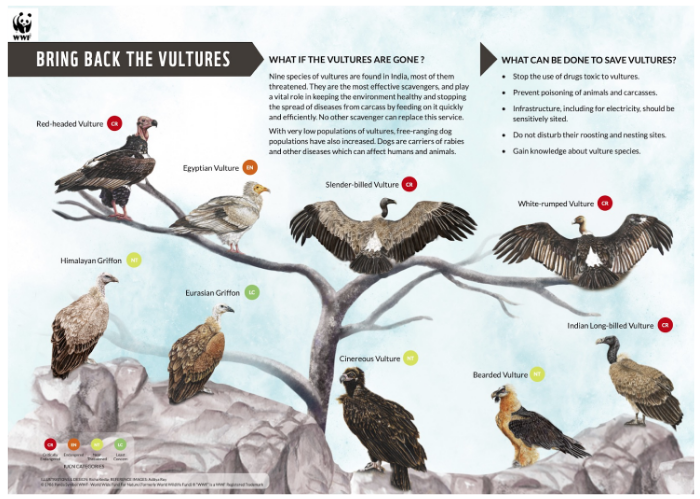
Source: Daily Current Affairs for UPSC | CarpeDiem IAS — Daily Current Affairs for UPSC | CarpeDiem IAS · www.carpediemias.com
Wildlife-Pharmaceutical Interactions
Environment
Pharmaceutical Drugs & Wildlife: Unintended Consequences
Veterinary drugs can have devastating effects on non-target wildlife species
Diclofenac-vulture crisis is the most documented case of veterinary drug wildlife impact
Bioaccumulation through food chains amplifies pharmaceutical effects
Drug residues persist in animal tissues even after death
The Hidden Threat
Pharmaceutical drugs designed for livestock can become ecological time bombs when they enter wildlife food chains. The diclofenac-vulture crisis exemplifies how modern veterinary medicine can have unintended but catastrophic effects on ecosystem health.
Examples of Wildlife-Drug Interactions
Drug/Chemical | Original Use | Wildlife Affected | Impact | Response |
|---|---|---|---|---|
Diclofenac | Cattle painkiller | Vultures | Kidney failure, 97% population crash | Veterinary ban, safe alternatives |
Ketoprofen | Livestock anti-inflammatory | Vultures | Similar toxicity to diclofenac | Banned in some countries |
Antibiotics | Livestock disease treatment | Soil microbes, aquatic life | Resistance, ecosystem disruption | Regulated use guidelines |
Growth hormones | Cattle growth promotion | Fish, amphibians | Reproductive disruption | Restricted in many regions |
Key Mechanisms of Impact
Food chain transfer: Drugs in livestock enter scavengers and predators
Species-specific toxicity: Same drug can be safe for one species, lethal for another
Bioaccumulation: Drug concentrations increase up the food chain
Persistent residues: Drugs remain active in carcasses for days or weeks
Ecosystem cascades: Loss of key species affects entire ecological networks
Remember: Indirect exposure through food is often more dangerous than direct drug use
Key concept: Species-specific toxicity - what's safe for cattle can kill vultures
Don't assume all NSAIDs are equally toxic - Meloxicam is vulture-safe while Diclofenac is lethal