Consider the following organisms: 1. Agaricus 2. Nostoc 3. Spirogyra Which of the above is/are used as biofertilizer/biofertilizers?
Contents15
- A1 and 2
- B2 only
- C2 and 3
- D3 only
Show answer
Answer: (B) 2 only
Only Nostoc (2) is used as a biofertilizer.
Biofertilizers are microbial preparations that enhance nutrient uptake by plants from the soil.
There are two main types of organisms used as bioinoculants:
(a) Symbiotic nitrogen-fixers: Rhizobium, Bradyrhizobium, Nostoc, Anabaena, etc.
(b) Non-symbiotic/free-living nitrogen-fixers: Azotobacter, Azospirillum, Beijerinckia, etc.
Nostoc is a genus of cyanobacteria (blue-green algae) that can fix atmospheric nitrogen into a form usable by plants.
It is widely used as a biofertilizer in rice paddies (paddy fields).
Agaricus (1) — NOT a biofertilizer.
Agaricus is a genus of mushrooms (includes both edible species like button mushroom and poisonous species).
While mushrooms decompose organic matter, they are not classified as biofertilizers.
Spirogyra (3) — NOT a biofertilizer.
Spirogyra is a genus of filamentous green algae (named for its spiral/helical chloroplasts).
It does not fix nitrogen and is not used as a biofertilizer.
Nostoc is a cyanobacteria that fixes atmospheric nitrogen into forms plants can use, making it valuable as a biofertilizer in rice cultivation.
The question tests whether students can distinguish nitrogen-fixing organisms from other microorganisms like decomposer fungi and non-nitrogen-fixing algae.
Biofertilizers & Microbial Preparations
Environment biofertilizer biofertilizers
Biofertilizers: Types & Nitrogen-Fixing Organisms
Biofertilizers are microbial preparations that enhance nutrient uptake by plants from soil
Nostoc is a cyanobacteria used as biofertilizer in rice paddies
Two main types: symbiotic (Rhizobium, Nostoc) and free-living nitrogen-fixers (Azotobacter)
Mushrooms and green algae are not classified as biofertilizers
What Are Biofertilizers
Biofertilizers are living microbial preparations that enhance plant nutrition by fixing atmospheric nitrogen or making soil nutrients more available to plants. Unlike chemical fertilizers, they work through biological processes.
Types of Biofertilizers
Type | Mechanism | Key Examples | Application |
|---|---|---|---|
Symbiotic Nitrogen-Fixers | Form partnerships with plants | Rhizobium, Bradyrhizobium, Nostoc, Anabaena | Root nodules, rice fields |
Free-Living Nitrogen-Fixers | Fix nitrogen independently | Azotobacter, Azospirillum, Beijerinckia | Soil application |
Phosphate Solubilizers | Release bound phosphorus | Pseudomonas, Bacillus | Soil inoculation |
Mycorrhizal Fungi | Enhance root nutrient absorption | Glomus, Gigaspora | Root association |
Nostoc as Biofertilizer
Nostoc is a genus of cyanobacteria (blue-green algae) that fixes atmospheric nitrogen
Widely used in rice paddies where it forms mats on water surface
Can survive in harsh conditions due to protective heterocysts for nitrogen fixation
Forms symbiotic relationships with certain plants like cycads and liverworts
Trap: Agaricus (mushrooms) decompose matter but are not biofertilizers
Trap: Spirogyra (green algae) does not fix nitrogen despite being aquatic
Common confusion: All algae are biofertilizers - only nitrogen-fixing cyanobacteria qualify
Remember: Nostoc = cyanobacteria = biofertilizer; Spirogyra = green algae = not biofertilizer
Nostoc - Nitrogen-Fixing Cyanobacteria
Environment Nostoc
Nostoc: Structure, Ecology & Agricultural Importance
Nostoc is a filamentous cyanobacteria with specialized heterocysts for nitrogen fixation
Used as biofertilizer in rice paddies and forms symbiotic relationships
Forms gelatinous colonies and survives extreme conditions including drought
Classification & Structure
Nostoc belongs to cyanobacteria (blue-green algae) - prokaryotic organisms that perform photosynthesis. It forms filamentous colonies enclosed in a gelatinous sheath and contains specialized cells called heterocysts for nitrogen fixation.
Key Characteristics
Heterocysts - thick-walled cells that create anaerobic environment for nitrogen fixation
Gelatinous colonies - can expand dramatically when wet, contract when dry
Photosynthetic - contains chlorophyll and can produce its own food
Prokaryotic - lacks membrane-bound nucleus and organelles
Agricultural Applications
Application | Mechanism | Benefits | Usage |
|---|---|---|---|
Rice Paddies | Forms mats on water surface | Continuous nitrogen supply | Direct inoculation |
Symbiotic Partner | Lives in plant cavities | Mutual nutrient exchange | Natural association |
Soil Enrichment | Dies and decomposes | Adds organic nitrogen | Seasonal cultivation |
Drought Recovery | Reactivates after rain | Long-term soil fertility | Semi-arid regions |
Agaricus - Mushroom Genus
Environment Agaricus
Agaricus: Mushroom Genus & Ecological Role
Agaricus is a genus of mushrooms including edible button mushrooms
Functions as decomposer breaking down organic matter, not as biofertilizer
Contains both edible and poisonous species
Classification & Role
Agaricus is a large genus of mushrooms (fungi) that includes the common button mushroom (Agaricus bisporus). These are saprophytic fungi that decompose organic matter but are not classified as biofertilizers.
Key Species & Uses
Agaricus bisporus - common button/white mushroom, widely cultivated
Agaricus campestris - field mushroom, edible wild species
Some species are poisonous and can cause illness
Important decomposers in forest ecosystems
Trap: Mushrooms decompose matter but don't fix nitrogen - not biofertilizers
Common error: Confusing decomposition with nitrogen fixation
Remember: Fungi break down, cyanobacteria build up (nitrogen)
Spirogyra - Filamentous Green Algae
Environment Spirogyra
Spirogyra: Structure & Reproduction in Green Algae
Spirogyra is filamentous green algae with distinctive spiral chloroplasts
Found in freshwater ponds and streams, does not fix nitrogen
Reproduces by conjugation - characteristic sexual reproduction method
Structure & Identification
Spirogyra is a genus of filamentous green algae easily identified by its spiral or helical chloroplasts. It forms long, unbranched filaments in freshwater environments but does not fix atmospheric nitrogen.
Key Features
Spiral chloroplasts - ribbon-like, helical arrangement gives the genus its name
Unbranched filaments - cells arranged in long chains
Freshwater habitat - ponds, streams, slow-moving water bodies
Conjugation reproduction - two filaments form conjugation tubes for sexual reproduction
Microscopic Structure
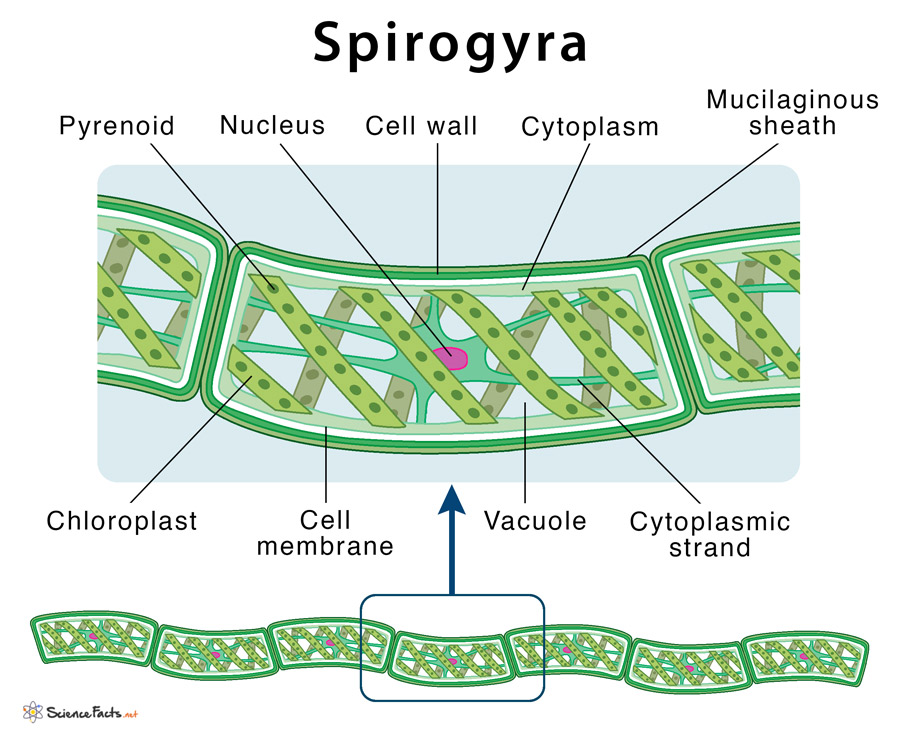
Source: Science Facts — Spirogyra: Structure & Characteristics with Labeled Diagram · www.sciencefacts.net
Trap: Being aquatic doesn't make Spirogyra a nitrogen-fixer
Key distinction: Green algae (like Spirogyra) vs blue-green algae (cyanobacteria like Nostoc)
Remember: Only cyanobacteria among algae can fix nitrogen