Photochemical smog is a resultant of the reaction among
Contents14
- ANO2, O3 and peroxyacetyl nitrate in the presence of sunlight
- BCO, O2 and peroxyacetyl nitrate in the presence of sunlight
- CCO, CO2 and NO2 at low temperature
- Dhigh concentration of NO2, O3 and CO in the evening
Show answer
Answer: (A) NO2, O3 and peroxyacetyl nitrate in the presence of sunlight
Photochemical smog is formed by the reaction of sunlight with certain pollutants in the atmosphere.
The major chemical pollutants involved are:
(1) Nitrogen oxides (NO and NO₂) — released from vehicle exhausts and industrial processes.
(2) Volatile Organic Compounds (VOCs) — from vehicle emissions, solvents, paints.
(3) Ozone (O₃) — formed at ground level when NOₓ and VOCs react in the presence of sunlight (this is 'bad' ozone, unlike the protective ozone layer).
(4) Peroxyacetyl Nitrate (PAN) — a secondary pollutant formed by the photochemical reaction of NOₓ with organic compounds in sunlight. PAN is a powerful eye irritant.
Option (a) correctly identifies NO₂, O₃, and PAN in the presence of sunlight as the components.
Option (b) is wrong — CO and O₂ are not the primary reactants.
Option (c) is wrong — photochemical smog requires SUNLIGHT and WARM temperatures, not low temperature.
Option (d) is wrong — photochemical smog forms during DAYTIME (when sunlight is available), not in the evening. The word 'photo' in photochemical itself tells you sunlight is essential.
Photochemical smog forms when nitrogen oxides and volatile organic compounds from vehicles react with sunlight to create ground-level ozone and peroxyacetyl nitrate, causing serious air quality problems in cities.
The question tests whether students understand that photochemical smog requires sunlight and warm daytime conditions, not evening or low temperatures, which is why it peaks during sunny afternoons in polluted cities.
Photochemical Smog Formation
Environment Photochemical smog NO2 O3 peroxyacetyl nitrate sunlight
Photochemical Smog: Formation, Components & Key Facts
Photochemical smog forms when NOx and VOCs react in sunlight at warm temperatures
Key components: NO₂, O₃ (ground-level), and PAN (peroxyacetyl nitrate)
Occurs during daytime when sunlight intensity is high, not evening
PAN is a secondary pollutant and powerful eye irritant
Photochemical smog is a type of air pollution that forms through complex chemical reactions in the atmosphere. Unlike classical smog (smoke + fog), it requires specific atmospheric conditions and chemical precursors to develop.
Formation Process
%%{init: {"flowchart": {"wrappingWidth": 460}}}%%
flowchart TD
  s1["`**Primary Emission**
Vehicles and industries release **NOx** (NO, NO₂) and **VOCs** into atmosphere`"]
  s2["`**Sunlight Catalyst**
**UV radiation** from sunlight breaks down NO₂ molecules`"]
  s3["`**Ozone Formation**
Released oxygen atoms react with O₂ to form **ground-level O₃**`"]
  s4["`**Secondary Pollutants**
NOx + VOCs + sunlight → **PAN** and other toxic compounds`"]
  s5["`**Smog Formation**
Mixture of O₃, NO₂, PAN creates visible **brownish haze**`"]
  s1 --> s2
  s2 --> s3
  s3 --> s4
  s4 --> s5
Key Chemical Components
Pollutant | Source | Role | Health Effect |
|---|---|---|---|
NO₂ (Nitrogen Dioxide) | Vehicle exhaust, power plants | Primary reactant | Respiratory irritant |
O₃ (Ground-level Ozone) | Secondary formation | Major component | Lung damage, asthma |
PAN (Peroxyacetyl Nitrate) | NOx + VOCs reaction | Secondary pollutant | Eye irritant |
VOCs (Volatile Organic Compounds) | Vehicles, solvents, paints | Precursor | Carcinogenic potential |
Essential Conditions
High sunlight intensity - UV radiation acts as catalyst for reactions
Warm temperatures - typically above 25°C accelerate chemical reactions
Low wind speed - allows pollutants to accumulate and react
Morning to afternoon hours - peak formation during 10 AM to 4 PM
Urban areas - high concentration of NOx and VOC sources
Trap: CO and O₂ are NOT the primary reactants - it's NOx and VOCs
Trap: Photochemical smog needs warm temperatures, not low temperatures
Trap: Forms during daytime with sunlight, not in the evening
Trap: PAN is peroxyacetyl nitrate, not any other nitrate compound
Trap: Ground-level O₃ is bad (pollutant), stratospheric O₃ is good (protective)
Types of Smog
Environment
Classical vs Photochemical Smog: Key Differences
Classical smog = smoke + fog, occurs in cold, humid conditions
Photochemical smog = chemical reactions in warm, sunny conditions
London smog (classical) vs Los Angeles smog (photochemical)
Comparison of Smog Types
Aspect | Classical Smog | Photochemical Smog |
|---|---|---|
Other Names | London smog, Industrial smog | Los Angeles smog, Summer smog |
Main Components | SO₂ + particulates + fog | NOx + VOCs + O₃ + PAN |
Temperature | Cold (0-5°C) | Warm (25-35°C) |
Humidity | High (85%+) | Low to moderate |
Sunlight Role | Not required | Essential catalyst |
Time of Formation | Early morning/winter | Daytime/summer |
Color | Greyish-black | Brown/yellowish |
Primary Sources | Coal burning, industries | Vehicle exhaust |
Geographic Examples
London smog - Historic problem from coal burning, reduced after Clean Air Acts
Los Angeles smog - Modern photochemical smog due to vehicle emissions + geography
Delhi smog - Mixed type: classical (winter) + photochemical (summer)
Beijing smog - Predominantly classical from coal + industrial emissions
Nitrogen Oxides in Atmosphere
Environment NO2
NOx Compounds: Sources, Reactions & Environmental Impact
NOx refers to NO and NO₂ - major air pollutants from combustion
Primary sources: vehicle exhaust (70%) and thermal power plants
Environmental impacts: photochemical smog, acid rain, eutrophication
Nitrogen oxides (NOx) are reactive gases formed during high-temperature combustion. They play crucial roles in atmospheric chemistry and are key precursors to multiple environmental problems.
Major NOx Compounds
Compound | Formula | Properties | Primary Role |
|---|---|---|---|
Nitric Oxide | NO | Colorless, reactive | Primary emission, converts to NO₂ |
Nitrogen Dioxide | NO₂ | Brown gas, toxic | Photochemical smog precursor |
Nitrous Oxide | N₂O | Greenhouse gas | Ozone layer depletion |
Nitric Acid | HNO₃ | Secondary formation | Acid rain component |
NOx Transformation Chain
%%{init: {"flowchart": {"wrappingWidth": 460}}}%%
flowchart TD
  s1["`**Combustion Source**
High temperature burning releases **NO** (primary)`"]
  s2["`**Atmospheric Oxidation**
NO + O₂ → **NO₂** (brown gas formation)`"]
  s3["`**Photolysis**
Sunlight breaks NO₂ → NO + O (atomic oxygen)`"]
  s4["`**Ozone Formation**
O + O₂ → **O₃** (ground-level ozone)`"]
  s5["`**Secondary Products**
Further reactions → **PAN**, **HNO₃** (acid rain)`"]
  s1 --> s2
  s2 --> s3
  s3 --> s4
  s4 --> s5
Indian Context
BS VI norms (2020) - Stricter NOx emission limits for vehicles
NCR air quality - NOx major contributor during winter months
Thermal power plants - Largest stationary NOx sources in India
Catalytic reduction - Technology for NOx control in industries
Ground-level vs Stratospheric Ozone
Environment O3
Good Ozone vs Bad Ozone: Location Makes the Difference
Stratospheric O₃ (10-50 km) = good ozone - protects from UV radiation
Tropospheric O₃ (0-10 km) = bad ozone - air pollutant causing health problems
Same molecule O₃, but location determines whether beneficial or harmful
Ozone Comparison by Location
Aspect | Stratospheric Ozone (Good) | Tropospheric Ozone (Bad) |
|---|---|---|
Altitude | 10-50 km (ozone layer) | 0-10 km (ground level) |
Formation | UV + O₂ → natural process | NOx + VOCs + sunlight |
Function | UV shield - protects life | Air pollutant - harms life |
Concentration | 90% of total atmospheric ozone | 10% of total ozone |
Human Impact | Depletion causes skin cancer | Excess causes respiratory problems |
Environmental Issue | Ozone hole problem | Photochemical smog problem |
Seasonal Variation | Varies by latitude/season | Higher in summer (more sunlight) |
Management Need | Protect from depletion | Reduce formation/concentration |
Atmospheric Layers
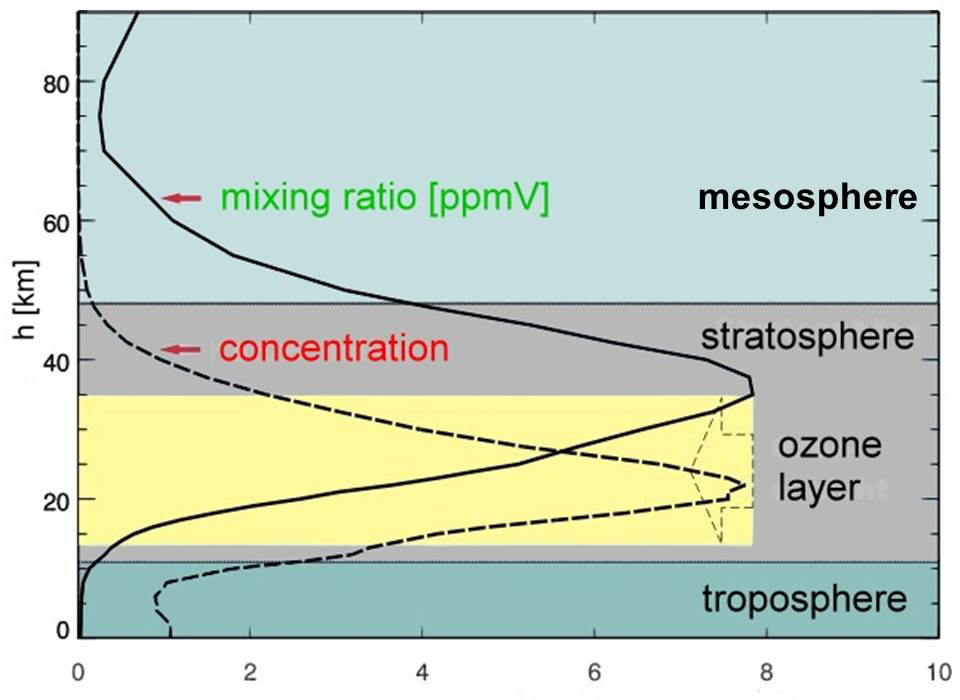
Source: The Ozone Depletion Theory of Global Warming — Ozone Distribution in Earth's Atmosphere · ozonedepletiontheory.info
Trap: Don't confuse ozone depletion (stratosphere problem) with ozone pollution (troposphere problem)
Trap: CFCs destroy stratospheric ozone but don't directly create tropospheric ozone
Trap: Ground-level ozone is not emitted directly - it forms through photochemical reactions
Trap: Montreal Protocol addresses stratospheric ozone, not ground-level ozone pollution