What are the significances of a practical approach to sugarcane production known as 'Sustainable Sugarcane Initiative'? 1. Seed cost is very low in this compared to the conventional method of cultivation 2. Drip irrigation can be practiced very effectively in this 3. There is no application of chemical/inorganic fertilizers at all in this 4. The scope for intercropping is more in this compared to the conventional method of cultivation Select the correct answer using the code given below.
Contents17
- A1 and 3 only
- B1, 2 and 4 only
- C2, 3 and 4 only
- D1, 2, 3 and 4
Show answer
Answer: (B) 1, 2 and 4 only
The Sustainable Sugarcane Initiative (SSI) is an improved method adapted from SRI (System of Rice Intensification).
Key features:
Statement 1 — CORRECT: SSI uses single-bud chips (settlings) instead of full setts, drastically reducing seed cane cost (only 1/6th of conventional seed material).
Statement 2 — CORRECT: SSI uses wider spacing (5 ft × 2 ft), which makes drip irrigation very effective and practical.
Statement 3 — WRONG: SSI encourages REDUCED use of chemical fertilizers and promotes organic inputs, but it does NOT completely eliminate chemical fertilizers. The word 'no application at all' makes this an absolute claim, which is false.
Statement 4 — CORRECT: The wider spacing allows more intercropping (growing pulses, vegetables between sugarcane rows). UPSC
tip: Beware of extreme words like 'no', 'all', 'never', 'completely' — they usually make the statement wrong.
SSI reduces seed costs to one-sixth of conventional methods by using single-bud chips instead of full setts, making sugarcane farming more economical.
The technique adapts SRI (System of Rice Intensification) principles to sugarcane, using wider spacing that enables both drip irrigation and intercropping.
UPSC uses absolute words like 'no application at all' to create traps - SSI reduces chemical fertilizers but does not eliminate them completely.
Sustainable Sugarcane Initiative (SSI)
Environment Sustainable Sugarcane Initiative SSI single-bud chips drip irrigation
Sustainable Sugarcane Initiative (SSI): Methods & Benefits
SSI is adapted from System of Rice Intensification (SRI) for sugarcane
Uses single-bud chips instead of full setts, reducing seed cost to 1/6th
Wider spacing (5ft × 2ft) enables effective drip irrigation
Reduces chemical fertilizers but doesn't eliminate them completely
Greater intercropping scope due to wider row spacing
What is SSI
The Sustainable Sugarcane Initiative (SSI) is an improved cultivation method adapted from the System of Rice Intensification (SRI). It focuses on reducing input costs while maintaining productivity through better spacing, water management, and soil health practices.
SSI vs Conventional Method
Aspect | SSI Method | Conventional Method |
|---|---|---|
Seed Material | Single-bud chips (settlings) | Full setts |
Seed Cost | 1/6th of conventional | High seed material cost |
Plant Spacing | 5 ft × 2 ft (wider) | Closer spacing |
Irrigation | Drip irrigation effective | Flood irrigation common |
Fertilizer Use | Reduced chemicals + organics | Heavy chemical fertilizers |
Intercropping | More scope between rows | Limited intercropping |
Key Benefits of SSI
Water efficiency: Drip irrigation works well due to wider spacing, reducing water consumption
Cost reduction: Dramatic seed cost savings through single-bud chip technology
Diversified income: Intercropping with pulses and vegetables provides additional revenue
Soil health: Reduced chemical inputs and organic matter addition improve soil fertility
Environmental sustainability: Lower chemical runoff and better resource utilization
Trap: Statement 3 uses 'no application at all' - SSI reduces chemicals but doesn't eliminate them completely
Absolute words warning: 'No', 'all', 'never', 'completely' in options usually make statements incorrect
SRI confusion: Don't mix up SSI (sugarcane) with SRI (rice) - SSI is adapted FROM SRI
Intercropping logic: Wider spacing = more intercropping scope, not less
System of Rice Intensification (SRI)
Environment SRI System of Rice Intensification
System of Rice Intensification (SRI): Original Method
SRI is the original sustainable farming method that inspired SSI
Uses single seedlings with wider spacing instead of multiple seedlings
Alternate Wetting and Drying (AWD) instead of continuous flooding
Focuses on soil health and reduced external inputs
SRI Principles
System of Rice Intensification (SRI) is a methodology for increasing rice productivity by changing plant, soil, water, and nutrient management practices. It emphasizes creating optimal growing conditions with minimal external inputs.
SRI vs Conventional Rice Farming
Practice | SRI Method | Conventional Method |
|---|---|---|
Seedling Age | 8-12 days old | 20-25 days old |
Seedlings per Hill | Single seedling | 3-6 seedlings |
Spacing | 25cm × 25cm (wider) | 15cm × 15cm (closer) |
Water Management | Alternate Wetting & Drying | Continuous flooding |
Weeding | Mechanical using rotary hoe | Manual or chemical |
Organic Matter | Encouraged (compost, vermicompost) | Chemical fertilizers dominant |
SRI Adaptation in India
States: Successfully implemented in Tamil Nadu, Andhra Pradesh, West Bengal, and Tripura
Water savings: Up to 40-50% reduction in water usage compared to conventional flooding
Yield increase: Reports of 20-50% higher yields with proper implementation
Cost reduction: Lower seed and water costs offset by higher labor for mechanical weeding
Intercropping in Sugarcane
Environment intercropping
Intercropping: Types & Benefits in Sugarcane Systems
Intercropping = growing two or more crops simultaneously on the same land
Wider spacing in SSI enables more effective intercropping than conventional method
Common intercrops with sugarcane: pulses, vegetables, fodder crops
Provides additional income and improves soil fertility
Why Intercropping Works
Intercropping maximizes land use efficiency by growing compatible crops together. In sugarcane, the wider row spacing (5ft × 2ft) in SSI creates space for intercrops, while conventional closer spacing limits this opportunity.
Types of Intercropping Systems
Type | Description | Example with Sugarcane |
|---|---|---|
Row Intercropping | Crops grown in separate rows | Sugarcane + groundnut in alternate rows |
Strip Intercropping | Crops in wide strips | Sugarcane strips + pulse strips |
Mixed Intercropping | Random crop distribution | Sugarcane with scattered vegetables |
Relay Intercropping | Second crop planted before first harvest | Wheat planted before sugarcane harvest |
Benefits of Intercropping
Economic: Additional income from intercrops (pulses, vegetables) during sugarcane growing period
Soil fertility: Legume intercrops fix nitrogen, reducing fertilizer needs for main crop
Risk reduction: Crop diversification protects against price fluctuations and weather risks
Pest management: Mixed cropping can reduce pest and disease incidence naturally
Resource optimization: Better utilization of space, light, water, and nutrients
Drip Irrigation Systems
Environment drip irrigation
Drip Irrigation: Technology & Applications
Drip irrigation delivers water directly to plant roots through tubes/emitters
Water Use Efficiency up to 90% compared to 35-40% in flood irrigation
Works best with wider plant spacing like in SSI
Suitable for water-scarce regions and high-value crops
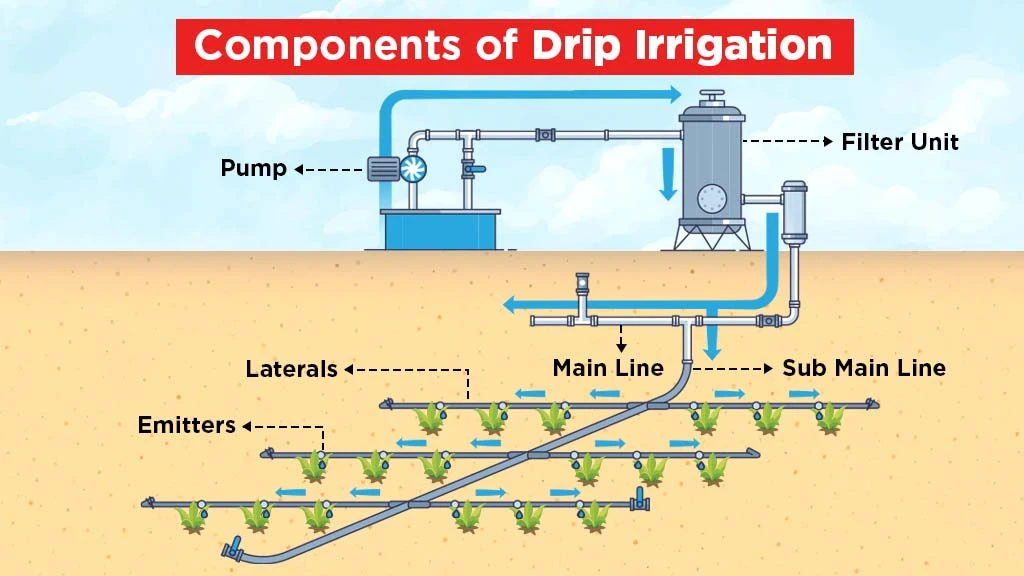
How Drip Irrigation Works
Drip irrigation is a micro-irrigation system that delivers water slowly and directly to the root zone through a network of valves, pipes, tubing, and emitters. This targeted approach minimizes water loss through evaporation and runoff.
Irrigation Methods Comparison
Method | Water Use Efficiency | Labor Requirement | Initial Cost | Best For |
|---|---|---|---|---|
Drip Irrigation | 85-90% | Low | High | High-value crops, water-scarce areas |
Sprinkler | 70-80% | Medium | Medium | Field crops, uneven terrain |
Flood/Furrow | 35-40% | High | Low | Traditional rice, wheat |
Basin Irrigation | 60-70% | High | Low | Orchard crops |
Advantages in SSI
Spacing compatibility: SSI's 5ft × 2ft spacing allows easy installation of drip lines
Precise water delivery: Each sugarcane plant gets optimal water without wastage
Fertigation possible: Fertilizers can be applied through the drip system
Reduced labor: Less manual irrigation work compared to flood methods
Better yield: Consistent water supply improves sugarcane quality and tonnage
Drip System Layout
Source: TractorKarvan — Drip irrigation system in India: Benefits, types and Uses · tractorkarvan.com