If a wetland of international importance is brought under the 'Montreux Record', what does it imply?
Contents13
- AChanges in ecological character have occurred, are occurring or are likely to occur in the wetland as a result of human interference.
- BThe country in which the wetland is located should enact a low to prohibit any human activity within five kilometres from the edge of the wetland.
- CThe survival of the wetland depends on the cultural practices and traditions of certain communities living in its vicinity and therefore the cultural diversity therein should not be destroyed.
- DIt is given the status of 'World Heritage Site'.
Show answer
Answer: (A) Changes in ecological character have occurred, are occurring or are likely to occur in the wetland as a result of human interference.
The Montreux Record is a register of Ramsar wetland sites where ecological changes have occurred, are occurring, or are likely to occur due to human interference.
Think of it as a 'red flag list' or 'danger list' for wetlands.
Being on the Montreux Record means the wetland needs urgent attention and conservation measures.
It does NOT mean:
(b) A 5 km no-activity zone is created — no such rule exists.
(c) Cultural diversity protection — this confuses it with UNESCO cultural heritage concepts.
(d) World Heritage Site status — that's a separate UNESCO designation.
India's Montreux Record sites have included Chilika Lake (removed after improvement), Loktak Lake, and Keoladeo Ghana NP.
The Montreux Record is essentially a 'danger list' for Ramsar wetlands where ecological damage has occurred or is likely due to human interference.
India has had wetlands like Chilika Lake and Loktak Lake on this record, making it a recurring exam topic about wetland conservation mechanisms.
UPSC is testing whether students can distinguish between different international conservation frameworks - Ramsar conventions, UNESCO World Heritage, and cultural protection concepts.
Montreux Record
Environment Montreux Record
Montreux Record: Red Flag List for Wetlands
Montreux Record is a danger list of Ramsar sites facing ecological threats
Lists wetlands where human interference has caused or may cause ecological changes
India's current sites: Loktak Lake (Manipur), Keoladeo Ghana NP (Rajasthan)
Chilika Lake was removed after successful restoration
The Montreux Record is essentially a 'red flag list' under the Ramsar Convention. When a Ramsar wetland site faces serious ecological threats, it gets listed here to signal urgent conservation action is needed.
What Triggers Listing
Ecological character changes due to human activities
Pollution from industrial, agricultural, or urban sources
Water diversion or altered hydrology
Habitat destruction or invasive species introduction
Unsustainable tourism or developmental pressures
Indian Sites on Montreux Record
Site | State | Status | Main Threats |
|---|---|---|---|
Loktak Lake | Manipur | Currently listed | Phumdis degradation, pollution |
Keoladeo Ghana NP | Rajasthan | Currently listed | Water shortage, invasive species |
Chilika Lake | Odisha | Removed in 2002 | Successfully restored |
This question tested the precise definition of Montreux Record. Option A correctly identifies it as a mechanism to flag wetlands facing ecological character changes from human interference. The other options confused it with different conservation concepts.
Trap: Confusing Montreux Record with World Heritage Site status - these are separate UNESCO and Ramsar designations
Trap: Thinking it creates 5 km buffer zones - no such legal requirement exists
Trap: Mixing it with cultural heritage protection - Montreux Record is purely ecological
Memory aid: Montreux = Monitoringeux = monitoring wetlands in trouble
Ramsar Convention & Wetlands
Environment wetland of international importance Ramsar
Ramsar Convention: Global Wetland Protection Framework
Ramsar Convention (1971) is the global treaty for wetland conservation
India has 75+ Ramsar sites covering over 1.3 million hectares
Sites must meet specific criteria for international importance
Promotes wise use principle for sustainable wetland management
The Ramsar Convention on Wetlands (1971) is the world's oldest environmental treaty. Named after the Iranian city where it was signed, it creates a framework for national action and international cooperation to conserve wetlands.
Ramsar Site Designation Criteria
Criteria Type | Examples | Key Indicators |
|---|---|---|
Unique/Representative | Contains representative wetland types | Ecological uniqueness |
Species Support | Supports vulnerable species | 20,000+ waterbirds |
Fish Biodiversity | Significant fish species/stages | Breeding/feeding grounds |
Hydrological Functions | Water purification, flood control | Ecosystem services |
India's Ramsar Achievements
First site: Chilika Lake and Keoladeo Ghana NP (1981)
Recent additions: Bakhira Wildlife Sanctuary, Karikili Bird Sanctuary
Largest site: Sundarbans (West Bengal)
High-altitude site: Tso Moriri (Ladakh at 4,500m)
Urban wetland: Kolleru Lake faces development pressure
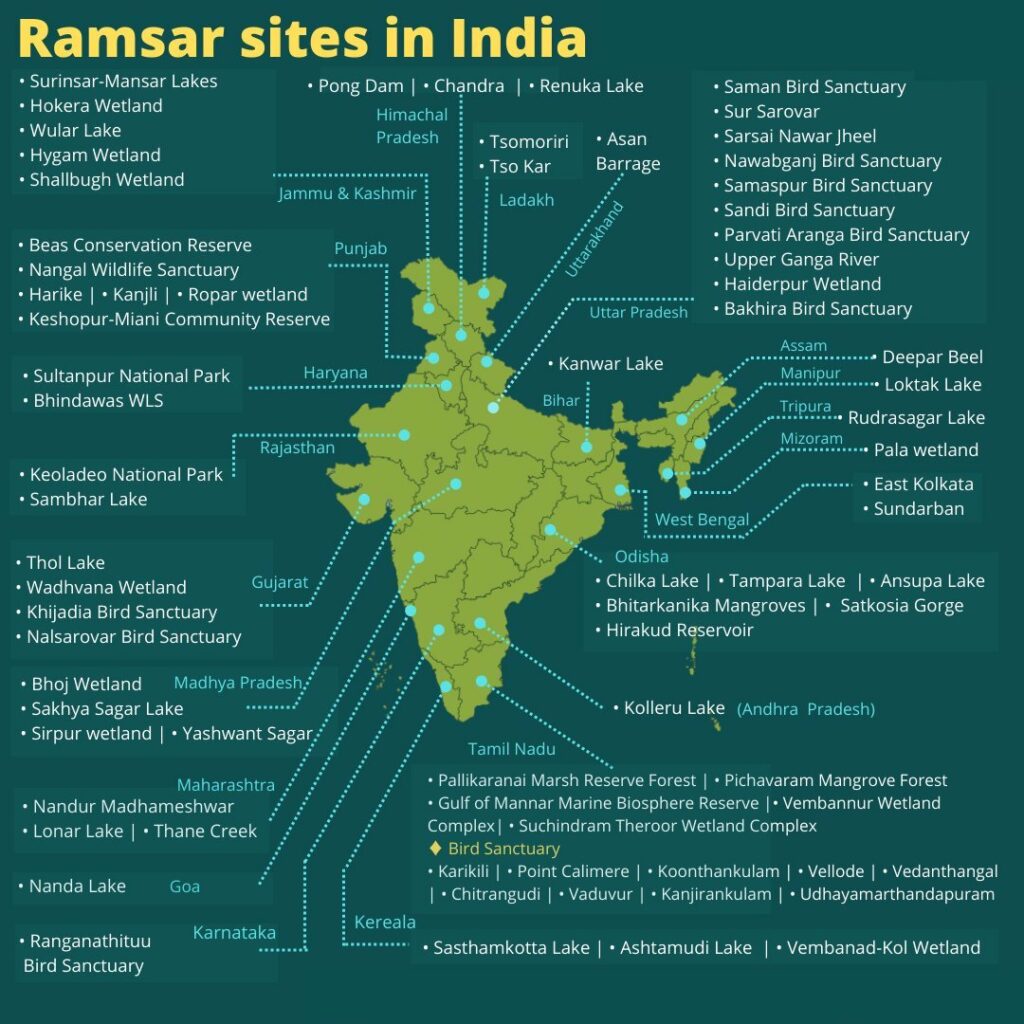
Source: LotusArise — Ramsar Sites in India with Map (Updated in 2026) | UPSC · lotusarise.com
Numbers trap: Ramsar site count keeps increasing - focus on major sites like Chilika, Sundarbans, Bharatpur
Confusion: Ramsar sites ≠ Biosphere Reserves ≠ National Parks - different designation systems
Criteria mix-up: Not all wetlands qualify - must meet international importance criteria
Think beyond birds: Ramsar covers all wetland functions - water storage, fish breeding, climate regulation
World Heritage Sites vs Other Designations
Environment World Heritage Site
International Conservation Designations: Key Differences
World Heritage Sites are UNESCO's top-tier cultural/natural heritage protection
Ramsar sites focus specifically on wetland conservation
India has 40 World Heritage Sites (32 cultural + 8 natural)
Different organizations manage different designation types
Major International Designations
Designation | Organization | Focus | India Count | Examples |
|---|---|---|---|---|
World Heritage Sites | UNESCO | Outstanding universal value | 40 | Taj Mahal, Kaziranga |
Ramsar Sites | Ramsar Convention | Wetlands of international importance | 75+ | Chilika Lake, Sundarbans |
Biosphere Reserves | UNESCO MAB | Conservation + sustainable development | 18 | Nilgiri, Gulf of Mannar |
Global Geoparks | UNESCO | Geological heritage | 1 | None yet approved |
World Heritage Site Criteria
Outstanding Universal Value - significance to all humanity
Authenticity and integrity must be maintained
Legal protection and management systems required
Can be cultural (monuments, sites) or natural (ecosystems, landscapes)
Danger List exists for threatened sites (like Montreux Record for wetlands)
The question's wrong option D confused World Heritage Site designation with Montreux Record. While both indicate international recognition, World Heritage focuses on outstanding universal value, while Montreux Record specifically flags wetlands in ecological danger.
Trap: Mixing UNESCO World Heritage with Ramsar Montreux Record - different organizations and purposes
Numbers confusion: India has 40 World Heritage Sites vs 75+ Ramsar sites - don't swap counts
Criteria confusion: World Heritage needs outstanding universal value, Ramsar needs international wetland importance
Status trap: Some sites can have multiple designations - e.g., Sundarbans is both World Heritage AND Ramsar site
Ecological Character Changes in Wetlands
Environment ecological character human interference
Ecological Character Changes: How Human Activities Threaten Wetlands
Ecological character refers to the biological, physical and chemical components of wetlands
Human interference is the primary cause of wetland degradation globally
Changes can be gradual (pollution) or sudden (land conversion)
Early detection allows for restoration efforts like Chilika Lake success
Ecological character encompasses all the biological, physical, and chemical components that make a wetland function. When human activities disrupt these components, the wetland loses its ability to provide ecosystem services like water purification, flood control, and biodiversity support.
Types of Human Interference
# Human Impacts on Wetlands
## Water Management
- Dam construction
- Water diversion
- Over-extraction
- Flow alteration
## Pollution
- Industrial discharge
- Agricultural runoff
- Urban sewage
- Plastic waste
## Land Use Changes
- Urban expansion
- Agriculture conversion
- Aquaculture
- Infrastructure
## Direct Exploitation
- Overfishing
- Sand mining
- Reed harvesting
- Tourism pressure
Ecological Indicators of Wetland Degradation
Component | Healthy State | Degraded State | Impact |
|---|---|---|---|
Water Quality | Clear, low nutrients | Turbid, eutrophic | Fish kills, algal blooms |
Biodiversity | Rich species variety | Invasive species dominance | Loss of endemic species |
Hydrology | Natural seasonal cycles | Altered water levels | Breeding failure |
Vegetation | Native plant communities | Monoculture/degraded | Habitat loss |
Case Study: Restoration Success
Chilika Lake was listed in Montreux Record (1993) due to salinity changes and siltation
Restoration efforts: Dredging, hydrological restoration, community involvement
Result: Removed from Montreux Record (2002) after ecological recovery
Key lesson: Early intervention through monitoring systems can reverse degradation
Current challenge: Maintaining long-term sustainability
Trap: Thinking natural changes trigger Montreux listing - it's specifically for human-caused changes
Scope confusion: Ecological character includes physical, chemical AND biological components - not just wildlife
Timeline trap: Changes can be occurring (present) or likely to occur (predicted future) - both count
Restoration possibility: Being on Montreux Record doesn't mean permanent damage - Chilika was successfully restored