The most important strategy for the conservation of biodiversity together with traditional human life is the establishment of
Contents18
- Abiosphere
- Breserves
- Cnational parks
- DWildlife sanctuaries
Show answer
Answer: (A) biosphere
Biosphere Reserves are the best answer because they are designed to achieve BOTH conservation AND sustainable human life together.
A Biosphere Reserve has three zones:
(1) Core Zone — strictly protected, no human activity (like a National Park).
(2) Buffer Zone — limited human activity, research, and education allowed.
(3) Transition Zone — outermost area where traditional human activities like farming, settlement, and sustainable resource use continue.
National Parks — strict protection, no human habitation or grazing allowed.
Wildlife Sanctuaries — some human activities allowed but focus is on wildlife, not integrating traditional life.
The question specifically asks about conservation 'together with traditional human life' — only Biosphere Reserves are explicitly designed for this dual purpose.
India has 18 Biosphere Reserves (e.g., Nilgiri, Sundarbans, Gulf of Mannar).
(Ref: NCERT Class 12 Biology, Ch.15)
Biosphere reserves use a three-zone model (core, buffer, transition) that allows both strict conservation and continuation of traditional human activities in the same protected area.
The question tests whether students understand that national parks and wildlife sanctuaries prohibit or restrict human settlement, while only biosphere reserves are specifically designed to integrate traditional communities with conservation goals.
Biosphere Reserves
Environment biosphere reserves traditional human life
Biosphere Reserves: Conservation with Traditional Life
Biosphere Reserves combine strict conservation with sustainable human activities through a three-zone system
India has 18 Biosphere Reserves including Nilgiri, Sundarbans, and Gulf of Mannar
Transition Zone allows traditional farming, settlement, and resource use
Part of UNESCO's Man and Biosphere (MAB) Programme
Why Biosphere Reserves?
Biosphere Reserves are the only protected area model designed to achieve both biodiversity conservation and sustainable human development. Unlike National Parks or Wildlife Sanctuaries that prioritize wildlife protection, Biosphere Reserves explicitly integrate traditional communities and their livelihoods into the conservation framework.
Three-Zone System
Zone | Protection Level | Human Activities | Purpose |
|---|---|---|---|
Core Zone | Strictly protected | No human activity allowed | Pure conservation like National Park |
Buffer Zone | Limited protection | Research, education, tourism | Scientific activities only |
Transition Zone | Sustainable use | Traditional farming, settlement, grazing | Human-nature coexistence |
Protected Areas Comparison
Protected Area | Human Habitation | Traditional Activities | Primary Focus |
|---|---|---|---|
Biosphere Reserve | Allowed in Transition Zone | Explicitly encouraged | Conservation + Human development |
National Park | Strictly prohibited | Not allowed | Wildlife conservation only |
Wildlife Sanctuary | Limited/restricted | Some grazing allowed | Wildlife protection |
Indian Biosphere Reserves
Nilgiri (first in India, 1986) - covers Tamil Nadu, Karnataka, Kerala
Sundarbans - mangrove ecosystem with traditional fishing communities
Gulf of Mannar - marine biosphere with coral reefs and fishing villages
Nanda Devi - high altitude ecosystem in Uttarakhand
Great Nicobar - tropical rainforest and tribal communities
Biosphere Reserve Zones
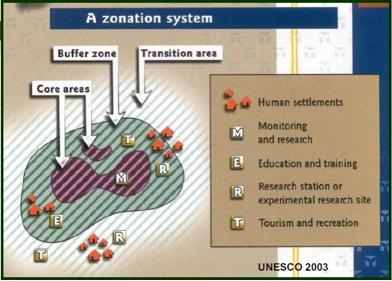
Source: BYJU'S — UNESCO Protected Biosphere Reserves List · byjus.com
Trap: Don't confuse Buffer Zone (research only) with Transition Zone (traditional life allowed)
Trap: National Parks allow NO human habitation - they cannot conserve 'with traditional life'
Trap: The question asks for conservation together with traditional life - only Biosphere Reserves are designed for this dual purpose
Trap: Wildlife Sanctuaries allow some activities but focus on wildlife, not integrating human communities
National Parks
Environment national parks
National Parks: Strict Wildlife Protection
National Parks have the strictest protection - no human habitation or activities allowed
Established by state governments under Wildlife Protection Act 1972
India has 104 National Parks covering about 1.23% of geographical area
Jim Corbett (1936) was India's first National Park
Core Features
National Parks represent the highest level of wildlife protection in India. They are established to preserve ecosystems in their natural state with zero human interference. No grazing, farming, or settlement is permitted, making them unsuitable for conserving traditional human life.
Famous National Parks
National Park | State | Famous For | Year Established |
|---|---|---|---|
Jim Corbett | Uttarakhand | First National Park, Tigers | 1936 |
Kaziranga | Assam | One-horned Rhinoceros | 1974 |
Ranthambore | Rajasthan | Tigers, Historical ruins | 1980 |
Bandhavgarh | Madhya Pradesh | Highest tiger density | 1968 |
Sundarbans | West Bengal | Mangrove tigers | 1984 |
Legal Framework
Established under Section 35 of Wildlife Protection Act 1972
State governments have power to declare National Parks
Supreme Court approval required for any boundary changes
No mining, grazing, or commercial activities permitted
Entry requires permission from Chief Wildlife Warden
Trap: National Parks do NOT allow traditional human life - they are for pure conservation
Trap: Don't confuse with Biosphere Reserves which have zones for human activities
Trap: State governments establish National Parks, not Central government
Wildlife Sanctuaries
Environment Wildlife sanctuaries
Wildlife Sanctuaries: Protected Areas with Limited Activities
Wildlife Sanctuaries allow some human activities like grazing but focus on wildlife protection
India has 500+ Wildlife Sanctuaries - largest network of protected areas
Chief Wildlife Warden of state can permit activities
Less restrictive than National Parks but more than Reserve Forests
Balanced Approach
Wildlife Sanctuaries strike a balance between conservation and limited human use. While the primary focus remains wildlife protection, certain traditional activities like grazing may be permitted under regulation. However, they are not designed to integrate traditional human communities like Biosphere Reserves.
Sanctuaries vs Parks vs Biosphere Reserves
Feature | Wildlife Sanctuary | National Park | Biosphere Reserve |
|---|---|---|---|
Human habitation | Generally not allowed | Strictly prohibited | Allowed in Transition Zone |
Grazing | May be permitted | Prohibited | Allowed in Transition Zone |
Authority | State Chief Wildlife Warden | State Government | Central Government |
Primary focus | Wildlife protection | Ecosystem preservation | Conservation + Development |
Number in India | 500+ | 104 | 18 |
Key Features
Regulated access - Chief Wildlife Warden can grant permissions
Some traditional rights may continue under supervision
Research and education activities generally allowed
Buffer zones may be created around core sanctuary area
Largest protected area network in India by number
Trap: Wildlife Sanctuaries allow some human activities but are not designed for traditional life conservation
Trap: Focus remains on wildlife protection, not human-nature integration
Trap: More flexible than National Parks but less comprehensive than Biosphere Reserves for the question's requirement
Protected Areas Classification
Environment conservation of biodiversity
India's Protected Area Network: Categories & Management
India follows IUCN classification with modifications under Wildlife Protection Act 1972
Four main categories: National Parks, Wildlife Sanctuaries, Conservation Reserves, Community Reserves
In-situ conservation is the primary strategy
Protected areas cover about 5% of India's geographical area
Conservation Strategy
India's protected area system represents the backbone of in-situ biodiversity conservation. The network ranges from strictly protected National Parks to community-managed reserves, offering different levels of protection and human involvement.
Protected Area Hierarchy
# Protected Areas in India
## **Strict Protection**
- National Parks (104)
- Wildlife Sanctuaries (500+)
## **Community Based**
- Community Reserves
- Conservation Reserves
## **Special Categories**
- Biosphere Reserves (18)
- Tiger Reserves (50+)
- Ramsar Sites (75+)
Protection Levels
Category | Human Activities | Management Authority | Primary Goal |
|---|---|---|---|
National Parks | Prohibited | State Government | Ecosystem preservation |
Wildlife Sanctuaries | Regulated/Limited | Chief Wildlife Warden | Wildlife protection |
Conservation Reserves | Sustainable use | State with communities | Buffer to parks/sanctuaries |
Community Reserves | Community managed | Local communities | Community conservation |
Biosphere Reserves | Zoned approach | Central Government | Conservation + Development |
Trap: Conservation Reserves and Community Reserves were added by 2002 amendment - newer categories
Trap: Don't confuse in-situ (protected areas) with ex-situ (zoos, botanical gardens) conservation
Trap: Tiger Reserves are a separate category under Project Tiger, not under basic Wildlife Protection Act classification