Brominated flame retardants are used in many household products like mattresses and upholstery. Why is there some concern about their use? 1. They are highly resistant to degradation in the environment 2. They are able to accumulate in humans and animals Select the correct answer using the code given below.
Contents17
- A1 only
- B2 only
- CBoth 1 and 2
- DNeither 1 nor 2
Show answer
Answer: (C) Both 1 and 2
Both concerns are valid:
(1) Persistent in environment — CORRECT: Brominated flame retardants (BFRs) are chemically very stable, meaning they resist natural breakdown (biodegradation). They persist in soil, water, and sediments for years — similar to how DDT and PCBs persist.
(2) Bioaccumulation — CORRECT: Because BFRs are fat-soluble (lipophilic), they accumulate in the fatty tissues of animals and humans over time. They biomagnify up the food chain — higher predators (including humans) have higher concentrations. BFRs have been found in human breast milk and blood.
These two properties together — persistence + bioaccumulation — are exactly what makes Persistent Organic Pollutants (POPs) dangerous. BFRs are regulated under the Stockholm Convention on POPs.
Brominated flame retardants combine two dangerous properties - they persist in the environment for years without breaking down and accumulate in fatty tissues of humans and animals.
BFRs are classified as Persistent Organic Pollutants (POPs) under the Stockholm Convention, the same category as banned chemicals like DDT and PCBs.
The question tests understanding of what makes chemicals environmentally hazardous - persistence plus bioaccumulation creates the most dangerous pollution pattern.
Brominated Flame Retardants (BFRs)
Environment Brominated flame retardants mattresses upholstery
Brominated Flame Retardants: Environmental & Health Concerns
BFRs are chemicals added to household products to prevent fires
They are persistent in environment and bioaccumulate in living tissues
Regulated under Stockholm Convention as POPs
Found in mattresses, upholstery, electronics, and textiles
What are BFRs
Brominated Flame Retardants (BFRs) are chemicals containing bromine that are added to consumer products to slow down or prevent fires. They are commonly found in household items like mattresses, furniture upholstery, carpets, and electronic devices.
Environmental & Health Concerns
Property | Problem | Impact | Example |
|---|---|---|---|
Persistence | Resist natural breakdown | Stay in environment for years | Accumulate in soil, water, sediments |
Bioaccumulation | Fat-soluble, store in tissues | Build up in food chain | Found in human breast milk, blood |
Biomagnification | Concentrate at higher levels | Top predators most affected | Humans have highest concentrations |
Why These Properties Matter
Chemical stability means natural processes cannot break down BFRs quickly
Lipophilic nature allows them to dissolve in fats and accumulate in fatty tissues
Long half-life in human body means exposure effects persist for years
Global transport through air and water currents spreads contamination worldwide
Trap: Both statements are correct — don't pick 'A only' or 'B only'
Common confusion: Thinking flame retardants are safe because they prevent fires
Key link: Persistence + bioaccumulation = criteria for Persistent Organic Pollutants (POPs)
Persistent Organic Pollutants (POPs)
Environment
Persistent Organic Pollutants: The Dirty Dozen & Beyond
POPs are toxic chemicals that persist, bioaccumulate, and travel globally
Regulated by Stockholm Convention (2001) — ratified by India
Original 12 POPs called 'Dirty Dozen' — now expanded to 30+
Definition & Criteria
Persistent Organic Pollutants (POPs) are carbon-based chemicals that combine four dangerous properties:
Persistence: resist degradation in environment
Bioaccumulation: build up in living organisms
Long-range transport: spread globally through air/water
Toxicity: cause cancer, reproductive damage, immune system harm
Major POPs Categories
Category | Examples | Uses | Health Effects |
|---|---|---|---|
Pesticides | DDT, Aldrin, Dieldrin | Crop protection, malaria control | Cancer, reproductive harm |
Industrial Chemicals | PCBs, BFRs | Electrical equipment, flame retardants | Endocrine disruption |
Unintentional Byproducts | Dioxins, Furans | Waste burning, industrial processes | Immune system damage |
How POPs Spread Globally
%%{init: {"flowchart": {"wrappingWidth": 460}}}%%
flowchart TD
  s1["`**Release**
Industrial use, pesticide application, waste burning`"]
  s2["`**Transport**
Air currents carry POPs to remote areas (Arctic, mountains)`"]
  s3["`**Deposition**
Settle in soil, water, sediments worldwide`"]
  s4["`**Food Chain Entry**
Absorbed by plants, small animals`"]
  s5["`**Biomagnification**
Concentrate at each level — highest in top predators`"]
  s1 --> s2
  s2 --> s3
  s3 --> s4
s4 --> s5Stockholm Convention is about POPs — not Rotterdam (pesticide trade) or Basel (waste)
DDT still allowed for malaria control despite being a POP
PCBs are industrial chemicals, not pesticides
POPs affect Arctic regions most due to cold condensation effect
Stockholm Convention on POPs
Environment
Stockholm Convention: Global Action on Toxic Chemicals
Stockholm Convention (2001) — global treaty to eliminate/restrict POPs
India ratified in 2006, implements National Implementation Plan
Started with 12 POPs (Dirty Dozen), now covers 30+ chemicals
Treaty Overview
The Stockholm Convention on Persistent Organic Pollutants came into force in 2004 and is administered by UNEP. It requires countries to eliminate or restrict production, use, and release of POPs, and provides technical assistance to developing countries.
Three Annexes of Convention
Annex | Action Required | Examples | Exceptions |
|---|---|---|---|
Annex A | Elimination | PCBs, most pesticides | Essential use exemptions |
Annex B | Restriction | DDT | Malaria control only |
Annex C | Reduce unintentional releases | Dioxins, Furans | Best practices required |
India's Implementation
Ministry of Environment is the nodal agency for implementation
National Implementation Plan covers inventory, action plans, monitoring
PCB phase-out program for electrical utilities underway
Dioxin reduction through improved waste management practices
Stockholm Convention (2001) is different from Stockholm Declaration (1972 UN Conference)
DDT exemption for malaria control — not completely banned globally
Convention covers both intentional production (pesticides) and unintentional release (dioxins)
UNEP administers Stockholm — not WHO or FAO
Bioaccumulation & Biomagnification
Environment accumulate humans animals
Bioaccumulation & Biomagnification: How Toxins Concentrate
Bioaccumulation: toxins build up in individual organisms over time
Biomagnification: toxin concentration increases up the food chain
Fat-soluble chemicals accumulate most — stored in fatty tissues
Bioaccumulation vs Biomagnification
Process | Definition | Scale | Mechanism | Example |
|---|---|---|---|---|
Bioaccumulation | Buildup within one organism | Individual level | Intake > excretion rate | Mercury in fish liver |
Biomagnification | Increase up food chain levels | Ecosystem level | Each predator concentrates toxins | DDT: plankton → fish → birds |
Biomagnification Process
%%{init: {"flowchart": {"wrappingWidth": 460}}}%%
flowchart TD
  s1["`**Primary Producers**
Plants absorb low concentrations from soil/water`"]
  s2["`**Primary Consumers**
Herbivores eat many plants — toxins concentrate`"]
  s3["`**Secondary Consumers**
Carnivores eat many herbivores — higher concentration`"]
  s4["`**Top Predators**
Apex species have highest toxin levels — thousands of times more`"]
  s1 --> s2
  s2 --> s3
  s3 --> s4
Why Lipophilic Chemicals Accumulate
Fat-soluble chemicals dissolve in lipids, not water — hard to excrete
Stored in fatty tissues like liver, brain, reproductive organs
Long biological half-life — takes years to eliminate from body
Released during stress when body burns fat reserves
Biomagnification Pyramid
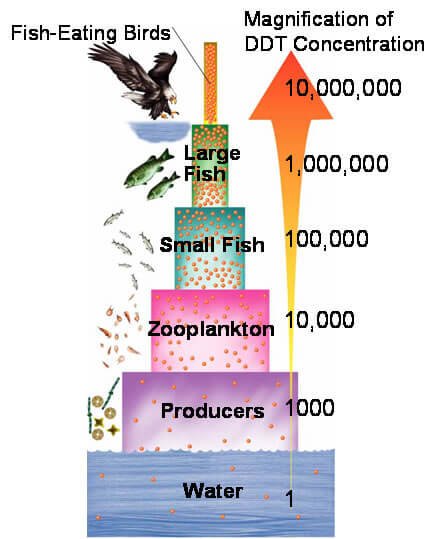
Source: PMF IAS — Energy Flow through an Ecosystem: Ecological Pyramids - PMF IAS · www.pmfias.com
Bioaccumulation happens in one animal — biomagnification across food chain
Water-soluble toxins are excreted easily — fat-soluble ones accumulate
Top predators (eagles, humans) most affected — not primary consumers
Process explains why breast milk and egg yolks have high toxin levels