Among the following, which were frequently mentioned in the news for the outbreak of Ebola virus recently?
Contents21
- ASyria and Jordan
- BGuinea, Sierra Leone and Liberia
- CPhilippines and Papua New Guinea
- DJamaica, Haiti and Surinam
Show answer
Answer: (B) Guinea, Sierra Leone and Liberia
The 2014 Ebola outbreak — the largest in history — was centered in three West African countries:
Guinea (where it started),
Sierra Leone, and
Liberia.
These three nations were devastated by the virus and were constantly in the news throughout 2014-15.
You can easily eliminate the other options using basic geography:
Option
(a) Syria and Jordan are in the Middle East (associated with conflict/refugee crisis, not Ebola).
Option
(c) Philippines and Papua New Guinea are in the Southeast Asia/Pacific region.
Option
(d) Jamaica, Haiti and Surinam are in the Caribbean/South America. None of these regions were affected by the Ebola outbreak.
Tip: Ebola is historically associated with Africa (the virus was first discovered near the Ebola River in the Democratic Republic of Congo in 1976).
Whenever you see Ebola in a question, think Africa first.
The 2014-15 Ebola outbreak was the largest in history, killing over 11,000 people across Guinea, Sierra Leone, and Liberia.
This question was asked in 2015 UPSC because the Ebola crisis dominated international headlines throughout 2014-15, making it prime current affairs material.
UPSC is testing whether students can connect major global health emergencies to their correct geographical regions and timeframes.
Ebola Virus Disease
Science And Technology Ebola virus outbreak
Ebola Virus Disease: Outbreaks, Transmission & Global Impact
Ebola is a viral hemorrhagic fever with 60-90% fatality rate
2014-16 West Africa outbreak was the largest in history
Guinea, Sierra Leone, Liberia were the epicenter countries
First discovered in 1976 near Ebola River in Democratic Republic of Congo
Transmitted through direct contact with bodily fluids of infected persons
What is Ebola
Ebola Virus Disease (EVD) is a severe viral hemorrhagic fever caused by the Ebola virus. The disease spreads through direct contact with blood, secretions, or other bodily fluids of infected people or animals. It causes internal bleeding, organ failure, and has one of the highest fatality rates among infectious diseases.
Major Ebola Outbreaks
Year | Location | Cases | Key Features |
|---|---|---|---|
1976 | Zaire (DRC) near Ebola River | 318 | First identified outbreak, gave the virus its name |
2014-16 | Guinea, Sierra Leone, Liberia | 28,600+ | Largest outbreak in history, WHO emergency |
2018-20 | Democratic Republic of Congo | 3,400+ | Second largest outbreak, conflict zone |
2021 | Guinea | 23 | New outbreak, different strain |
2014-16 West Africa Crisis
Started in Guinea in December 2013, officially declared in March 2014
Spread rapidly to Sierra Leone and Liberia due to porous borders and cultural practices
WHO declared Public Health Emergency of International Concern in August 2014
International response included US military deployment and MSF medical teams
Outbreak officially ended in June 2016 after multiple re-emergences
West Africa Outbreak Map
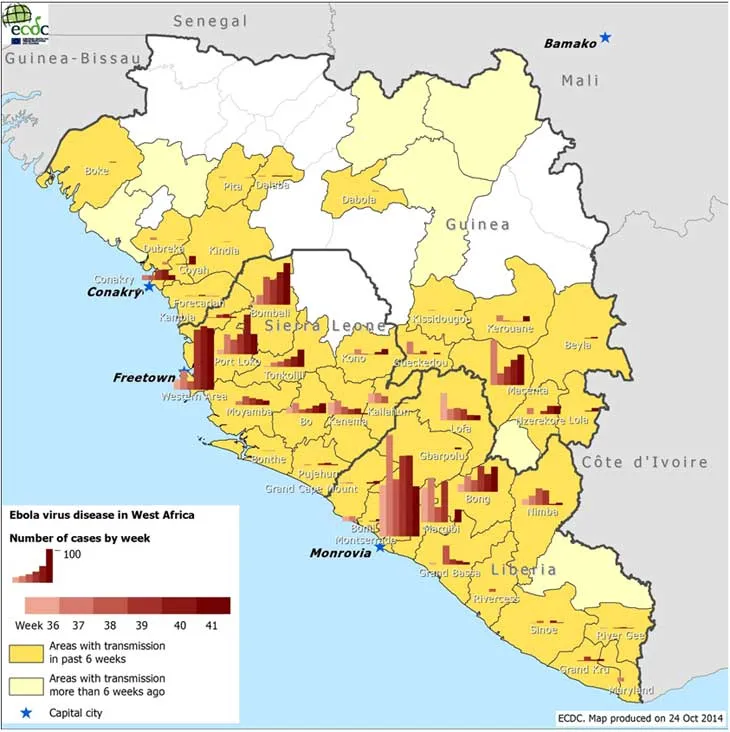
Source: ECDC - European Union — Epidemiological update: outbreak of Ebola virus disease in West ... · www.ecdc.europa.eu
Ebola Transmission Chain
%%{init: {"flowchart": {"wrappingWidth": 460}}}%%
flowchart TD
  s1["`****Animal Reservoir****
Fruit bats are primary hosts, virus spreads to primates`"]
  s2["`****Zoonotic Transmission****
Humans infected through contact with infected animals`"]
  s3["`****Human-to-Human Spread****
Direct contact with blood, vomit, feces, sweat of infected persons`"]
  s4["`****Community Transmission****
Funeral practices, healthcare settings amplify spread`"]
  s5["`****Epidemic Phase****
Exponential growth without proper isolation measures`"]
  s1 --> s2
  s2 --> s3
  s3 --> s4
s4 --> s5Geographic confusion: Ebola is African disease - eliminate non-African options immediately
Time period trap: 2014-16 outbreak was West Africa, not Central/East Africa
Country confusion: Guinea-Bissau is different from Guinea (Conakry)
Transmission myth: Ebola does NOT spread through air - only direct contact with fluids
West African Countries & Geography
Geography Guinea Sierra Leone Liberia
West African Countries: Guinea, Sierra Leone & Liberia
Guinea, Sierra Leone, Liberia are neighboring West African countries
All three have Atlantic Ocean coastline and tropical climate
Guinea has capital Conakry, Sierra Leone has Freetown
Liberia was founded by freed American slaves in 1847
Regional Context
These three countries form a contiguous bloc in West Africa along the Atlantic coast. They share similar tropical climates, cultural practices, and porous borders that facilitate movement of people and goods - factors that contributed to rapid disease spread during the Ebola crisis.
Country Profiles
Country | Capital | Key Feature | Borders |
|---|---|---|---|
Guinea | Conakry | Bauxite mining, French colonial heritage | Mali, Senegal, Guinea-Bissau, Sierra Leone, Liberia, Côte d'Ivoire |
Sierra Leone | Freetown | Diamond mining, British colonial heritage | Guinea, Liberia |
Liberia | Monrovia | Founded by freed slaves, never colonized | Guinea, Sierra Leone, Côte d'Ivoire |
West Africa Map
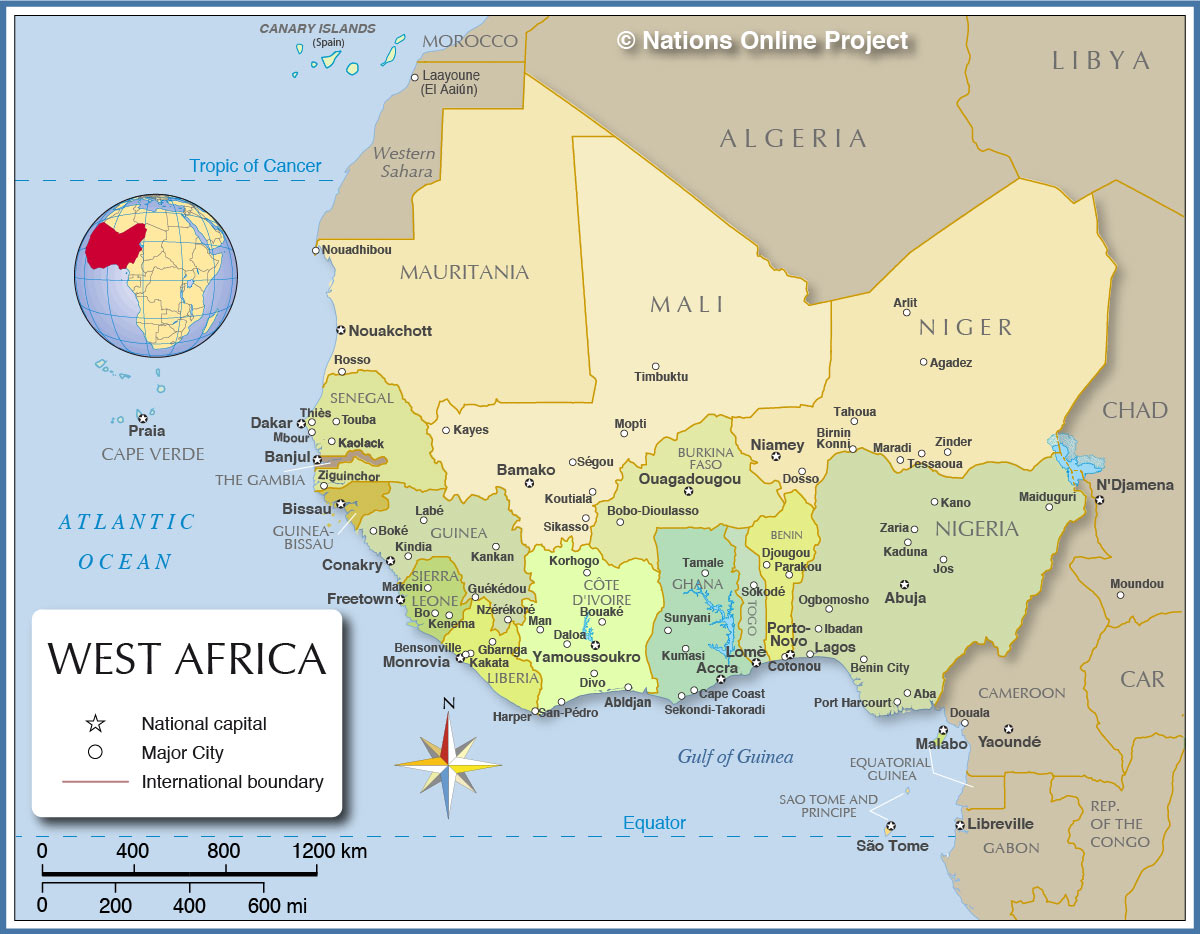
Source: Nations Online — Political Map of West Africa - Nations Online Project · www.nationsonline.org
UPSC Relevance
Mano River Union: Regional organization linking Guinea, Sierra Leone, Liberia
Natural resources: Guinea has bauxite, Sierra Leone has diamonds, Liberia has iron ore
Post-conflict recovery: Sierra Leone and Liberia emerged from civil wars in 2000s
Peacekeeping: India contributed troops to UNAMSIL (Sierra Leone) peacekeeping
Guinea vs Guinea-Bissau: Different countries - Guinea borders Sierra Leone, Guinea-Bissau borders Senegal
Regional confusion: These are West African countries, not Central or East African
Capital traps: Conakry (Guinea), Freetown (Sierra Leone), Monrovia (Liberia) - don't mix up
Global Health Emergencies & WHO Response
Science And Technology outbreak news
Global Health Emergencies: WHO's PHEIC Mechanism
PHEIC = Public Health Emergency of International Concern declared by WHO
2014 Ebola was third PHEIC ever declared
COVID-19 (2020) was sixth PHEIC declaration
PHEIC triggers international coordination and resource mobilization
PHEIC Framework
Public Health Emergency of International Concern (PHEIC) is WHO's highest level of health alert. It's declared when a health event constitutes a risk to other countries through international spread and requires coordinated international response.
Major PHEIC Declarations
Year | Disease/Event | Region | Outcome |
|---|---|---|---|
2009 | H1N1 Influenza (Swine Flu) | Global pandemic | First PHEIC, ended 2010 |
2014 | Ebola Virus Disease | West Africa | Ended 2016, 28,600+ cases |
2016 | Zika Virus | Americas | Linked to microcephaly, ended 2016 |
2019 | Ebola (DRC) | Democratic Republic of Congo | Conflict zone outbreak |
2020 | COVID-19 | Global pandemic | Ongoing, 700+ million cases |
2022 | Monkeypox | Global (non-endemic countries) | Ended 2023 |
WHO Emergency Response
Emergency Committee of international experts advises WHO Director-General on PHEIC
International Health Regulations (2005) legally bind 196 countries to report outbreaks
Temporary recommendations can include travel restrictions, border screening, vaccine deployment
Global Health Security Agenda aims to prevent, detect, respond to health threats
Emergency Response Components
# Health Emergency Response
## **Detection**
- Disease surveillance
- Laboratory networks
- Early warning systems
## **Response**
- Medical countermeasures
- Contact tracing
- Isolation protocols
## **Coordination**
- WHO leadership
- Country cooperation
- NGO partnerships
## **Resources**
- Emergency funding
- Medical supplies
- Expert deploymentPHEIC vs pandemic: PHEIC is WHO's alert mechanism, pandemic describes disease spread
Recent updates: Monkeypox PHEIC ended in 2023, COVID-19 emergency phase ended
Authority confusion: Only WHO Director-General can declare PHEIC, not individual countries
Viral Hemorrhagic Fevers
Science And Technology
Viral Hemorrhagic Fevers: Ebola Family & Related Diseases
Viral Hemorrhagic Fevers (VHFs) cause bleeding disorders and high mortality
Ebola and Marburg are filoviruses with similar symptoms
Lassa fever is common in West Africa, CCHF in Central Asia
All spread through direct contact with infected fluids or vectors
Disease Category
Viral Hemorrhagic Fevers (VHFs) are a group of diseases caused by RNA viruses that damage the vascular system, leading to internal bleeding, shock, and often death. They're among the most dangerous infectious diseases known to humans.
Major Viral Hemorrhagic Fevers
Disease | Virus Family | Geographic Distribution | Fatality Rate | Vector/Transmission |
|---|---|---|---|---|
Ebola | Filovirus | Central/West Africa | 60-90% | Direct contact, fruit bats |
Marburg | Filovirus | Central/East Africa | 50-80% | Direct contact, fruit bats |
Lassa Fever | Arenavirus | West Africa | 15-20% | Rodent urine, human contact |
CCHF | Bunyavirus | Africa, Asia, Europe | 10-40% | Tick bites, livestock contact |
Hantavirus | Bunyavirus | Americas, Asia | 35-50% | Rodent droppings, inhalation |
Clinical Features
Initial symptoms: High fever, headache, muscle pain, weakness - resemble flu
Hemorrhagic phase: Internal bleeding, blood in vomit/stool, bleeding from gums
Shock phase: Organ failure, low blood pressure, confusion, coma
No specific treatment: Supportive care only, experimental drugs for some types
VHF Global Distribution
Source: Research journals - PLOS — The number of cases, mortality and treatments of viral hemorrhagic ... · journals.plos.org
Ebola vs Marburg: Both filoviruses from Africa, but Marburg discovered earlier (1967)
Transmission confusion: VHFs are NOT airborne - require direct contact or vector bites
Geographic mixing: Lassa is West Africa, Marburg is East/Central Africa
Fatality rates: Ebola highest (60-90%), Lassa lowest among major VHFs (15-20%)