Which one of the following is associated with the issue of control and phasing out of the use of ozone-depleting substances?
Contents12
- ABretton Woods Conference
- BMontreal Protocol
- CKyoto Protocol
- DNagoya Protocol
Show answer
Answer: (B) Montreal Protocol
As per NCERT Class 12 Biology (pg 282):
The Montreal Protocol on Substances that Deplete the Ozone Layer was signed in 1987 under the Vienna Convention for the Protection of the Ozone Layer.
It is an international treaty specifically designed to protect the ozone layer by phasing out the production and consumption of ozone-depleting substances (ODS) like:
- chlorofluorocarbons (CFCs)
- halons
- carbon tetrachloride
- methyl chloroform
It is considered one of the most successful environmental treaties ever, as it has led to a significant reduction in ODS and the ozone hole is slowly recovering.
Why are the other options wrong?
(a) Bretton Woods Conference (1944) — established the International Monetary Fund (IMF) and the World Bank. It was about post-war international financial architecture, nothing to do with environment.
(c) Kyoto Protocol (1997) — deals with GREENHOUSE GAS emissions (like CO2, methane) that cause global warming/climate change, NOT ozone depletion. Students often confuse this with Montreal Protocol. Remember: Montreal = Ozone, Kyoto = Climate Change/Greenhouse Gases.
(d) Nagoya Protocol (2010) — deals with Access and Benefit Sharing (ABS) related to genetic resources under the Convention on Biological Diversity (CBD). It is about biodiversity, not ozone.
The Montreal Protocol is considered the most successful environmental treaty ever, having reduced ozone-depleting substances by over 95% since 1987.
Students frequently confuse Montreal Protocol (ozone depletion) with Kyoto Protocol (climate change) - these address completely different atmospheric problems with different causes and solutions.
Montreal Protocol
Environment Montreal Protocol ozone-depleting substances
Montreal Protocol: Ozone Layer Protection & Success Story
Montreal Protocol (1987) phases out ozone-depleting substances like CFCs and halons
Signed under Vienna Convention for ozone layer protection
Most successful environmental treaty — ozone hole is slowly recovering
Targets production and consumption of ODS, not just emissions
The Montreal Protocol on Substances that Deplete the Ozone Layer was signed in 1987 as the implementation treaty under the Vienna Convention. Unlike other environmental agreements that set emission targets, it directly phases out the production and consumption of ozone-depleting substances.
Key Ozone-Depleting Substances
Substance | Main Uses | Ozone Depletion Potential | Phase-out Status |
|---|---|---|---|
Chlorofluorocarbons (CFCs) | Refrigerants, aerosol propellants | High (0.6-1.0) | Completely phased out |
Halons | Fire suppressants | Very high (3.0-16.0) | Completely phased out |
Carbon Tetrachloride | Industrial solvent | High (1.1) | Phased out |
HCFCs | CFC replacements | Lower (0.02-0.12) | Being phased out by 2030 |
Why Montreal Protocol Succeeded
Universal participation — 197 countries have ratified it
Mandatory binding targets with specific phase-out schedules
Technology transfer provisions to help developing countries
Trade restrictions on ODS with non-parties
Regular assessment and amendment process based on scientific evidence
Question Connection
This question tests the specific mandate of Montreal Protocol. The trap lies in confusing environmental treaties — students often mix up ozone depletion (Montreal) with climate change (Kyoto) or biodiversity (Nagoya).
Montreal = Ozone, Kyoto = Climate Change — never confuse these two
Montreal targets ozone-depleting substances (CFCs), Kyoto targets greenhouse gases (CO2)
Vienna Convention (1985) is the framework, Montreal Protocol (1987) is the implementation treaty
Don't confuse ozone depletion (stratospheric) with ground-level ozone pollution
Major Environmental Protocols
Environment Bretton Woods Conference Kyoto Protocol Nagoya Protocol
Environmental Protocols: UPSC's Favorite Confusion Matrix
Montreal (1987) = Ozone depletion, Kyoto (1997) = Climate change, Nagoya (2010) = Biodiversity
Bretton Woods (1944) created IMF and World Bank — not environmental
Each protocol addresses different environmental problems with different approaches
Protocol Comparison Matrix
Protocol/Conference | Year | Primary Focus | Key Target | Success Level |
|---|---|---|---|---|
Montreal Protocol | 1987 | Ozone layer protection | Phase out CFCs, halons | Highly successful |
Kyoto Protocol | 1997 | Climate change | Reduce greenhouse gases | Limited success |
Nagoya Protocol | 2010 | Biodiversity | Access & benefit sharing of genetic resources | Implementation ongoing |
Bretton Woods | 1944 | International finance | Create IMF & World Bank | Economic, not environmental |
Key Distinctions
Montreal Protocol — only treaty to achieve universal ratification (197 countries)
Kyoto Protocol — replaced by Paris Agreement (2015) for climate action
Nagoya Protocol — part of Convention on Biological Diversity framework
Bretton Woods — established post-WWII economic order, completely unrelated to environment
Timeline Visualization
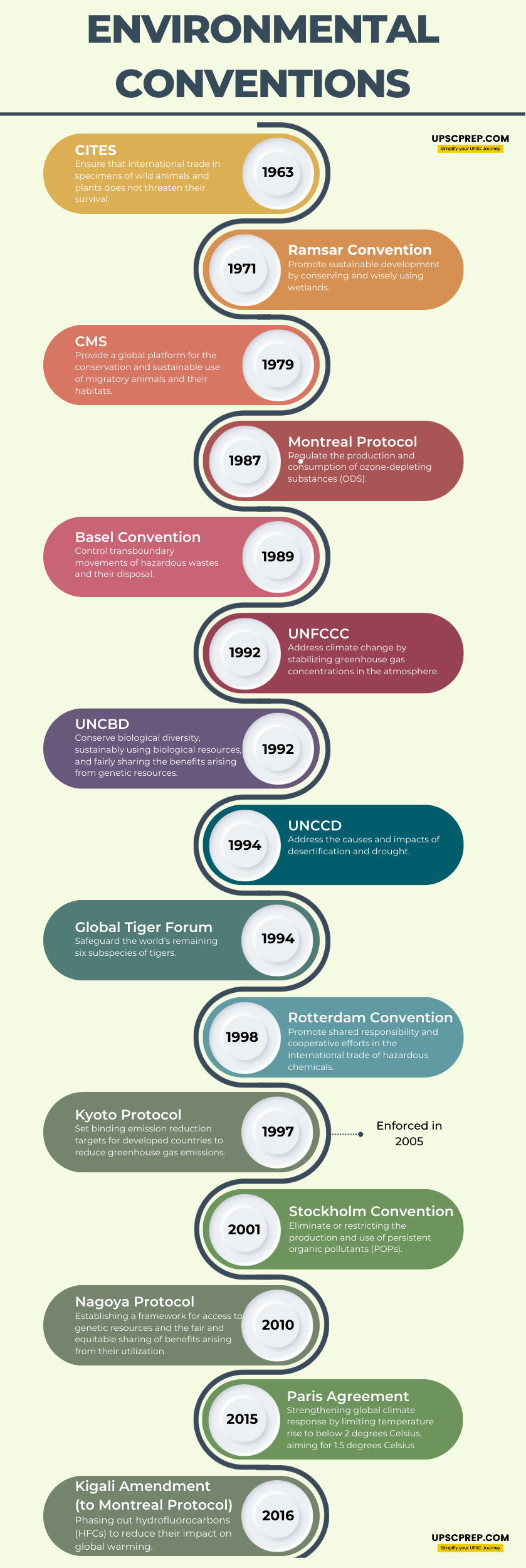
Source: UPSCprep.com — Previse 2025: Environmental Conventions · UPSCprep.com · www.upscprep.com
Never mix ozone and climate — Montreal ≠ Kyoto, different problems entirely
Bretton Woods appears in environment questions as distractor — it's purely economic
Nagoya Protocol is about genetic resources, not general biodiversity conservation
Vienna Convention (1985) vs Montreal Protocol (1987) — framework vs implementation
Ozone Depletion Mechanism
Environment ozone-depleting substances
Ozone Depletion: Science Behind Montreal Protocol
Stratospheric ozone absorbs harmful UV-B radiation protecting life on Earth
CFCs release chlorine atoms that destroy ozone molecules in chain reaction
Antarctic ozone hole appears seasonally due to polar stratospheric clouds
One chlorine atom can destroy thousands of ozone molecules
Stratospheric ozone (15-50 km altitude) forms a protective shield absorbing 99% of harmful UV-B radiation. When chlorofluorocarbons (CFCs) reach the stratosphere, UV radiation breaks them down, releasing chlorine atoms that catalytically destroy ozone.
Ozone Destruction Cycle
%%{init: {"flowchart": {"wrappingWidth": 460}}}%%
flowchart TD
  s1["`**CFC Release**
**CFCs** released from refrigerators, aerosols rise to stratosphere`"]
  s2["`**UV Breakdown**
**UV radiation** breaks CFC molecules, releasing **chlorine atoms**`"]
  s3["`**Ozone Attack**
**Cl + O₃ → ClO + O₂** (chlorine destroys ozone)`"]
  s4["`**Regeneration**
**ClO + O → Cl + O₂** (chlorine atom regenerated)`"]
  s5["`**Chain Reaction**
**Same chlorine atom** destroys thousands more ozone molecules`"]
  s1 --> s2
  s2 --> s3
  s3 --> s4
  s4 --> s5
Health & Environmental Impacts
Skin cancer and cataracts from increased UV-B exposure
Immune system suppression in humans and animals
Crop damage and reduced agricultural productivity
Marine ecosystem disruption — phytoplankton decline
Antarctic ozone hole reaches size of North America during spring
Ozone Hole Visualization
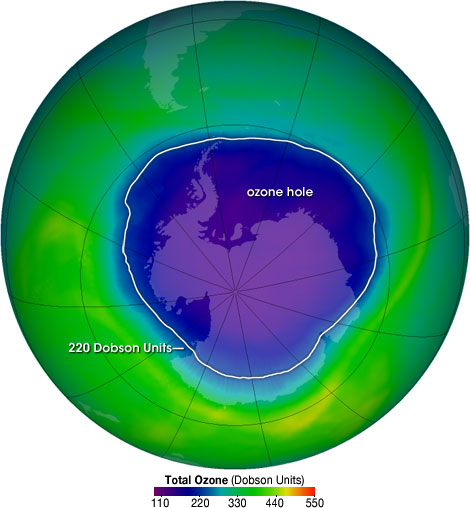
Source: NASA Ozone Watch — Nasa Ozone Watch: Ozone hole facts · ozonewatch.gsfc.nasa.gov
Stratospheric ozone = good, ground-level ozone = pollutant — opposite roles
UV-B radiation (harmful) vs UV-A radiation (less harmful) — ozone blocks UV-B
Antarctic ozone hole ≠ Arctic — Arctic depletion is less severe
Ozone depletion ≠ global warming — different causes, different solutions