Indira Gandhi Prize for Peace, Disarmament and Development for 2014 was given to which one of the following?
Contents18
- ABhabha Atomic Research Centre
- BIndian Institute of Science
- CIndian Space Research Organization
- DTata Institute of Fundamental Research.
Show answer
Answer: (C) Indian Space Research Organization
The Indira Gandhi Prize for Peace, Disarmament and Development for 2014 was awarded to the Indian Space Research Organisation (ISRO).
A jury chaired by the then Vice-President Hamid Ansari selected ISRO for this prestigious award, recognizing its contributions to promoting international peace, development, and scientific discoveries for the benefit of humanity.
ISRO was particularly recognized for its remarkable achievements including the Mars Orbiter Mission (Mangalyaan) — India's first interplanetary mission, which made India the first Asian nation to reach Mars orbit and the first in the world to do so on its maiden attempt (September 2014).
This was achieved at remarkably low cost ($74 million, less than the budget of the Hollywood movie 'Gravity').
Why not the other institutions?
- BARC (Bhabha Atomic Research Centre) focuses on nuclear research,
- IISc (Indian Institute of Science) is a premier research university in Bangalore,
- TIFR (Tata Institute of Fundamental Research) focuses on fundamental research in mathematics and sciences.
While all are important, the award in 2014 went specifically to ISRO.
This is a current affairs factual question — such questions require regular newspaper reading.
ISRO received the Indira Gandhi Prize for Peace, Disarmament and Development in 2014 for its contributions to international peace and scientific discoveries for humanity's benefit.
The Mars Orbiter Mission (Mangalyaan) successfully reached Mars orbit in September 2014, making India the first Asian nation and first country globally to succeed on its maiden attempt.
This was a direct current affairs question testing whether students followed major awards and recognitions given to Indian institutions in 2014.
Indira Gandhi Prize for Peace, Disarmament and Development
World Affairs (International Relations) Indira Gandhi Prize Peace Disarmament Development 2014
Indira Gandhi Prize for Peace, Disarmament and Development: Key Facts & Recipients
Annual international award instituted by Indira Gandhi Memorial Trust in 1986
ISRO won in 2014 for Mars Orbiter Mission and space achievements
Recognizes contributions to international peace, disarmament, and development
Selection by jury chaired by Vice-President of India
Award Overview
The Indira Gandhi Prize for Peace, Disarmament and Development is India's premier international award recognizing outstanding contributions to promoting international peace, development, and a nuclear-weapon-free world. Established in 1986 by the Indira Gandhi Memorial Trust, it carries significant prestige in international diplomacy.
Recent Notable Recipients
Year | Recipient | Recognition For |
|---|---|---|
2014 | Indian Space Research Organisation (ISRO) | Mars Orbiter Mission, space diplomacy |
2013 | Angela Merkel | Leadership in European integration |
2012 | Ellen Johnson Sirleaf | Women's rights and peace in Liberia |
2010 | Luiz Inácio Lula da Silva | Social inclusion and South-South cooperation |
Why ISRO Won in 2014
ISRO was recognized specifically for its Mars Orbiter Mission (Mangalyaan) achievements in September 2014:
• First Asian nation to reach Mars orbit
• First country globally to succeed in maiden Mars attempt
• Ultra-low cost mission at $74 million (less than Hollywood movie 'Gravity')
• Demonstrated space technology for development rather than military purposes
Trap: Confusing this with Nobel Peace Prize or other international awards — this is India-specific
Trap: Assuming BARC won due to nuclear disarmament connection — award went to ISRO for peaceful space use
Trap: Missing the 2014 timing — coincided with Mars mission success in September 2014
Common error: Thinking IISc or TIFR could win — award targets institutional achievements in peace/development, not pure research
Mars Orbiter Mission (Mangalyaan)
Science And Technology Indian Space Research Organization ISRO
Mars Orbiter Mission (Mangalyaan): India's Historic Space Achievement
Launched November 5, 2013, reached Mars orbit September 24, 2014
First Asian country to reach Mars, first globally to succeed in maiden attempt
Ultra-low cost: $74 million (₹450 crore) — cheaper than Hollywood movie budgets
Mission duration: Originally 6 months, operated for over 7 years
Global Mars Mission Comparison
Country/Agency | Mission | Cost | Success on First Try | Year |
|---|---|---|---|---|
India (ISRO) | Mangalyaan | $74 million | Yes | 2014 |
USA (NASA) | MAVEN | $671 million | Yes | 2014 |
Europe (ESA) | Mars Express | $400 million | Yes | 2003 |
China | Yinghuo-1 | $115 million | No (failed) | 2011 |
Japan | Nozomi | $200 million | No (failed) | 1998 |
Key Scientific Objectives
Methane detection in Martian atmosphere — indicator of possible life
Surface mapping and mineral composition analysis
Study atmospheric loss — how Mars lost its atmosphere over time
Technology demonstration for future interplanetary missions
Test deep space communication and navigation systems
Mission Timeline
%%{init: {"flowchart": {"wrappingWidth": 460}}}%%
flowchart TD
  s1["`**Launch Phase**
November 5, 2013 from Sriharikota using **PSLV-C25**`"]
  s2["`**Earth Orbit Phase**
25 days in Earth orbit, **6 orbit-raising maneuvers**`"]
  s3["`**Trans-Mars Injection**
December 1, 2013 — spacecraft leaves Earth's sphere of influence`"]
  s4["`**Cruise Phase**
300 days journey to Mars, **4 trajectory correction maneuvers**`"]
  s5["`**Mars Orbit Insertion**
September 24, 2014 — **successful capture into Mars orbit**`"]
  s6["`**Science Operations**
Ongoing scientific observations and data collection`"]
  s1 --> s2
  s2 --> s3
  s3 --> s4
  s4 --> s5
  s5 --> s6
Mission Trajectory
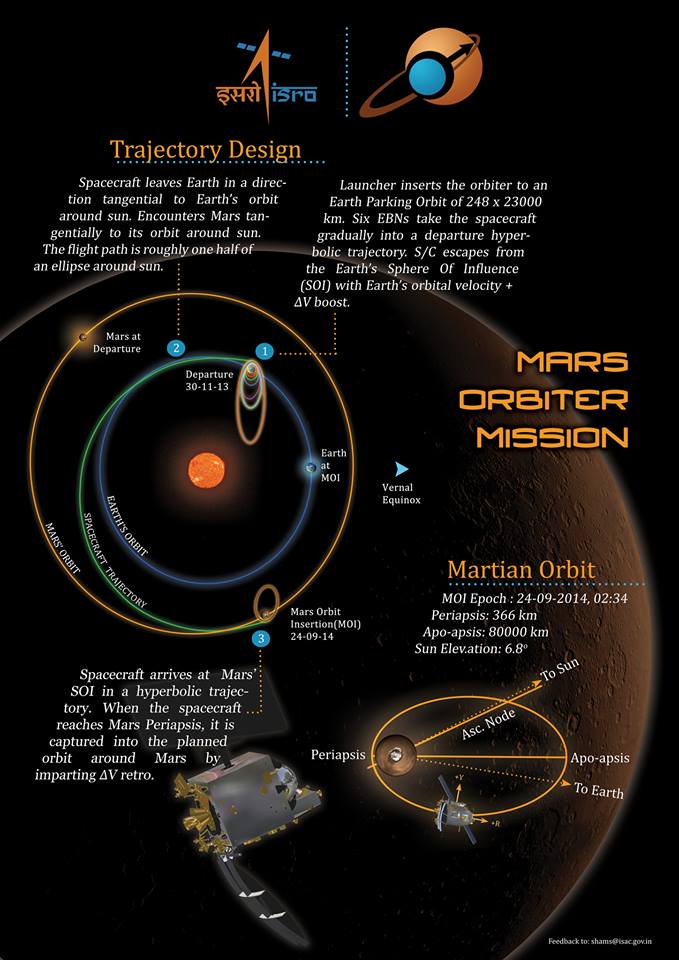
Source: AmericaSpace — India's Mars Mission Back On Track as Spacecraft Apogee Exceeds ... · www.americaspace.com
Trap: Confusing launch year (2013) with Mars arrival year (2014) — mission timeline spans both
Cost confusion: $74 million vs ₹450 crore — both figures are correct (exchange rate dependent)
First vs Only: India was first Asian and first to succeed on maiden attempt — not first globally to reach Mars
Mission status: Originally 6-month mission but operated for 7+ years until 2022
Indian Space Research Organisation (ISRO)
Science And Technology Indian Space Research Organization ISRO
Indian Space Research Organisation (ISRO): Structure, Achievements & Programs
Established 1969, headquartered in Bangalore
Under Department of Space, reports to Prime Minister
World's 4th space agency to reach Mars (after USA, Russia, Europe)
Known for cost-effective missions and commercial satellite launches
ISRO Mission Categories
# ISRO Missions
## Earth Observation
- INSAT series
- IRS series
- Cartosat
- RISAT
## Communication
- GSAT series
- INSAT
- Direct-to-Home TV
- Internet connectivity
## Navigation
- NAVIC/IRNSS
- GAGAN
- Regional coverage
- Strategic applications
## Space Exploration
- Chandrayaan (Moon)
- Mangalyaan (Mars)
- Aditya-L1 (Sun)
- Gaganyaan (Human)
## Launch Vehicles
- PSLV
- GSLV
- SSLV
- Commercial launches
Major ISRO Centers
Center | Location | Primary Function |
|---|---|---|
ISRO HQ | Bangalore | Overall coordination and management |
VSSC | Thiruvananthapuram | Launch vehicle development |
SDSC SHAR | Sriharikota | Launch operations |
SAC | Ahmedabad | Satellite applications |
ISITE | Bangalore | Satellite integration and testing |
MCF | Hassan | Master control facility for satellites |
Recent Major Achievements
Chandrayaan-3 (2023) — successful Moon landing near South Pole
104 satellites in single launch (2017) — world record using PSLV-C37
Aditya-L1 (2023) — India's first solar mission to study Sun
Commercial success — launched 400+ foreign satellites earning significant revenue
NAVIC constellation — India's own GPS system with 7 satellites
ISRO Infrastructure
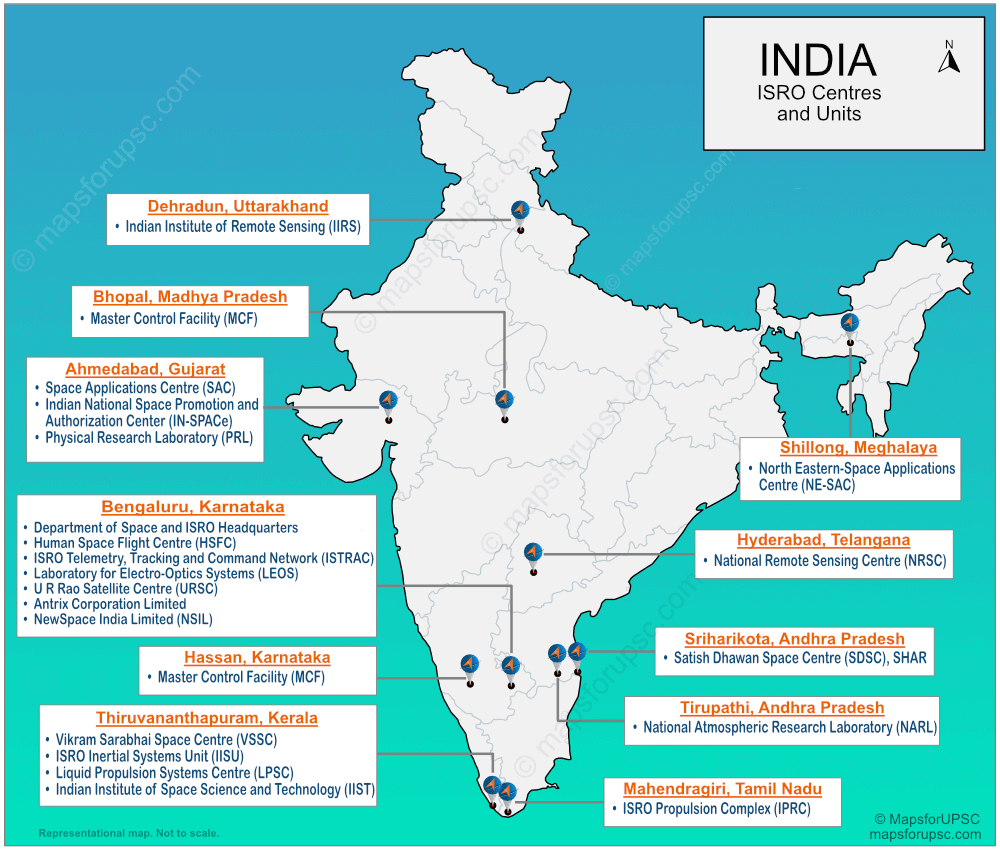
Source: MapsforUPSC — ISRO Centres in India: Map, Locations, Roles & Key Facts · mapsforupsc.com
Trap: Confusing ISRO with DRDO — ISRO is space, DRDO is defense research
Reporting confusion: ISRO reports to PM via Department of Space, not directly to President
Establishment year: 1969 (not 1972 when first satellite Aryabhata was launched)
HQ location: Bangalore (not where launches happen — that's Sriharikota)
Major Indian Research Institutions
Science And Technology Bhabha Atomic Research Centre Indian Institute of Science Tata Institute of Fundamental Research
Major Indian Research Institutions: BARC, IISc, TIFR Overview
BARC (1954) — India's premier nuclear research center under DAE
IISc (1909) — deemed university for advanced science and engineering research
TIFR (1945) — fundamental research in mathematics, physics, biology, computer science
All are autonomous institutions with distinct research mandates
Institution Comparison
Institution | Established | Location | Primary Focus | Parent Ministry/Dept |
|---|---|---|---|---|
BARC | 1954 | Mumbai | Nuclear research, reactors | Dept of Atomic Energy |
IISc | 1909 | Bangalore | Multi-disciplinary research & education | Ministry of Education |
TIFR | 1945 | Mumbai | Fundamental sciences research | Dept of Atomic Energy |
ISRO | 1969 | Bangalore | Space research & technology | Dept of Space |
Key Distinctions
BARC: Developed India's nuclear weapons program, operates research reactors, nuclear fuel cycle
IISc: India's top-ranked research university, produces maximum PhDs in science/engineering
TIFR: Pure research focus, no applied/commercial objectives, theoretical physics stronghold
All different from ISRO: None focus on space technology — ISRO's unique domain
Research Domains
# Indian Research Landscape
## Nuclear (BARC)
- Reactor technology
- Nuclear fuel
- Radioisotopes
- Safety research
## Multi-disciplinary (IISc)
- Engineering
- Physical sciences
- Biological sciences
- Management
## Fundamental (TIFR)
- Theoretical physics
- Mathematics
- Astronomy
- Computer science
## Space (ISRO)
- Satellite technology
- Launch vehicles
- Space exploration
- ApplicationsTrap: Assuming BARC won peace prize due to nuclear disarmament theme — it's a nuclear research center, not peace advocate
Confusion: IISc vs IIT — IISc is research-focused deemed university, IITs are engineering colleges
TIFR misconception: Despite 'Tata' name, it's government-funded under DAE, not private
Common error: All are prestigious but only ISRO had 2014 achievements worthy of international peace recognition