With reference to an organization known as 'BirdLife International', which of the following statements is/are correct? 1. It is a Global Partnership of Conservation Organizations. 2. The concept of 'biodiversity hotspots' originated from this organization. 3. It identifies the sites known/referred to as 'Important Bird and Biodiversity Areas'. Select the correct answer using the code given below.
Contents14
- A1 only
- B2 and 3 only
- C1 and 3 only
- D1, 2 and 3
Show answer
Answer: (C) 1 and 3 only
Statement 1 is CORRECT:
BirdLife International is the world's largest partnership of conservation organizations.
It operates as a global network with partner organizations in over 100 countries (like the Bombay Natural History Society/BNHS is BirdLife's partner in India, and the Royal Society for the Protection of Birds/RSPB is its partner in the UK).
Together, these partners work on bird conservation, habitat protection, and sustainable development.
Statement 2 is INCORRECT — this is the key trap:
The concept of 'biodiversity hotspots' did NOT originate from BirdLife International.
It was developed by the British biologist Norman Myers in 1988 in a landmark paper, and later refined by Conservation International (CI).
Myers identified areas with exceptionally high concentrations of endemic species that were also facing massive habitat loss.
Currently, 36 biodiversity hotspots are recognized globally, and India has 4 of them (Western Ghats, Himalayas, Indo-Burma, and Sundaland — Nicobar Islands).
Many students confuse BirdLife with this concept because both deal with biodiversity conservation.
Statement 3 is CORRECT:
BirdLife International identifies and designates IBAs (Important Bird and Biodiversity Areas) — specific sites that are critical for bird conservation and overall biodiversity.
There are over 13,000 IBAs worldwide.
This is BirdLife's signature contribution to global conservation — a site-based approach to identify priority areas.
Answer: 1 and 3 only.
Key distinction:
Biodiversity Hotspots = Norman Myers/Conservation International.
IBAs = BirdLife International.
BirdLife International operates through national partner organizations in over 100 countries, making it the world's largest conservation partnership network.
The biodiversity hotspots concept was created by Norman Myers in 1988 and refined by Conservation International, not BirdLife International - this is a common confusion since both work on biodiversity conservation.
BirdLife's signature contribution is the IBA (Important Bird and Biodiversity Areas) system with over 13,000 sites globally, while hotspots are a separate classification system.
BirdLife International
Environment BirdLife International
BirdLife International: Global Partnership & IBAs
World's largest partnership of conservation organizations with partners in 100+ countries
Identifies Important Bird and Biodiversity Areas (IBAs) - over 13,000 sites globally
Did NOT create the biodiversity hotspots concept - that was Norman Myers
BNHS is BirdLife's partner in India, RSPB in the UK
BirdLife International is the world's largest conservation partnership, operating through national partner organizations rather than direct country offices. This partnership model allows local expertise to drive conservation while maintaining global coordination.
BirdLife Partnership Model
Country | Partner Organization | Key Role |
|---|---|---|
India | Bombay Natural History Society (BNHS) | Bird conservation, research, habitat protection |
United Kingdom | Royal Society for Protection of Birds (RSPB) | Bird protection, policy advocacy |
USA | National Audubon Society | Bird conservation, education programs |
Australia | BirdLife Australia | Native bird species protection |
Core Functions
Identifies and designates Important Bird and Biodiversity Areas (IBAs) - critical sites for bird conservation
Maintains global database of 13,000+ IBAs across all continents
Conducts species assessments for IUCN Red List of threatened birds
Implements site-based conservation approach focusing on habitat protection
Coordinates flyway conservation for migratory bird species
Major Trap: BirdLife did NOT create biodiversity hotspots - that was Norman Myers in 1988
Don't confuse IBAs (BirdLife's concept) with biodiversity hotspots (Conservation International)
BirdLife is a partnership of organizations, not a single centralized NGO
BNHS is BirdLife's Indian partner - remember this India connection
Biodiversity Hotspots Concept
Environment biodiversity hotspots
Biodiversity Hotspots: Norman Myers' Conservation Framework
Concept developed by British biologist Norman Myers in 1988
Later refined by Conservation International (CI), not BirdLife International
Currently 36 biodiversity hotspots recognized globally
India has 4 hotspots: Western Ghats, Himalayas, Indo-Burma, Sundaland
Biodiversity hotspots are regions with exceptionally high concentrations of endemic species that face massive habitat loss. This concept revolutionized conservation by focusing limited resources on areas with maximum biodiversity under greatest threat.
Qualification Criteria
Must contain at least 1,500 endemic vascular plant species (0.5% of global total)
Must have lost 70% or more of original primary habitat
Covers only 2.4% of Earth's land surface but supports 36% of endemic species
Home to 43% of bird, mammal, reptile and amphibian species as endemics
India's Biodiversity Hotspots
Hotspot | Coverage in India | Key Endemic Species | Major Threats |
|---|---|---|---|
Western Ghats | Maharashtra to Kerala | Lion-tailed macaque, Nilgiri tahr | Deforestation, urbanization |
Himalayas | Entire Himalayan range | Snow leopard, red panda | Climate change, infrastructure |
Indo-Burma | Northeast India | Hoolock gibbon, Asian elephant | Jhum cultivation, logging |
Sundaland | Nicobar Islands only | Nicobar pigeon, crab-eating macaque | Tsunami damage, development |
Global Hotspots Distribution
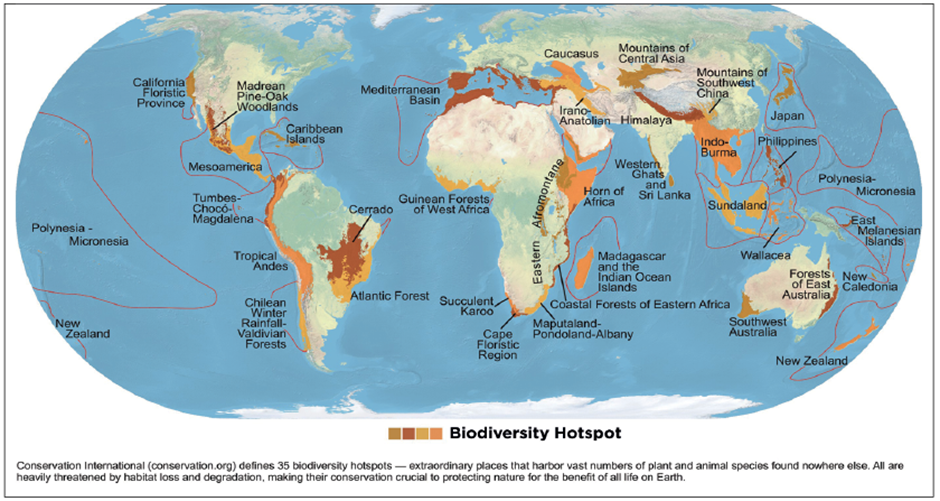
Source: Launchpad IAS — Biodiversity Hotspots · launchpadeducation.in
Key Trap: Hotspots concept = Norman Myers, NOT BirdLife International
Don't confuse with Endemic Bird Areas (EBAs) which ARE mapped by BirdLife
Conservation International now manages hotspot framework, not the original creator Myers
India has 4 hotspots, not 3 or 5 - Sundaland coverage is limited to Nicobar Islands only
Important Bird Areas (IBAs)
Environment Important Bird and Biodiversity Areas
Important Bird and Biodiversity Areas: BirdLife's Site Conservation
BirdLife International's signature conservation tool - identifies critical bird habitats
Over 13,000 IBAs identified worldwide across all continents
Sites critical for threatened species, endemic species, or large congregations
India has 465+ IBAs covering diverse ecosystems from Himalayas to coasts
Important Bird and Biodiversity Areas (IBAs) represent BirdLife International's site-based approach to conservation. Unlike broad landscape conservation, IBAs focus on specific locations that are critical for bird species survival and overall biodiversity.
IBA Identification Criteria
Threatened species: Sites holding significant populations of globally threatened birds
Endemic species: Areas supporting species with restricted ranges or biome-restricted assemblages
Congregatory species: Sites where large numbers of birds gather (breeding, roosting, migration)
Must meet specific population thresholds (typically 1% of global/flyway population)
Evaluated using standardized scientific criteria applied globally
IBA Categories & Examples
IBA Type | Criteria Focus | India Example | Key Species |
|---|---|---|---|
Threatened Species Sites | Globally threatened birds | Keoladeo National Park | Siberian Crane, Sarus Crane |
Endemic Areas | Restricted-range species | Western Ghats sites | Malabar Grey Hornbill, Nilgiri Flycatcher |
Migration Bottlenecks | Concentrated flyway routes | Chilika Lake | Bar-headed Goose, various shorebirds |
Breeding Colonies | Large congregations | Point Calimere | Flamingos, terns, plovers |
IBA Designation Process
%%{init: {"flowchart": {"wrappingWidth": 460}}}%%
flowchart TD
  s1["`**Site Identification**
BirdLife partners identify potential sites using global criteria`"]
  s2["`**Data Collection**
Detailed bird surveys, population counts, habitat assessment`"]
  s3["`**Criteria Application**
Apply standardized thresholds for threatened/endemic/congregatory species`"]
  s4["`**IBA Designation**
Site officially recognized in global IBA database`"]
  s5["`**Conservation Action**
Local partners implement protection and monitoring programs`"]
  s1 --> s2
  s2 --> s3
  s3 --> s4
s4 --> s5IBAs are identified by BirdLife International, not by government agencies
Don't confuse IBAs with Ramsar Sites (wetland focus) or UNESCO Biosphere Reserves
IBA designation doesn't automatically provide legal protection - that requires government action
465+ IBAs in India - managed through BNHS as BirdLife's partner
Conservation International
Environment
Conservation International: Biodiversity Hotspots Framework
American NGO that refined and now manages the biodiversity hotspots framework
Built upon Norman Myers' 1988 concept of biodiversity hotspots
Maintains current list of 36 recognized biodiversity hotspots globally
Focuses on ecosystem services and nature-based solutions for conservation
Conservation International (CI) is the organization that took Norman Myers' biodiversity hotspots concept and developed it into a comprehensive global conservation framework. Many students incorrectly associate hotspots with BirdLife International due to both organizations working on biodiversity.
CI's Hotspot Contributions
Refined criteria for hotspot designation beyond Myers' original framework
Secured major funding from donors like the MacArthur Foundation for hotspot conservation
Created comprehensive database of species and threats in each hotspot
Established Critical Ecosystem Partnership Fund (CEPF) for hotspot protection
Develops science-based strategies for priority area conservation
Conservation Framework Comparison
Organization | Conservation Tool | Focus | Global Count |
|---|---|---|---|
Conservation International | Biodiversity Hotspots | Endemic species + habitat loss | 36 hotspots |
BirdLife International | Important Bird Areas | Critical bird habitats | 13,000+ IBAs |
WWF | Global 200 Ecoregions | Representational biodiversity | 200 ecoregions |
UNESCO | Biosphere Reserves | Sustainable development model | 700+ reserves |
Biodiversity hotspots = Conservation International, NOT BirdLife International
Norman Myers created the concept, but CI refined and manages it now
Don't confuse CI's hotspots with BirdLife's Endemic Bird Areas (EBAs)
CI is American-based, while BirdLife International is UK-based partnership