Which of the following has/have been accorded 'Geographical Indication' status? 1. Banaras Brocades and Sarees 2. Rajasthani Daal-Bati-Churma 3. Tirupathi Laddu Select the correct answer using the code given below.
Contents14
- A1 only
- B2 and 3 only
- C1 and 3 only
- D1, 2 and 3
Show answer
Answer: (C) 1 and 3 only
A Geographical Indication (GI) tag is a sign used on products that have a specific geographical origin and possess qualities, reputation, or characteristics that are essentially attributable to that origin.
It is registered under the Geographical Indications of Goods (Registration and Protection) Act, 1999 in India.
Banaras Brocades and Sarees (Statement 1) — CORRECT.
The famous Banarasi silk sarees, known for their intricate gold and silver brocade/zari work, have been granted GI status.
They are uniquely associated with Varanasi (Banaras) and have centuries of weaving tradition.
Rajasthani Daal-Bati-Churma (Statement 2) — INCORRECT.
While Daal-Bati-Churma is a famous traditional dish from Rajasthan, it had NOT been accorded GI status at the time of this question.
GI tags are more commonly given to manufactured products, handicrafts, agricultural products, and foodstuffs with unique processing methods tied to a place.
A common home-cooked dish, while culturally significant, does not typically receive GI protection.
Tirupathi Laddu (Statement 3) — CORRECT.
The famous Tirupathi Laddu (the sweet prasadam offered at the Sri Venkateswara Temple in Tirumala, Andhra Pradesh) received GI tag in 2009.
The Tirumala Tirupati Devasthanams (TTD) holds this GI, and the laddu has a unique recipe and preparation method that is specific to the temple.
Answer: 1 and 3 only.
Key learning:
GI tags protect the reputation of products linked to a specific place.
Examples include Darjeeling Tea, Mysore Silk, Kanchipuram Silk, Alphonso Mango, Hyderabadi Haleem, and many more.
GI tags protect products with unique qualities tied to specific places, covering everything from textiles like Banarasi sarees to religious offerings like Tirupathi Laddu.
The question tests whether students can distinguish between products that actually received GI status versus culturally famous items that haven't been formally registered under the GI Act.
Geographical Indications (GI) Tags
Science And Technology Geographical Indication GI status
Geographical Indications: Legal Framework & UPSC Applications
GI tags protect products with specific geographical origin and unique qualities tied to that place
Governed by Geographical Indications Act, 1999 - India's implementation of WTO TRIPS Agreement
Famous examples: Darjeeling Tea (first GI in India), Banarasi Sarees, Tirupathi Laddu
Registration valid for 10 years, renewable indefinitely
What Qualifies for GI
Geographical Indications protect products whose quality, reputation, or characteristics are essentially linked to their place of origin. The product must have a demonstrable connection between its geographical location and its special qualities - whether due to natural factors (climate, soil) or human factors (traditional methods, skills).
GI Categories & Examples
Category | Requirements | Indian Examples | Key Feature |
|---|---|---|---|
Handicrafts | Traditional methods, local artisans | Banarasi Brocades, Kanchipuram Silk | Centuries-old weaving techniques |
Agricultural Products | Unique variety, climate-dependent | Darjeeling Tea, Alphonso Mango | Specific growing conditions |
Food Products | Traditional recipe, local preparation | Tirupathi Laddu, Hyderabadi Haleem | Temple-specific or region-specific recipes |
Natural Products | Unique natural occurrence | Kashmiri Saffron, Nagpur Orange | Soil and climate advantages |
Legal Framework
Registration Authority: Geographical Indications Registry, Chennai (under Controller General of Patents)
International Compliance: Implements Article 22-24 of WTO's TRIPS Agreement
Ownership: Can be held by associations, organizations, or government bodies (not individuals)
Protection Scope: Prevents unauthorized use of GI name on non-genuine products
Enforcement: Both civil and criminal remedies available for infringement
Question Analysis
This 2015 question tests knowledge of specific GI grants. Banarasi Sarees and Tirupathi Laddu had received GI status, but Rajasthani Daal-Bati-Churma had not. The trap lies in assuming all traditional regional foods automatically get GI protection - they need formal registration and must meet specific criteria.
Not all traditional products have GI status - UPSC tests specific grants, not assumptions
Common dishes vs registered products - Daal-Bati-Churma is famous but wasn't registered at question time
Temple products can get GI - Tirupathi Laddu shows religious offerings qualify if they meet criteria
Handicrafts dominate early GI grants - textile products like Banarasi items were among first to receive protection
Banarasi Brocades & Sarees
Art And Culture Banaras Brocades Sarees
Banarasi Textiles: GI Protection & Cultural Significance
Banarasi silk sarees have GI status - protected traditional weaving from Varanasi
Famous for gold and silver brocade work (zari) with intricate patterns
Centuries-old tradition - dates back to Mughal period influence
Unique Characteristics
Banarasi sarees are distinguished by their metallic thread work (zari) using real gold and silver threads. The intricate brocade patterns include Mughal-inspired motifs like kalga, bel, and floral designs. The weaving process is entirely handloom-based and can take weeks to months depending on complexity.
GI Significance
Geographical Link: Unique to Varanasi weavers using traditional pit looms
Quality Standards: Specific silk quality, thread count, and zari purity requirements
Cultural Heritage: Represents continuity of Mughal textile traditions in modern India
Economic Impact: Protects livelihood of thousands of traditional weavers
Market Protection: Prevents fake 'Banarasi' sarees from other regions
Tirupathi Laddu GI Status
Art And Culture Tirupathi Laddu
Tirupathi Laddu: First Temple Food with GI Protection
Tirupathi Laddu received GI tag in 2009 - first temple prasadam to get protection
Owned by Tirumala Tirupati Devasthanams (TTD) - temple administration body
Unique recipe and preparation method specific to Sri Venkateswara Temple, Tirumala
Unique Features
The Tirupathi Laddu has a centuries-old recipe using specific ingredients like Bengal gram flour, sugar, ghee, and cardamom in precise proportions. The preparation follows traditional temple methods in dedicated kitchens within the temple complex, making it geographically and culturally unique to Tirumala.
GI Protection Details
Legal Ownership: TTD holds exclusive rights to produce and distribute authentic Tirupathi Laddu
Quality Control: Strict adherence to traditional recipe and temple preparation standards
Religious Significance: Offered as prasadam to devotees visiting Sri Venkateswara Temple
Commercial Impact: Prevents unauthorized commercial production using 'Tirupathi' name
Cultural Preservation: Maintains sanctity and authenticity of temple offering traditions
Famous Indian GI Products
Science And Technology
Major Indian GI Products: State-wise Distribution & UPSC Relevance
Darjeeling Tea was India's first GI product (2004) - protected from imitation
Karnataka leads with most GI registrations, followed by Tamil Nadu and Kerala
Categories include textiles, food, agriculture, handicrafts - each state has unique strengths
State-wise Famous GI Products
State | Textiles | Food/Agriculture | Handicrafts | Total GI Count |
|---|---|---|---|---|
Karnataka | Mysore Silk, Ilkal Sarees | Coorg Orange, Byadgi Chilli | Channapatna Toys, Bidri Work | 47+ |
Tamil Nadu | Kanchipuram Silk | Nilgiri Tea, Madurai Malli | Tanjore Paintings, Bronze Icons | 32+ |
West Bengal | Baluchari Sarees, Dhaniakhali Sarees | Darjeeling Tea, Fazli Mango | Shola Crafts | 19+ |
Kerala | Kasavu Sarees | Malabar Pepper, Pokkali Rice | Aranmula Mirrors, Nettur Petti | 18+ |
Uttar Pradesh | Banarasi Sarees, Chikankari | Allahabad Surkha, Malihabad Mango | Firozabad Glass, Moradabad Metal | 12+ |
GI Distribution Map
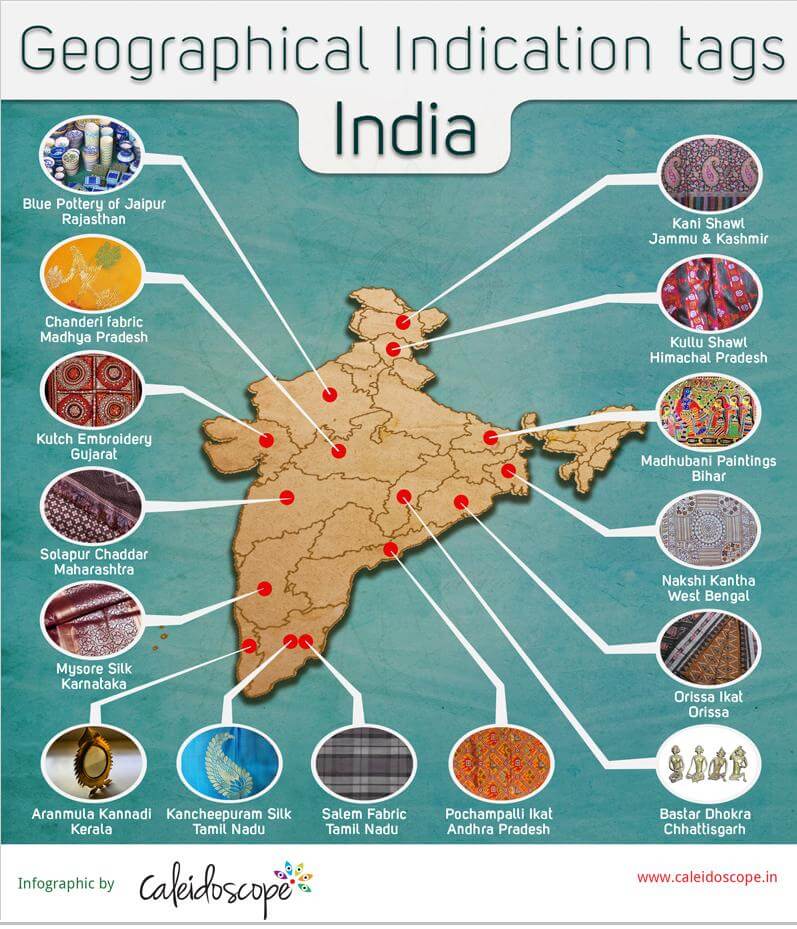
Source: ClearIAS — Geographical Indication (GI) Tags in India: Memorize Faster - ClearIAS · www.clearias.com
Darjeeling Tea vs Assam Tea - only Darjeeling has GI status, Assam tea doesn't (common confusion)
Mysore vs Kanchipuram Silk - both have separate GI status, don't assume one covers the other
Recent grants may not appear in older questions - UPSC tests products that had GI status at question time
Food products need specific preparation methods - not all regional dishes qualify automatically