What is/are the importance/ importances of the ‘United Convention to Combat Desertification’? 1. It aims to promote effective action through innovative national programmes and supportive international partnerships 2. It has a special/particular focus on South Asia and North Africa regions, and its Secretariat facilitates the allocation of major portion of financial resources to these regions. 3. It is committed to bottom-up approach, encouraging the participation of local people in combating the desertification. Select the correct answer using the code given below.
Contents17
- A1 only
- B2 and 3 only
- C1 and 3 only
- D1, 2 and 3
Show answer
Answer: (C) 1 and 3 only
Answer: (c) 1 and 3 only
Statement 1 (✓ CORRECT):
UNCCD promotes effective action through innovative national programmes and supportive international partnerships.
Established after the 1992 Rio Earth Summit, it is the sole legally binding agreement linking environment and development to sustainable land management.
Statement 2 (✗ WRONG):
UNCCD does NOT have a special focus on South Asia and North Africa with major funding allocation to these regions.
It addresses ALL arid, semi-arid, and dry sub-humid areas globally.
Statement 3 (✓ CORRECT):
UNCCD is committed to bottom-up approach, encouraging local people's participation in combating desertification.
Key UNCCD facts:
- Established 1994
- 197 parties
- Focuses on drylands globally
- India is a signatory
- Secretariat in Bonn, Germany.
UNCCD is the only legally binding international agreement that directly links environment and development to sustainable land management in dryland areas.
The convention covers all global drylands, not specific regions, making statement 2's claim about South Asia and North Africa focus incorrect.
UNCCD's bottom-up approach with local participation distinguishes it from top-down environmental frameworks, which UPSC tests to check understanding of participatory governance in environmental policy.
UNCCD Framework & Key Objectives
Environment United Convention to Combat Desertification innovative national programmes international partnerships
United Nations Convention to Combat Desertification: Framework & Objectives
UNCCD is the sole legally binding international agreement linking environment and development to sustainable land management
Established in 1994 after Rio Earth Summit, with 197 parties including India
Focuses on innovative national programmes and international partnerships
Secretariat located in Bonn, Germany
Genesis & Mandate
UNCCD emerged from the 1992 Rio Earth Summit as the world's response to land degradation in drylands. Unlike other environmental conventions, it uniquely links environmental protection with sustainable development and poverty alleviation.
Core Objectives
Combat desertification and mitigate effects of drought in arid, semi-arid, and dry sub-humid areas
Promote innovative national action programmes tailored to local conditions
Foster supportive international partnerships for technology and knowledge transfer
Link land management with poverty reduction and sustainable development
Build capacity for drought preparedness and early warning systems
Question Connection
Statement 1 correctly captures UNCCD's dual approach: national innovation and international cooperation. Statement 3 reflects its participatory philosophy, while Statement 2 creates a false regional limitation.
Trap: UNCCD does NOT focus specifically on South Asia and North Africa — it covers all drylands globally
Confusion: Don't mix UNCCD with regional programmes that may have geographic priorities
Memory aid: UNCCD = Universal coverage, National programmes, Community participation, Dryland focus
UNCCD Geographic Scope & Regional Coverage
Environment South Asia North Africa financial resources
UNCCD Geographic Coverage: Global Scope vs Regional Misconceptions
UNCCD covers ALL arid, semi-arid, and dry sub-humid areas globally — not specific regions
No special funding allocation to South Asia and North Africa under UNCCD
Affects over 1.5 billion people across 100+ countries worldwide
Global Dryland Distribution
Region | Affected Countries | Key Characteristics | UNCCD Priority |
|---|---|---|---|
Africa | Sahel, Horn of Africa, Southern Africa | Severe desertification, drought cycles | Equal priority with others |
Asia | Central Asia, Middle East, Parts of India/China | Water scarcity, land degradation | Equal priority with others |
Americas | Western USA, Northern Mexico, Parts of Brazil | Agricultural land loss, urbanization pressure | Equal priority with others |
Europe | Mediterranean countries, Eastern Europe | Soil erosion, climate change impacts | Equal priority with others |
Funding Mechanism
UNCCD operates through the Global Mechanism housed at IFAD, Rome. Funding is needs-based and capacity-dependent, not regionally predetermined. The Global Environment Facility (GEF) provides financial support based on project merit, not geographic quotas.
Global Drylands Map
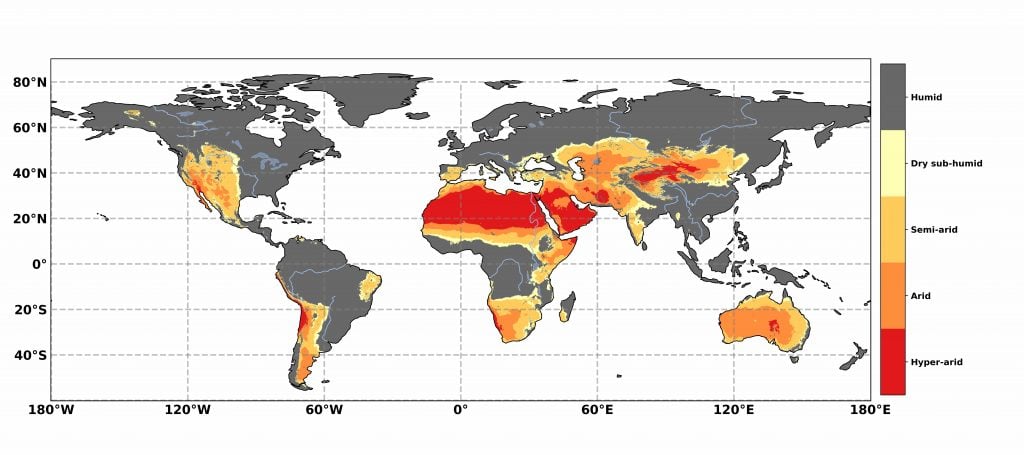
Source: www.ipcc.ch — Figure 3.1 — Special Report on Climate Change and Land · www.ipcc.ch
Major Trap: Statement 2 falsely claims regional focus and funding preference — UNCCD is universal
Confusion: While South Asia and North Africa ARE severely affected, UNCCD doesn't prioritize them over other regions
Red flag: Any statement claiming UNCCD has geographic funding bias is likely incorrect
UNCCD Bottom-Up Approach & Community Participation
Environment bottom-up approach local people combating desertification
UNCCD's Bottom-Up Philosophy: Community Participation in Land Management
UNCCD mandates bottom-up approach with local community participation as core principle
Recognizes traditional knowledge and local practices in sustainable land management
National Action Programmes must involve affected populations in planning and implementation
Participatory Mandate
UNCCD uniquely mandates that affected populations must participate in identifying, planning, and implementing measures to combat desertification. This bottom-up approach recognizes that local communities are both the most affected by land degradation and the best positioned to implement sustainable solutions.
Bottom-Up Implementation Process
%%{init: {"flowchart": {"wrappingWidth": 460}}}%%
flowchart TD
  s1["`****Community Identification****
Local communities identify land degradation problems and priorities`"]
  s2["`****Traditional Knowledge Integration****
Incorporate indigenous practices and local ecological knowledge`"]
  s3["`****Participatory Planning****
Communities co-design National Action Programmes (NAPs)`"]
  s4["`****Local Implementation****
Community-led projects with technical and financial support`"]
  s5["`****Monitoring & Feedback****
Local monitoring systems feed back into planning cycle`"]
  s1 --> s2
  s2 --> s3
  s3 --> s4
  s4 --> s5
Key Participatory Elements
National Action Programmes (NAPs) must be developed through consultative processes with local communities
Traditional ecological knowledge is recognized as valuable for sustainable land management
Women's participation is specifically emphasized given their role in natural resource management
Civil society organizations are formal partners in UNCCD implementation
Capacity building focuses on strengthening local institutions and knowledge systems
India's Implementation
India's National Action Programme involves Panchayati Raj Institutions, Joint Forest Management Committees, and Self Help Groups in watershed management and afforestation. The MGNREGA scheme aligns with UNCCD's bottom-up approach through community-based natural resource management works.
Correct Pattern: UNCCD emphasizes local participation — this is a defining feature
Remember: Bottom-up approach distinguishes UNCCD from top-down environmental policies
UPSC loves: Questions testing whether students know UNCCD's participatory philosophy
Major Global Environmental Conventions
Environment
Major Global Environmental Conventions: UNCCD in Context
Three Rio Conventions: UNFCCC (climate), CBD (biodiversity), UNCCD (desertification)
All emerged from 1992 Rio Earth Summit — the landmark environmental conference
Each has legally binding obligations with Conference of Parties (COP) meetings
Rio Convention Comparison
Convention | Focus Area | Established | Key Features | Secretariat Location |
|---|---|---|---|---|
UNFCCC | Climate Change | 1992 | Kyoto Protocol, Paris Agreement | Bonn, Germany |
CBD | Biodiversity Conservation | 1992 | Nagoya Protocol, Aichi Targets | Montreal, Canada |
UNCCD | Desertification & Land Degradation | 1994 | Bottom-up approach, NAPs | Bonn, Germany |
Other Key Environmental Treaties
Montreal Protocol (1987) — Ozone layer protection, most successful environmental treaty
CITES (1973) — Trade in endangered species, controls wildlife trafficking
Ramsar Convention (1971) — Wetlands conservation, oldest global environmental accord
Basel Convention (1989) — Hazardous waste movement control
Stockholm Convention (2001) — Persistent Organic Pollutants (POPs) elimination
India's Participation
India is party to all major environmental conventions and hosts Conference of Parties meetings regularly. India's National Biodiversity Authority, National Action Plan on Climate Change, and National Action Programme on desertification implement these treaty obligations domestically.
Don't confuse: UNCCD Secretariat is in Bonn (same as UNFCCC), not Montreal or Geneva
Timeline trap: UNCCD came after Rio 1992 — established in 1994, entered force in 1996
Scope confusion: Each Rio Convention has distinct mandate — don't mix their objectives