With reference to the cultural history of India, the term 'Panchayatan' refers to
Contents13
- Aan assembly of village elders
- Ba religious sect
- Ca style of temple construction
- Dan administrative functionary
Show answer
Answer: (C) a style of temple construction
Panchayatana is a style of Hindu temple construction where one main shrine (dedicated to the principal deity) is surrounded by four smaller subsidiary shrines at the four corners.
The word literally means 'group of five.'
It's like a quincunx pattern (one in the centre, four at corners).
This style is found in many North Indian Nagara-style temples.
Famous examples:
- Kandariya Mahadeva Temple (Khajuraho)
- Lakshmana Temple (Khajuraho)
- Dashavatara Temple (Deogarh).
Don't confuse with:
(a) Panchayat (village council),
(b) any religious sect, or
(d) any administrative post.
The '-tan' suffix relates to a structural arrangement, not governance.
(Ref: NCERT + CCRT website)
Panchayatana temples have one main shrine surrounded by four smaller shrines at the corners, creating a group of five structures that defines this architectural style.
UPSC uses the term 'Panchayatan' (without the final 'a') to test if students can distinguish temple architecture terminology from similar-sounding governance terms like Panchayat.
This tests knowledge of Nagara style temple construction patterns, specifically the quincunx arrangement seen in famous Khajuraho temples.
Panchayatan Temple Architecture
Art And Culture Panchayatan style of temple construction
Panchayatan Style: Five-Shrine Temple Layout
Panchayatan = five-shrine temple layout with one central shrine + four corner shrines
Word means 'group of five' - forms a quincunx pattern
Central shrine houses principal deity, corner shrines have subsidiary deities
Found in North Indian Nagara-style temples
Panchayatan is a distinctive Hindu temple construction style where architecture follows a sacred geometric pattern. The central shrine dominates while four smaller shrines create spiritual harmony through symmetrical placement.
Panchayatan Layout Structure
Component | Location | Purpose | Deity Type |
|---|---|---|---|
Main Shrine | Center | Primary worship | Principal deity |
Four Subsidiary Shrines | Four corners | Secondary worship | Associated deities/forms |
Courtyard | Between shrines | Circumambulation | Ritual space |
Famous Panchayatan Examples
Kandariya Mahadeva Temple at Khajuraho - classic Panchayatan with Shiva as central deity
Lakshmana Temple at Khajuraho - dedicated to Vishnu with four corner shrines
Dashavatara Temple at Deogarh - early example from Gupta period
Panchayatan Layout Pattern
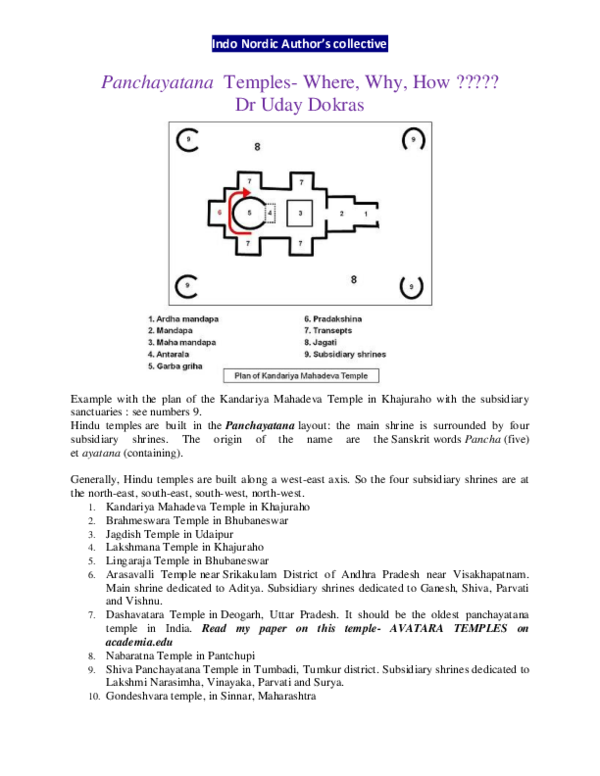
Source: Academia.edu — PDF) Panchayatana style of Temples · www.academia.edu
Question Context
This question tests knowledge of specific architectural terminology versus administrative/social terms. The '-tan' suffix indicates structural arrangement, distinguishing it from Panchayat (governance).
Trap: Confusing Panchayatan (temple style) with Panchayat (village council) due to similar spelling
Trap: Associating 'Pancha-' prefix only with administrative systems, missing architectural context
Trap: Thinking it's a religious sect because temples are religious structures
Nagara Style Temple Architecture
Art And Culture Nagara North Indian
Nagara Style: North Indian Temple Architecture
Nagara style = North Indian Hindu temple architecture with curvilinear shikhara
Characterized by beehive-shaped tower (shikhara) over main sanctum
No enclosing walls around temple complex
Found from Himalayas to Vindhyas
Nagara architecture represents the northern tradition of Hindu temple building, distinct from Dravidian (South) and Vesara (Deccan) styles. The curvilinear shikhara rising above the sanctum is its defining feature.
Three Major Temple Styles
Style | Region | Key Feature | Tower Type | Example |
|---|---|---|---|---|
Nagara | North India | Curvilinear shikhara | Beehive-shaped | Khajuraho temples |
Dravidian | South India | Pyramidal vimana | Step-pyramid | Brihadeeswarar Temple |
Vesara | Deccan | Mixed features | Hybrid | Hoysala temples |
Nagara Style Characteristics
Shikhara: Curvilinear tower with amalaka (circular stone disc) at top
No boundary walls: Temple stands free without enclosing compound walls
Garbhagriha: Square sanctum sanctorum housing main deity
Mandapa: Pillared hall for congregational worship
Elaborate sculptures: Rich carving on exterior walls
Nagara Temple Features
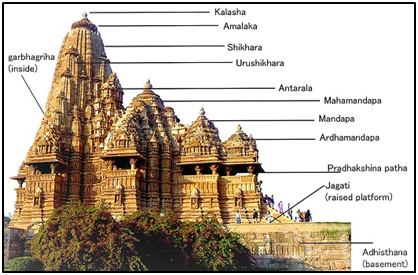
Source: Launchpad IAS — Hindu Temple Architecture of India · launchpadeducation.in
Trap: Confusing Nagara (North) with Dravidian (South) architectural features
Trap: Mixing up shikhara (Nagara tower) with vimana (Dravidian tower)
Trap: Forgetting that Panchayatan layout is specifically found in Nagara style temples
Khajuraho Temples
Art And Culture Khajuraho Kandariya Mahadeva Temple Lakshmana Temple
Khajuraho: Peak of Nagara Architecture
Built by Chandela dynasty (10th-11th centuries) in Madhya Pradesh
UNESCO World Heritage Site with 25 surviving temples out of original 85
Best examples of Panchayatan layout in Nagara style
Famous for erotic sculptures alongside religious and secular themes
Khajuraho temples represent the zenith of Nagara architecture under Chandela patronage. These temples demonstrate perfect Panchayatan planning with exquisite sculptural artistry covering religious, secular, and erotic themes.
Major Khajuraho Temples
Temple | Deity | Period | Key Feature | Layout |
|---|---|---|---|---|
Kandariya Mahadeva | Shiva | 1030 CE | Tallest shikhara (31m) | Panchayatan |
Lakshmana Temple | Vishnu | 954 CE | Best preserved | Panchayatan |
Jagadambi Temple | Parvati | 1000 CE | Erotic sculptures | Standard |
Chitragupta Temple | Surya | 1000 CE | Sun god images | Standard |
Khajuraho Sculptural Themes
Religious: Gods, goddesses, celestial beings, mythological stories
Secular: Musicians, dancers, daily life activities, royal processions
Erotic: Intimate couples representing tantric philosophy and celebration of life
Decorative: Floral patterns, geometric designs, animal motifs
Khajuraho Temple Complex
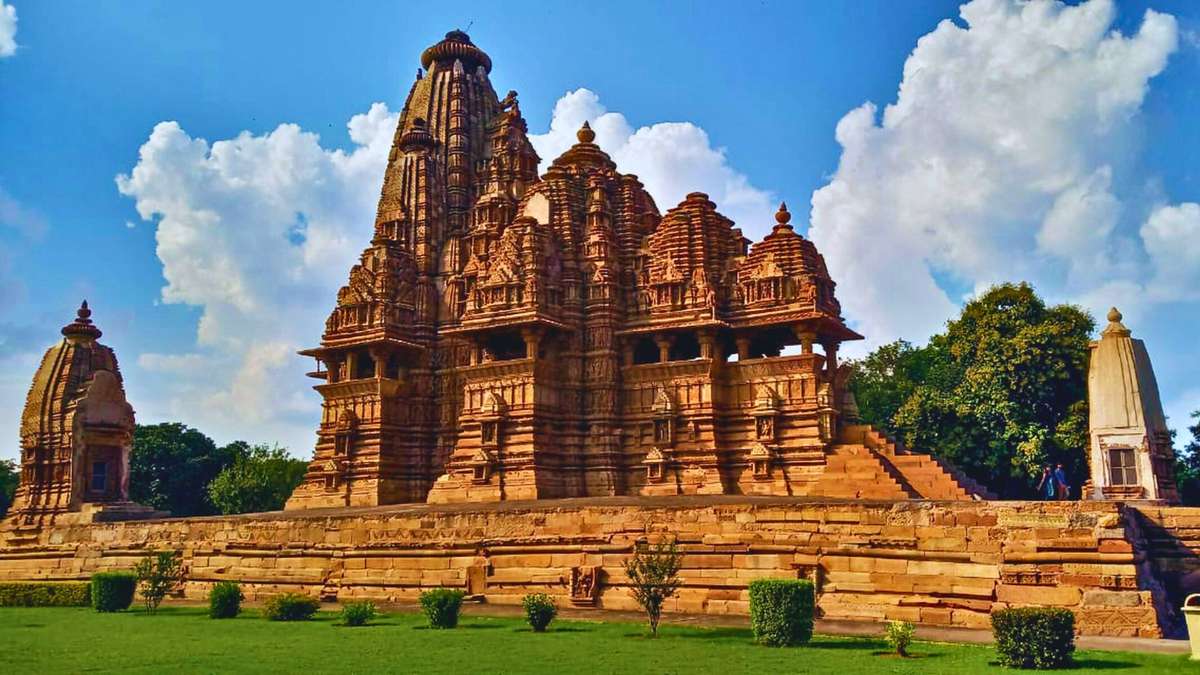
Source: Travel and Leisure Asia — Khajuraho: Exploring India's Remarkable UNESCO Heritage Temples · www.travelandleisureasia.com
Trap: Confusing Chandela dynasty (Khajuraho) with other medieval dynasties
Trap: Associating erotic sculptures only with Khajuraho - they appear in other medieval temples too
Trap: Thinking all Khajuraho temples follow Panchayatan layout - only major ones do