With reference to the art and archaeological history of India, which one among the following was made earliest?
Contents15
- ALingaraja Temple at Bhubaneswar
- BRock-cut Elephant at Dhauli
- CRock-cut Monuments Mahabalipuram
- DVaraha Image at Udayagiri
Show answer
Answer: (B) Rock-cut Elephant at Dhauli
To answer this, you need to know the approximate dates of each artwork:
(b) Rock-cut Elephant at Dhauli — 3rd century BCE (Mauryan period, around 260 BCE).
Dhauli, near Bhubaneswar in Odisha, is famous for Emperor Ashoka's rock edicts.
The rock-cut elephant carved at the top of the rock is one of the earliest examples of Indian rock-cut sculpture, dating to the Mauryan era.
This is the EARLIEST among all options by a wide margin.
(d) Varaha Image at Udayagiri — 5th century CE (Gupta period).
The Udayagiri caves near Vidisha in Madhya Pradesh contain a massive rock-cut panel of Varaha (boar incarnation of Vishnu) rescuing the earth goddess, created during the reign of Chandragupta II.
(c) Rock-cut Monuments at Mahabalipuram — 7th century CE (Pallava period).
These famous shore temples, rathas, and relief sculptures were built under Pallava kings Mahendravarman I and Narasimhavarman I (Mamalla).
(a) Lingaraja Temple at Bhubaneswar — 11th century CE (around 1000 CE).
It is the largest and most magnificent temple in Bhubaneswar, built in the Kalinga style of architecture.
So the chronological order is:
- Dhauli (3rd c. BCE)
- Udayagiri (5th c. CE)
- Mahabalipuram (7th c. CE)
- Lingaraja (11th c. CE).
Answer: Rock-cut Elephant at Dhauli.
Tip: For such questions, mentally place each artwork in its dynasty/period — Maurya, Gupta, Pallava, Medieval — and the timeline becomes clear.
The Rock-cut Elephant at Dhauli dates to the 3rd century BCE Mauryan period, making it approximately 800 years older than the next earliest artwork among the options.
UPSC is testing chronological knowledge across major Indian dynasties - students must place artworks within the Mauryan, Gupta, Pallava, and Medieval periods to solve such questions.
The question spans nearly 1400 years of Indian art history, requiring students to distinguish between early rock-cut traditions and later temple architecture.
Rock-cut Elephant at Dhauli
Art And Culture Rock-cut Elephant Dhauli
Rock-cut Elephant at Dhauli: Mauryan Art Pioneer
3rd century BCE - earliest among all major Indian rock-cut sculptures
Located at Dhauli, Odisha near Bhubaneswar
Associated with Emperor Ashoka's rock edicts
Represents Mauryan period artistic achievement
The rock-cut elephant at Dhauli marks the beginning of India's rock-cut sculpture tradition. Carved during Emperor Ashoka's reign (around 260 BCE), it sits atop the rock containing his famous edicts and represents the earliest example of large-scale rock carving in Indian art history.
Key Features
Front portion only carved - elephant emerges from living rock
Massive scale - demonstrates advanced Mauryan stone-carving techniques
Strategic location - positioned above Ashoka's rock edicts at Dhauli
Symbolic significance - elephant represents Buddha and royal power
Artistic innovation - pioneered rock-cut sculpture tradition in India
Dhauli Rock-cut Elephant

Source: Sarson ke Khet — Dhauli | Sarson ke Khet · sarsonkekhet.in
Trap: Don't confuse Dhauli with other Ashoka sites like Sanchi or Sarnath
Trap: 3rd century BCE makes it much older than Gupta, Pallava, or Medieval monuments
Trap: Located in Odisha, not Andhra Pradesh where other rock edicts exist
Varaha Image at Udayagiri
Art And Culture Varaha Image Udayagiri
Varaha Image at Udayagiri: Gupta Masterpiece
5th century CE - created during Gupta period
Located at Udayagiri caves, Madhya Pradesh near Vidisha
Depicts Varaha (boar incarnation) rescuing earth goddess
Commissioned during Chandragupta II's reign
The Varaha panel at Udayagiri represents the pinnacle of Gupta sculpture (5th century CE). This massive rock-cut relief shows Vishnu's boar incarnation lifting the earth goddess from cosmic waters, symbolizing the rescue of the world from chaos.
Artistic Significance
Largest relief sculpture in Gupta period - measures about 22 feet wide
Intricate detailing - shows divine figures, sages, and celestial beings
Religious narrative - depicts cosmic rescue by Varaha avatar
Royal patronage - likely commissioned by Chandragupta II
Cave 5 location - part of larger Udayagiri cave complex
Varaha Relief Sculpture
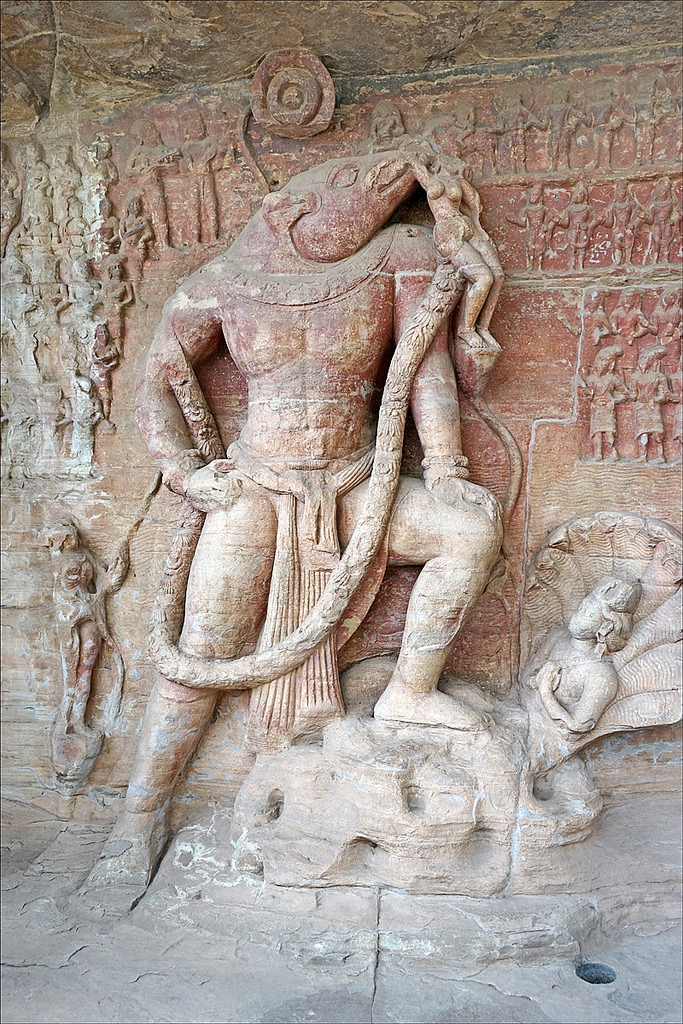
Source: World History Encyclopedia — Vishnu as Varaha, Udayagiri Caves - World History Encyclopedia · www.worldhistory.org
Trap: Udayagiri in MP, not the Udayagiri in Odisha near Bhubaneswar
Trap: 5th century CE makes it Gupta period, not Mauryan
Trap: Varaha is boar incarnation, not elephant or lion avatar
Rock-cut Monuments at Mahabalipuram
Art And Culture Rock-cut Monuments Mahabalipuram
Mahabalipuram Monuments: Pallava Architectural Marvel
7th century CE - created during Pallava dynasty
Located in Tamil Nadu along the coast
Includes rathas, caves, and shore temple
Built under Narasimhavarman I (Mamalla)
UNESCO World Heritage Site since 1984
Mahabalipuram showcases the architectural genius of the Pallava dynasty in the 7th century CE. Built primarily under Narasimhavarman I (Mamalla), these monuments represent the transition from rock-cut to structural temple architecture in South India.
Major Monuments
Monument Type | Examples | Key Features | Significance |
|---|---|---|---|
Rathas | Five Rathas (Pancha Rathas) | Monolithic, different architectural styles | Experimental temple forms |
Cave Temples | Varaha Cave, Krishna Cave | Pillared halls with sculptures | Narrative reliefs |
Relief Sculptures | Arjuna's Penance | World's largest bas-relief | Epic storytelling in stone |
Structural Temple | Shore Temple | Granite blocks, twin towers | Early structural temple |
Mahabalipuram Complex
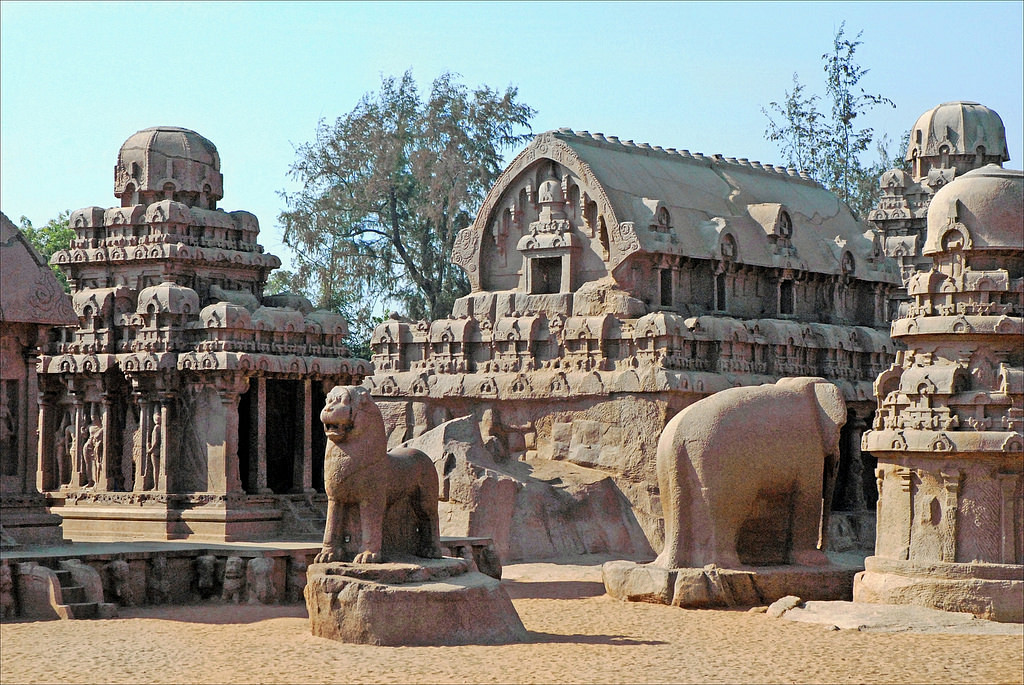
Source: World History Encyclopedia — Mahabalipuram - World History Encyclopedia · www.worldhistory.org
Trap: 7th century CE makes it Pallava period, not earlier Gupta or later Chola
Trap: Narasimhavarman I also called Mamalla - hence Mamallapuram
Trap: Mix of rock-cut and structural - not purely one type
Lingaraja Temple at Bhubaneswar
Art And Culture Lingaraja Temple Bhubaneswar
Lingaraja Temple: Kalinga Architecture Pinnacle
11th century CE - built around 1000 CE
Located in Bhubaneswar, Odisha
Kalinga style architecture with deula design
Dedicated to Lord Shiva as Harihara
Largest temple in Bhubaneswar complex
The Lingaraja Temple represents the pinnacle of Kalinga architecture in 11th century CE. Built during the Somavamsi dynasty, it showcases the mature deula style with its towering spire and intricate sculptural decoration, making it the largest and most magnificent temple in the Bhubaneswar complex.
Architectural Features
180 feet tall main tower (deula) - dominates Bhubaneswar skyline
Four-part structure - vimana, jagamohana, natamandira, bhogamandapa
Intricate sculptures - covers entire surface with religious and secular themes
Kalinga style - characteristic curvilinear tower with horizontal ridges
Sandstone construction - local Kalinga builders' expertise
Lingaraja Temple Architecture
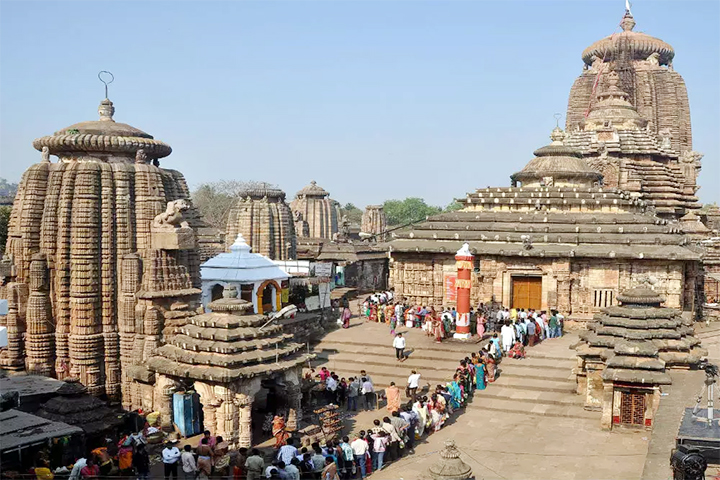
Source: Drishti IAS — Lingaraja Temple · www.drishtiias.com
Trap: 11th century CE makes it the latest among all options
Trap: Bhubaneswar also has ancient sites like Dhauli - don't mix the periods
Trap: Kalinga style is specific to Odisha, different from Dravidian or Nagara
Indian Art Chronology: Major Periods
Art And Culture
Indian Art Chronology: Mauryan to Medieval
Mauryan (3rd century BCE) - earliest rock-cut sculptures
Gupta (4th-6th century CE) - classical sculpture peak
Pallava (6th-8th century CE) - South Indian temple art
Medieval (10th-12th century CE) - regional temple styles
Understanding chronological sequence is crucial for UPSC art history questions. Each period brought distinct artistic innovations - from Mauryan rock-cutting to Gupta classical refinement to regional medieval styles.
Major Art Periods Timeline
Period | Timeline | Key Features | Examples from Question |
|---|---|---|---|
Mauryan | 3rd century BCE | Rock edicts, early sculpture | Dhauli Elephant (260 BCE) |
Gupta | 4th-6th century CE | Classical refinement, cave art | Udayagiri Varaha (5th c. CE) |
Pallava | 6th-8th century CE | South Indian rathas, reliefs | Mahabalipuram (7th c. CE) |
Medieval Regional | 10th-12th century CE | Mature temple styles | Lingaraja Temple (11th c. CE) |
Artistic Evolution
%%{init: {"flowchart": {"wrappingWidth": 460}}}%%
flowchart TD
  s1["`**Mauryan Innovation**
**Rock-cutting technique** pioneered - Dhauli elephant`"]
  s2["`**Gupta Refinement**
**Classical forms** perfected - Udayagiri cave sculptures`"]
  s3["`**Pallava Experimentation**
**Structural transition** - Mahabalipuram rathas to temples`"]
  s4["`**Medieval Maturation**
**Regional styles** established - Kalinga, Dravidian, Nagara`"]
  s1 --> s2
  s2 --> s3
s3 --> s4Trap: BCE vs CE - Mauryan is centuries before Christ, others are after
Trap: Gap of 800 years between Mauryan (3rd c. BCE) and Gupta (5th c. CE)
Trap: Regional medieval styles (10th-12th c. CE) are latest in timeline