What is/are common to the two historical places known as Ajanta and Mahabalipuram? 1. Both were built in the same period. 2. Both belong to the same religious denomination. 3. Both have rock-cut monuments. Select the correct answer using the code given below.
Contents22
- A1 and 2 only
- B3 only
- C1 and 3 only
- DNone of the statements given above is correct
Show answer
Answer: (B) 3 only
Answer: (b) 3 only
The only thing common between Ajanta and Mahabalipuram is that both have rock-cut monuments.
Statement 1 — Built in the same period (✗ INCORRECT)
Ajanta caves were built over several centuries, mainly during the Satavahana period (2nd century BCE) and the Vakataka period (5th-6th century CE).
Mahabalipuram monuments were built primarily during the Pallava dynasty period (7th-8th century CE).
So they were NOT built in the same period.
Statement 2 — Same religious denomination (✗ INCORRECT)
Ajanta caves are BUDDHIST monuments (they contain Buddhist paintings and sculptures).
Mahabalipuram monuments are predominantly HINDU (dedicated to Shiva and Vishnu, with some Jain elements).
They belong to DIFFERENT religious traditions.
Statement 3 — Rock-cut monuments (✓ CORRECT)
Both Ajanta and Mahabalipuram have rock-cut monuments:
- Ajanta — 30 rock-cut Buddhist caves carved into a cliff face
- Mahabalipuram — has rock-cut rathas (monolithic temples), cave temples, and the famous bas-relief 'Arjuna's Penance'
Both sites are UNESCO World Heritage Sites and represent remarkable achievements in Indian rock-cut architecture.
Only statement 3 is correct. The answer is (b) "3 only".
Both Ajanta and Mahabalipuram are UNESCO World Heritage Sites representing India's rock-cut architectural traditions across different periods and religions.
UPSC uses these two famous sites to test whether students can distinguish between Buddhist and Hindu monuments, and between different historical periods in Indian art.
The question tests precise knowledge of architectural techniques, religious contexts, and chronological periods rather than just recognition of famous monuments.
Ajanta Caves
Art And Culture Ajanta
Ajanta Caves: Buddhist Rock-Cut Monuments & Timeline
30 rock-cut Buddhist caves carved into horseshoe-shaped cliff in Maharashtra
Built in two phases: 2nd century BCE (Satavahana) and 5th-6th century CE (Vakataka)
Famous for Buddhist paintings and sculptures depicting Jataka tales
UNESCO World Heritage Site since 1983
Historical Context
Ajanta represents the pinnacle of Buddhist rock-cut architecture in India. The caves were carved over several centuries by Buddhist monks as viharas (monasteries) and chaityas (prayer halls).
Construction Timeline
Period | Dynasty | Caves Built | Key Features |
|---|---|---|---|
2nd century BCE | Satavahana | Caves 9, 10, 12, 13, 15A | Hinayana Buddhism, simple chaityas |
5th-6th century CE | Vakataka | Caves 1-8, 11, 14-29 | Mahayana Buddhism, elaborate paintings |
Artistic Significance
Paintings depict Jataka tales, Buddha's life, and Bodhisattva figures using natural pigments
Cave 1 contains famous paintings of Bodhisattva Padmapani and dying princess
Cave 26 has the magnificent reclining Buddha sculpture
Represents transition from Hinayana to Mahayana Buddhism in Indian art
Cave Layout
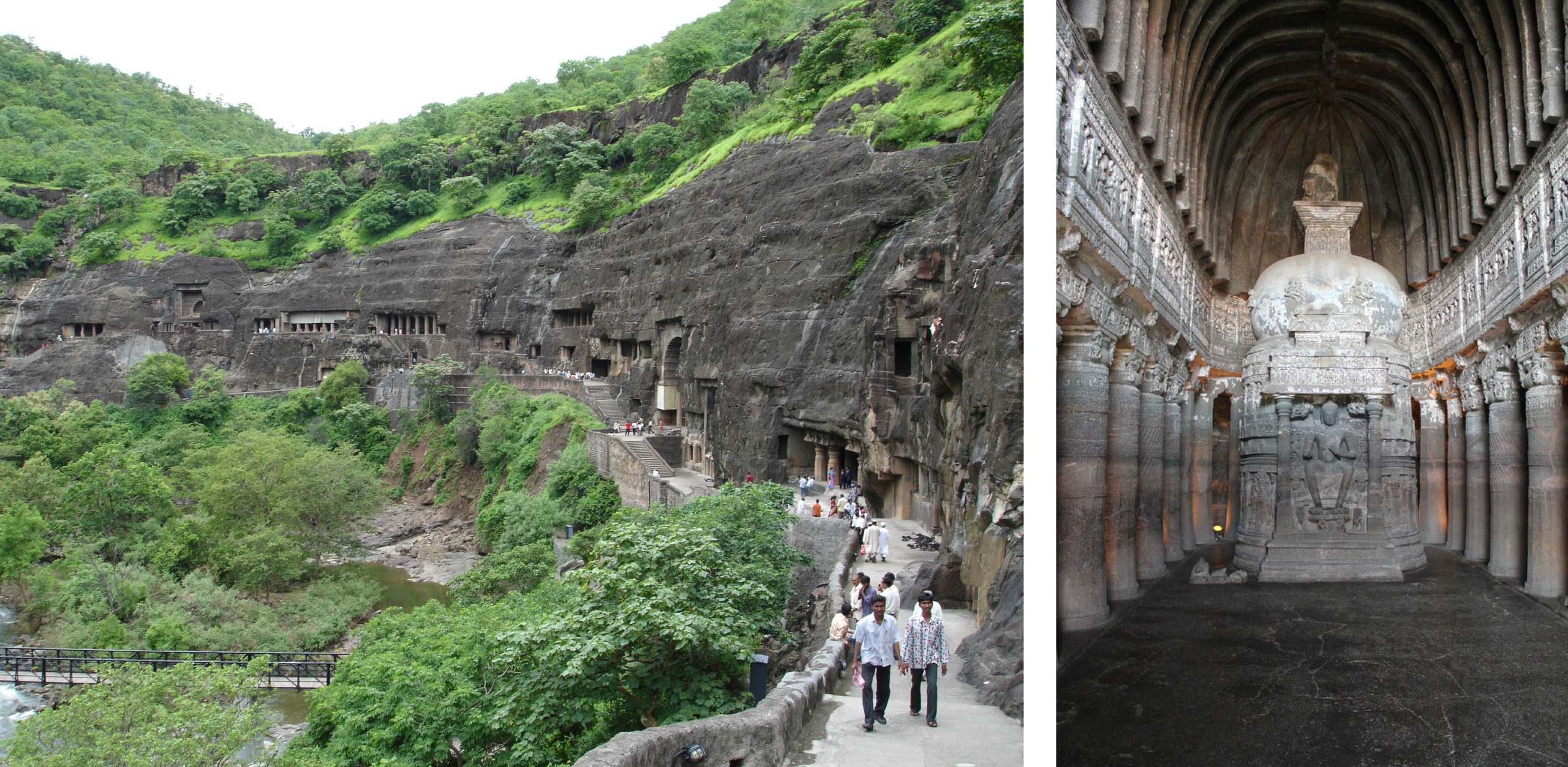
Source: Smarthistory — Smarthistory – The Caves of Ajanta · smarthistory.org
Mahabalipuram Monuments
Art And Culture Mahabalipuram
Mahabalipuram: Pallava Rock-Cut & Structural Temples
Built during 7th-8th century CE under Pallava dynasty rule
Predominantly Hindu monuments dedicated to Shiva and Vishnu
Features rock-cut rathas, cave temples, and bas-reliefs
UNESCO World Heritage Site since 1984, located in Tamil Nadu
Pallava Innovation
Mahabalipuram showcases the Pallava dynasty's architectural genius, combining rock-cut and structural temple styles. It served as a major port city and represents early Dravidian temple architecture.
Major Monument Types
Type | Examples | Deity | Key Feature |
|---|---|---|---|
Rock-cut Rathas | Pancha Rathas (5 chariots) | Various Hindu deities | Monolithic temples carved from single rocks |
Cave Temples | Varaha Cave, Krishna Cave | Vishnu, Krishna | Rock-cut chambers with sculptures |
Bas-relief | Arjuna's Penance/Descent of Ganga | Shiva | World's largest bas-relief (27m x 9m) |
Structural Temple | Shore Temple | Shiva, Vishnu | Granite blocks, faces the sea |
Architectural Significance
Pancha Rathas represent different Dravidian temple styles in monolithic form
Shore Temple is one of India's oldest structural stone temples (8th century CE)
Influenced later Chola and Vijayanagara temple architecture
Combines rock-cut and structural temple techniques in one site
Pancha Rathas
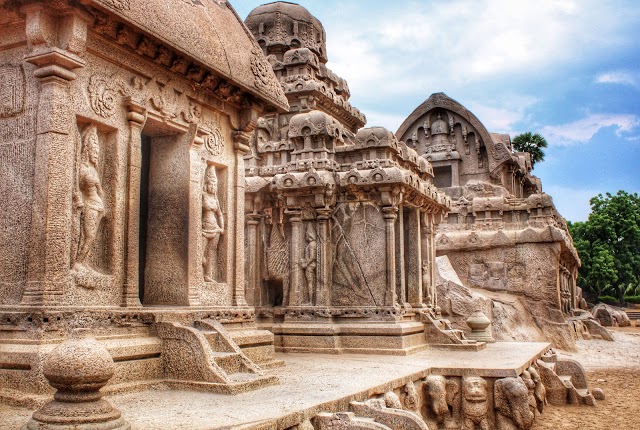)
Source: MakeMyTrip — Pancha Rathas | Mahabalipuram - What to Expect | Timings | Tips ... · www.makemytrip.com
Rock-Cut Architecture in India
Art And Culture rock-cut monuments
Rock-Cut Architecture: Techniques & Major Sites in India
Architecture carved directly into living rock faces or excavated from solid rock
Flourished from 2nd century BCE to 10th century CE across different religions
Major sites include Ajanta, Ellora, Elephanta, Mahabalipuram, Badami
Definition & Techniques
Rock-cut architecture involves carving temples, monasteries, and sculptures directly into natural rock formations. Two main techniques:
Excavation: Carving inward into cliff faces (Ajanta, Ellora caves)
Monolithic carving: Sculpting freestanding structures from single rock outcrops (Mahabalipuram rathas, Kailash temple)
Major Rock-Cut Sites by Religion
Site | Period | Religion | Key Features |
|---|---|---|---|
Ajanta | 2nd century BCE - 6th century CE | Buddhist | 30 caves, paintings, Jataka tales |
Ellora | 6th-10th century CE | Buddhist, Hindu, Jain | 34 caves, Kailash temple |
Elephanta | 5th-8th century CE | Hindu | Shiva caves, Trimurti sculpture |
Mahabalipuram | 7th-8th century CE | Hindu | Rathas, Shore temple, bas-reliefs |
Badami | 6th-8th century CE | Hindu, Jain | Chalukya cave temples |
Evolution Across Dynasties
# Rock-Cut Architecture
## Early Period (2nd century BCE)
- Satavahana
- Simple Hinayana caves
- Ajanta Caves 9, 10
## Classical Period (5th-6th century CE)
- Vakataka
- Mahayana Buddhism
- Elaborate paintings
- Ajanta golden age
## Hindu Renaissance (6th-8th century CE)
- Chalukya (Badami)
- Pallava (Mahabalipuram)
- Rashtrakuta (Ellora Kailash)Ajanta vs Ellora: Ajanta is purely Buddhist, Ellora has all three religions (Buddhist, Hindu, Jain)
Mahabalipuram vs Hampi: Mahabalipuram is Pallava (7th-8th century), Hampi is Vijayanagara (14th-16th century)
Rock-cut vs Cave: All rock-cut architecture involves caves, but not all caves are rock-cut (some are natural)
Buddhist vs Hindu Architecture
Art And Culture
Buddhist vs Hindu Architecture: Key Distinctions for UPSC
Buddhist: Viharas (monasteries), Chaityas (prayer halls), Stupas
Hindu: Temples with garbhagriha, mandapa, shikhara/vimana
Ajanta = Buddhist, Mahabalipuram = Hindu — different religious traditions
Architectural Elements Comparison
Aspect | Buddhist Architecture | Hindu Architecture |
|---|---|---|
Primary Structures | Viharas (monasteries), Chaityas (prayer halls) | Temples with garbhagriha (sanctum) |
Sacred Symbol | Stupa (Buddha relics) | Linga/Murti (deity image) |
Layout | Rectangular halls, horseshoe arches | Square sanctum, axial progression |
Iconography | Buddha, Bodhisattvas, Jataka tales | Hindu deities (Shiva, Vishnu, Devi) |
Period of Peak | 2nd century BCE - 8th century CE | 6th century CE onwards |
Famous Examples | Ajanta, Sanchi, Nalanda | Mahabalipuram, Khajuraho, Konark |
Question Context
Ajanta caves are exclusively Buddhist — contain Buddha images, Bodhisattva paintings, and Jataka stories
Mahabalipuram is predominantly Hindu — dedicated to Shiva and Vishnu with typical Hindu iconography
This religious difference makes Statement 2 incorrect in the PYQ — they belong to different denominations
Only commonality is rock-cut technique used at both sites, making Statement 3 the only correct answer
Trap: Assuming all ancient cave sites are Buddhist — many later caves like Elephanta and Badami are Hindu
Trap: Confusing Ellora (multi-religious) with Ajanta (purely Buddhist)
Trap: Thinking same technique = same period — rock-cutting was used across 8 centuries by different dynasties
Pallava Dynasty & Architecture
Art And Culture
Pallava Dynasty: Pioneers of Dravidian Temple Architecture
Ruled South India (4th-9th century CE) with capital at Kanchipuram
Pioneers of Dravidian temple architecture — influenced Chola and later dynasties
Mahabalipuram represents their architectural peak in 7th-8th century CE
Historical Context
The Pallava dynasty transformed South Indian architecture by developing the distinctive Dravidian style. Their port city Mahabalipuram facilitated cultural exchange with Southeast Asia.
Pallava Architectural Evolution
Phase | Period | Style | Key Examples |
|---|---|---|---|
Early Pallava | 4th-6th century CE | Rock-cut caves | Mandagapattu cave (earliest) |
Middle Pallava | 7th century CE | Monolithic rathas | Mahabalipuram Pancha Rathas |
Late Pallava | 8th-9th century CE | Structural temples | Shore Temple, Kailasanatha Temple |
Architectural Innovations
Vimana (tower over sanctum) and mandapa (hall) became standard Dravidian elements
Experimentation phase at Mahabalipuram — testing different architectural forms
Shore Temple represents transition to fully developed structural temple architecture
Influenced Chola temple architecture at Thanjavur and Gangaikonda Cholapuram
Pallava Territory
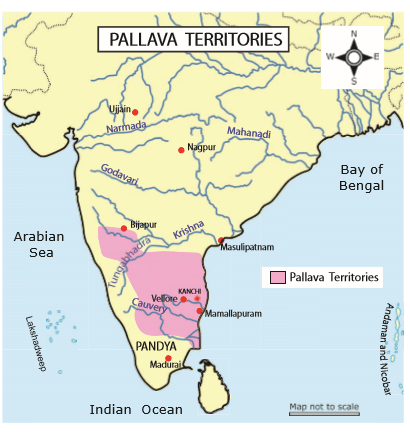
Source: Eduindex — South Indian Kingdom – Eduindex · eduindex.org