With reference to the Indian history of art and culture, consider the following pairs:
Contents20
With reference to the Indian history of art and culture, consider the following pairs:
| Famous work of sculpture | Site | |
|---|---|---|
| 1. | A grand image of Buddha's Mahaparinirvana with numerous celestial musicians above and the sorrowful figures of his followers below | Ajanta |
| 2. | A huge image of Varaha Avatar (boar incarnation) of Vishnu, as he rescues Goddess Earth from the deep and chaotic waters, sculpted on rock | Mount Abu |
| 3. | "Arjuna's Penance" / "Descent of Ganga" sculpted on the surface of huge boulders | Mamallapuram |
Which of the pairs given above is/are correctly matched?
- A1 and 2 only
- B3 only
- C1 and 3 only
- D1, 2 and 3
Show answer
Answer: (C) 1 and 3 only
Pair 1 — CORRECT: The grand Mahaparinirvana sculpture of Buddha (reclining Buddha with mourning disciples below and celestial musicians above) is in Cave 26 at Ajanta, Maharashtra.
Pair 2 — WRONG: The massive Varaha (boar incarnation) relief showing Vishnu rescuing Goddess Earth is at Udayagiri Caves near Vidisha (Madhya Pradesh), NOT Mount Abu.
Mount Abu is famous for Dilwara Jain temples. This is the key trap in this question.
Pair 3 — CORRECT: 'Arjuna's Penance' / 'Descent of Ganga' is a giant open-air rock relief at Mamallapuram (Mahabalipuram), Tamil Nadu — one of India's most iconic sculptures.
(Ref: A.L. Basham, pp.373-374)
These three sculptures represent the peak of Indian rock-cut art across different periods - Ajanta's Buddhist caves (5th-6th century), Udayagiri's Gupta reliefs (5th century), and Mamallapuram's Pallava monuments (7th-8th century).
The trap is placing the famous Varaha relief at Mount Abu instead of Udayagiri - students often confuse Rajasthan's Mount Abu (known for Dilwara Jain temples) with Madhya Pradesh's Udayagiri Caves where the actual Gupta-era Varaha sculpture exists.
UPSC tests precise site-sculpture matching to check if students can distinguish between major sculptural traditions and their correct geographical locations across India.
Ajanta Caves & Buddhist Sculptures
Art And Culture Ajanta Buddha's Mahaparinirvana celestial musicians
Ajanta Caves: Buddhist Art Masterpieces & UPSC Focus Areas
30 rock-cut caves in Maharashtra dating from 2nd century BCE to 6th century CE
Cave 26 contains the famous Mahaparinirvana sculpture of reclining Buddha
Divided into Chaityas (prayer halls) and Viharas (monasteries)
UNESCO World Heritage Site since 1983
What Makes Ajanta Special
Ajanta represents the pinnacle of Buddhist rock-cut architecture in India. These caves showcase the evolution of Buddhist art from the Hinayana (early caves) to Mahayana (later caves) traditions, with exquisite paintings and sculptures that influenced Indian art for centuries.
Key Ajanta Caves
Cave | Type | Period | Famous For |
|---|---|---|---|
Cave 1 | Vihara | 5th-6th century CE | Bodhisattva Padmapani paintings |
Cave 2 | Vihara | 5th-6th century CE | Jataka tales on ceiling |
Cave 9 | Chaitya | 2nd century BCE | Oldest chaitya hall |
Cave 19 | Chaitya | 5th century CE | Elaborate facade sculpture |
Cave 26 | Chaitya | 5th century CE | Mahaparinirvana sculpture (from the question) |
The Mahaparinirvana Scene
Cave 26 houses the magnificent reclining Buddha sculpture showing his final moments. The composition includes:
Celestial musicians above celebrating his liberation
Mourning disciples below showing human grief
Perfect artistic balance between divine joy and earthly sorrow
Ajanta Cave 26
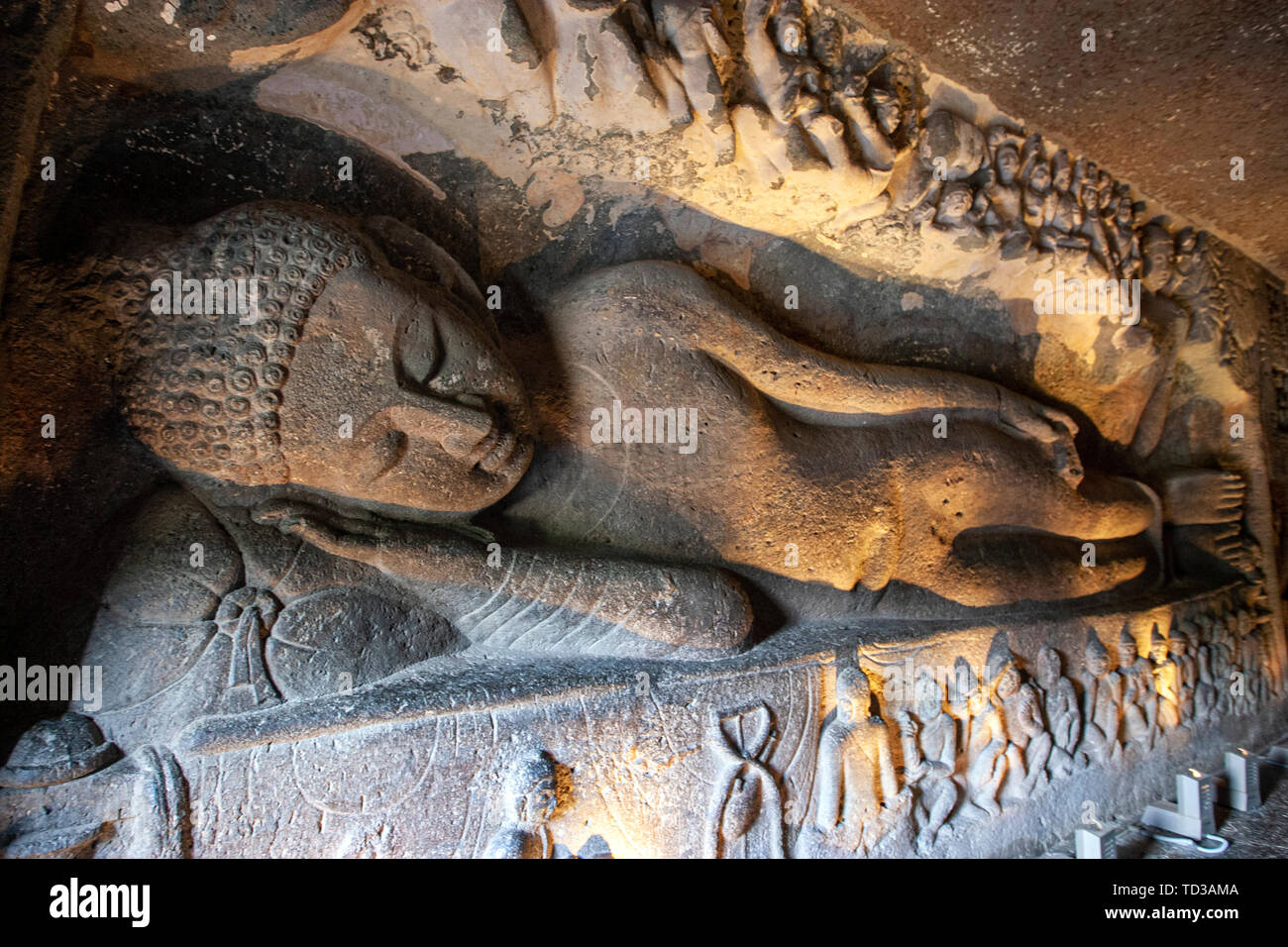
Source: Alamy — Mahaparinirvana of Buddha (reclining Buddha) on the wall of Cave ... · www.alamy.com
Location confusion: Ajanta is in Maharashtra, not Madhya Pradesh (that's Udayagiri)
Cave mix-up: Cave 26 has Mahaparinirvana, Cave 1 has Bodhisattva Padmapani paintings
Art period: Ajanta spans Hinayana and Mahayana periods, not just one tradition
Udayagiri Caves & Varaha Relief
Art And Culture Varaha Avatar Mount Abu
Udayagiri Caves: Gupta Hindu Art & The Great Varaha Relief
Udayagiri Caves near Vidisha, Madhya Pradesh — NOT Mount Abu
Cave 5 contains the massive Varaha relief (4th-5th century CE)
Represents Gupta period Hindu art at its finest
Shows Vishnu's boar incarnation rescuing Earth goddess Bhudevi
The Question's Trap
The question deliberately places Varaha relief at Mount Abu to test your knowledge. Mount Abu is famous for Dilwara Jain temples (11th-13th centuries), not Gupta Hindu sculptures. The actual Varaha relief is at Udayagiri, Madhya Pradesh.
Location Comparison
Site | State | Famous For | Period | Religion |
|---|---|---|---|---|
Udayagiri | Madhya Pradesh | Varaha relief, Gupta sculptures | 4th-5th century CE | Hindu |
Mount Abu | Rajasthan | Dilwara temples, marble architecture | 11th-13th century CE | Jain |
The Varaha Relief Story
Cave 5's Varaha panel shows Vishnu in his third avatar as a cosmic boar. The sculpture depicts him lifting Bhudevi (Earth goddess) from the primordial waters while sages and gods watch. This represents the cosmic rescue of Earth from chaos — a central Hindu creation myth.
Udayagiri Significance
# Udayagiri Caves
## Location
- Near Vidisha
- Madhya Pradesh
- Gupta heartland
## Art Style
- Classic Gupta
- High relief
- Hindu iconography
## Key Sculptures
- Varaha relief (Cave 5)
- Vishnu sculptures
- Durga panels
## Historical Context
- 4th-5th century CE
- Chandragupta II period
- Hindu revivalTrap from question: Varaha relief is at Udayagiri (MP), NOT Mount Abu (Rajasthan)
Temple confusion: Mount Abu = Jain Dilwara temples, Udayagiri = Hindu Gupta sculptures
Avatar order: Varaha is 3rd avatar of Vishnu, not 2nd (that's Kurma)
Mamallapuram Stone Sculptures
Art And Culture Arjuna's Penance Descent of Ganga Mamallapuram
Mamallapuram: Pallava Rock Art & The Great Relief
Mamallapuram (Mahabalipuram), Tamil Nadu — 7th century Pallava creation
Arjuna's Penance/Descent of Ganga — world's largest open-air rock relief
Carved on two giant granite boulders measuring 27m x 9m
UNESCO World Heritage Site showcasing Dravidian art
What Is This Sculpture
The Great Relief at Mamallapuram is carved on massive granite boulders and depicts either Arjuna's penance (from Mahabharata) or the Descent of Ganga (river's descent from heaven). Both interpretations are valid, showing the sculpture's rich mythological complexity.
Mamallapuram Monument Types
Monument | Style | Example | Significance |
|---|---|---|---|
Rathas | Monolithic temples | Pancha Rathas | 5 different Dravidian styles |
Open-air relief | Rock carving | Arjuna's Penance | World's largest rock relief |
Cave temples | Rock-cut | Varaha Cave | Early Pallava architecture |
Shore temple | Structural | Shore Temple | Earliest stone temple in South |
The Relief's Composition
The sculpture shows hundreds of figures including:
Central cleft representing the Ganges
Arjuna (or sage Bhagiratha) in penance posture
Animals, gods, and celestial beings witnessing the event
Elephants prominently featured in naturalistic poses
Nagas (serpents) in the central cleft representing water
The Great Relief
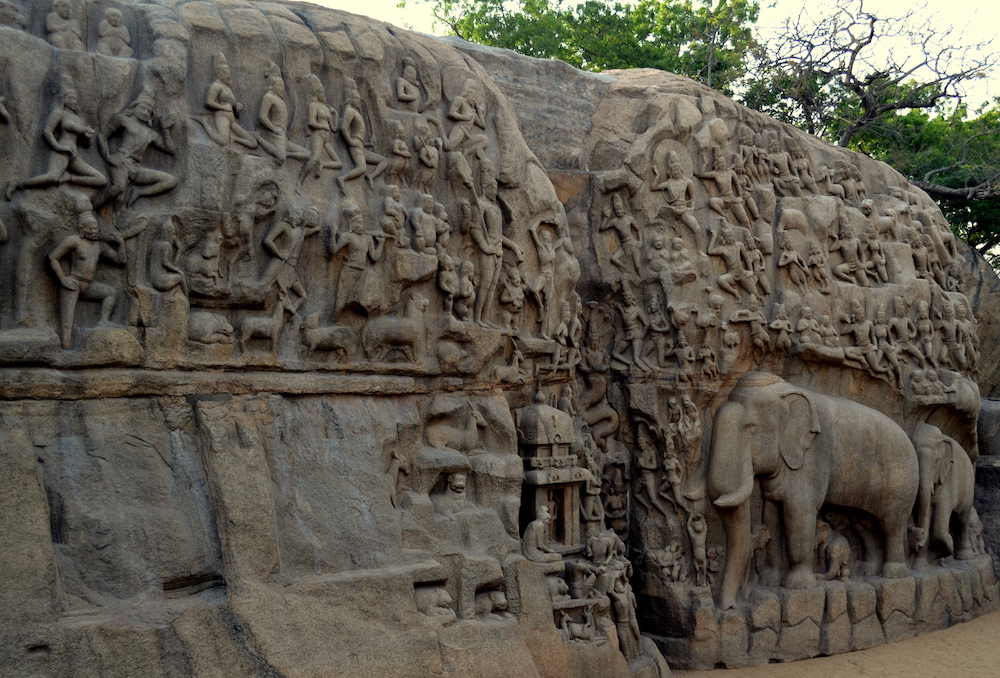
Source: Smarthistory — Smarthistory – The Great Relief at Mamallapuram · smarthistory.org
Pallava Art Legacy
# Mamallapuram
## Period & Dynasty
- 7th century CE
- Pallava rulers
- Narasimhavarman I
## Architectural Innovation
- Monolithic rathas
- Rock-cut caves
- Open-air reliefs
- Structural temples
## Artistic Features
- Dravidian style
- Narrative sculpture
- Animal motifs
- Mythological themes
## Influence
- South Indian temple art
- Chola architecture
- Southeast Asian artName variants: Mamallapuram = Mahabalipuram (same place, both names used)
Relief interpretation: Called both Arjuna's Penance AND Descent of Ganga — both accepted
Dynasty confusion: Mamallapuram = Pallava (7th century), not Chola or Pandya
Mount Abu Dilwara Temples
Art And Culture Mount Abu
Mount Abu Dilwara Temples: Jain Marble Architecture
Mount Abu, Rajasthan — famous for Dilwara Jain temples, NOT Hindu sculptures
Built between 11th-13th centuries during Solanki dynasty
White marble architecture with intricate carvings
5 temples dedicated to different Jain Tirthankaras
Why This Matters for UPSC
Mount Abu appears in the question as a deliberate trap. Students often confuse it with places having ancient Hindu sculptures. Mount Abu is exclusively known for medieval Jain temples, not Gupta-period Hindu art like the Varaha relief.
Major Dilwara Temples
Temple | Built By | Period | Dedicated To |
|---|---|---|---|
Vimal Vasahi | Vimal Shah | 1031 CE | 1st Tirthankara Adinatha |
Luna Vasahi | Tejpal & Vastupal | 1230 CE | 22nd Tirthankara Neminatha |
Pittalhar | - | 14th century | 1st Tirthankara Adinatha |
Parshvanatha | - | 15th century | 23rd Tirthankara Parshvanatha |
Mahavir Swami | - | 15th century | 24th Tirthankara Mahavira |
Architectural Excellence
Dilwara temples represent the pinnacle of Jain marble architecture. The intricate ceiling carvings, delicate pillars, and detailed sculptures showcase the sophisticated craftsmanship of medieval Indian artisans. The Vimal Vasahi and Luna Vasahi are considered the finest examples.
Religion trap: Mount Abu = Jain temples, NOT Hindu sculptures or Buddhist caves
Period trap: Dilwara temples = 11th-13th century, NOT ancient Gupta period
Sculpture trap: No Varaha relief at Mount Abu — that's at Udayagiri, MP