The Nagara, the Dravida and the Vesara are the
Contents13
- Athree main racial groups of the Indian subcontinent.
- Bthee main linguistic divisions into which the languages of India can be classified.
- CThree main styles of Indian temple architecture.
- DThree main musical Gharanas prevalent in India.
Show answer
Answer: (C) Three main styles of Indian temple architecture.
Nagara, Dravida, and Vesara are the three main styles of Indian temple architecture.
Nagara style — found in North India, characterized by a curvilinear tower (shikhara) over the sanctum.
Dravida style — found in South India, characterized by a pyramid-shaped tower (vimana).
Vesara style — a hybrid of Nagara and Dravida, found mainly in the Deccan region (Karnataka).
The other options are distractors — these terms have nothing to do with racial groups, languages, or music.
Source: NCERT Ancient India.
Nagara, Dravida, and Vesara are the three fundamental architectural styles that define all major Hindu temple construction across India.
The question tests whether students can distinguish architectural terminology from similar-sounding classifications in anthropology, linguistics, and music - a common UPSC trap.
Nagara Style Temple Architecture
Art And Culture Nagara
Nagara Style: North Indian Temple Architecture Features
Nagara style is the North Indian temple architecture with curvilinear shikhara
Found primarily in regions north of the Vindhyas
Main tower called shikhara rises above the sanctum (garbhagriha)
Examples: Khajuraho temples, Konark Sun Temple
Nagara style dominates North Indian temple architecture, characterized by its distinctive curvilinear shikhara that curves inward as it rises above the sanctum.
Key Features
Curvilinear shikhara - the main tower curves inward, unlike the straight-sided Dravida vimana
Single tower design - typically one main shikhara over the sanctum
Cruciform base - temples often built on a cross-shaped ground plan
Elaborate sculptures - extensive carved decoration on exterior walls
Mandapa halls - pillared halls leading to the sanctum
Famous Nagara Temples
Temple | Location | Period | Notable Feature |
|---|---|---|---|
Khajuraho Group | Madhya Pradesh | 10th-11th century CE | Erotic sculptures, multiple shikharas |
Konark Sun Temple | Odisha | 13th century CE | Chariot-shaped design |
Lingaraja Temple | Bhubaneswar | 11th century CE | Deula style shikhara |
Jagannath Temple | Puri | 12th century CE | Four main structures |
Trap: Confusing shikhara (Nagara) with vimana (Dravida) - both are main towers but different shapes
Trap: Thinking Nagara is only in extreme north - it includes Odisha and parts of central India
Trap: Assuming all North Indian temples are Nagara - some regions show Vesara influence
Dravida Style Temple Architecture
Art And Culture Dravida
Dravida Style: South Indian Temple Architecture Features
Dravida style is South Indian temple architecture with pyramid-shaped vimana
Found primarily south of the Vindhyas, especially Tamil Nadu and Karnataka
Main tower called vimana has straight sides forming pyramid shape
Features elaborate gopurams (gateway towers) and prakarams (enclosures)
Dravida style defines South Indian temple architecture with its signature pyramid-shaped vimana rising in distinct tiers above the sanctum, creating a markedly different silhouette from North Indian temples.
Distinctive Features
Pyramid-shaped vimana - main tower has straight sides forming stepped pyramid
Gopurams - elaborate gateway towers, often taller than the main vimana
Multiple prakarams - concentric enclosures around the main shrine
Pillared mandapas - thousand-pillar halls with intricate carvings
Water tanks - temple tanks for ritual purposes
Major Dravida Temples
Temple | Location | Dynasty | Key Feature |
|---|---|---|---|
Brihadeeswara Temple | Thanjavur | Chola | World's first complete granite temple |
Shore Temple | Mamallapuram | Pallava | UNESCO World Heritage Site |
Meenakshi Temple | Madurai | Pandya/Nayak | Towering gopurams |
Hoysaleswara Temple | Halebidu | Hoysala | Star-shaped platform |
Trap: Thinking gopurams are the main towers - the vimana above sanctum is the primary tower
Trap: Confusing Dravida with Dravidian languages - this question tests architecture, not linguistics
Trap: Assuming all South Indian temples are pure Dravida - some show Vesara influences
Vesara Style Temple Architecture
Art And Culture Vesara
Vesara Style: Hybrid Temple Architecture of the Deccan
Vesara style is a hybrid combining Nagara and Dravida elements
Predominantly found in Deccan region, especially Karnataka
Developed under Chalukya and Hoysala dynasties
Features star-shaped platforms and intricate stone carvings
Vesara style emerged as a unique hybrid architecture blending Nagara and Dravida elements, flourishing in the Deccan plateau under various dynasties.
Vesara Characteristics
# Vesara Style
## Structural Elements
- Star-shaped platforms
- Multiple towers
- Hybrid shikhara-vimana
## Regional Variants
- Chalukya style
- Hoysala style
- Kakatiya style
## Artistic Features
- Intricate stone carvings
- Soapstone material
- Lathe-turned pillars
Famous Vesara Temples
Temple | Location | Dynasty | Unique Feature |
|---|---|---|---|
Virupaksha Temple | Pattadakal | Chalukya | UNESCO World Heritage |
Chennakesava Temple | Belur | Hoysala | Star-shaped platform |
Thousand Pillar Temple | Warangal | Kakatiya | Unique three shrines |
Keshava Temple | Somnathpur | Hoysala | Perfect symmetry |
Trap: Thinking Vesara is purely South Indian - it's specifically Deccan region architecture
Trap: Calling it Western style - Vesara refers to the hybrid nature, not geographical west
Trap: Assuming it's a minor style - Vesara produced some of India's finest temple architecture
Comparison of Three Temple Styles
Art And Culture three main styles
Nagara vs Dravida vs Vesara: Complete Comparison
Three main styles: Nagara (North), Dravida (South), Vesara (Deccan)
Distinguished by tower shapes: curvilinear, pyramid, hybrid
Each style reflects regional cultural preferences and materials
Complete Style Comparison
Feature | Nagara | Dravida | Vesara |
|---|---|---|---|
Region | North India | South India | Deccan plateau |
Main Tower | Shikhara (curvilinear) | Vimana (pyramid) | Hybrid tower |
Shape | Curves inward | Straight-sided tiers | Star-shaped base |
Gateway | Simple entrance | Elaborate gopurams | Moderate gateways |
Enclosures | Single/few | Multiple prakarams | Varied layouts |
Examples | Khajuraho, Konark | Thanjavur, Madurai | Belur, Pattadakal |
Visual Comparison
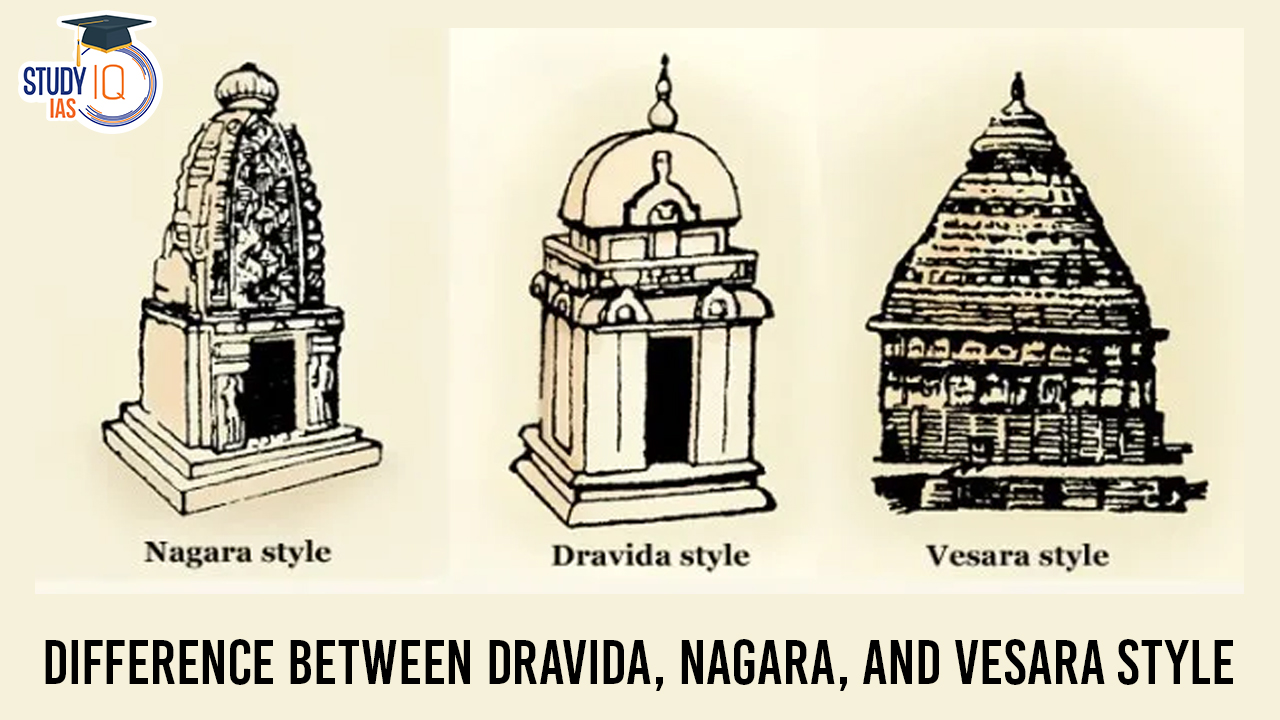
Source: StudyIQ — Difference between Dravida, Nagara, and Vesara Style · www.studyiq.com
Question Context
This 2012 UPSC question tested basic knowledge of India's temple architecture classification. The distractors cleverly used racial groups, languages, and music - all legitimate areas where India has three-fold divisions, making this a classic elimination question requiring specific cultural knowledge.
Trap: Confusing with language families - Dravidian is a language family, but Dravida here means architecture
Trap: Mixing up geographical boundaries - styles don't follow strict north-south lines
Trap: Overthinking the 'three main' phrase - these are indeed the universally accepted three styles