Every year, a month long ecologically important campaign/festival is held during which certain communities/tribes plant samplings of fruit-bearing trees. Which of the following are such communities/tribes?
Contents21
- ABhutia and Lepcha
- BGond and Korku
- CIrula and Toda
- DSahariya and Agariya
Show answer
Answer: (B) Gond and Korku
The Gond and Korku tribes of central India (Madhya Pradesh region) celebrate a month-long traditional eco-festival where they plant saplings of fruit-bearing trees.
This is their own green revolution — a conservation practice passed down through generations, rooted in their deep relationship with forests.
The other pairs (Bhutia-Lepcha from Sikkim, Irula-Toda from Nilgiris, Sahariya-Agariya from MP/UP) are not associated with this specific tree-planting festival.
The Gond and Korku tribes of central India have a traditional month-long festival where they plant saplings of fruit-bearing trees as part of their forest conservation practices.
UPSC is testing knowledge of specific tribal ecological practices rather than just tribal locations - students need to know which tribes have distinctive environmental traditions, not just where they live.
Gond and Korku Tribes
Art And Culture Gond Korku
Gond and Korku Tribes: Central India's Ecological Guardians
Gond and Korku tribes celebrate month-long tree-planting festival with fruit saplings
Both tribes are from central India, primarily Madhya Pradesh
Gonds are India's largest tribal group with rich Gondwana kingdom history
Traditional ecological practices reflect deep forest-tribe relationship
Ecological Festival Context
The Gond and Korku tribes practice a unique month-long ecological campaign where they plant saplings of fruit-bearing trees. This traditional festival represents their indigenous conservation wisdom — a community-driven green movement that predates modern environmental awareness by centuries.
Gond vs Korku Comparison
Aspect | Gond | Korku |
|---|---|---|
Population Status | Largest tribal group in India | Smaller tribal community |
Primary States | Madhya Pradesh, Chhattisgarh, Maharashtra | Madhya Pradesh, Maharashtra |
Historical Legacy | Gondwana Kingdom rulers | Forest-dwelling community |
Language Family | Dravidian languages | Austro-Asiatic (Munda group) |
Traditional Occupation | Agriculture, forest produce | Shifting cultivation, forest gathering |
Cultural Identity | Rich art traditions, Gond painting | Strong ecological practices |
Traditional Ecological Practices
Community-based conservation: Entire villages participate in the tree-planting festival
Fruit-bearing focus: Planted trees serve both ecological and nutritional purposes
Seasonal timing: Festival aligns with optimal planting seasons for sapling survival
Intergenerational knowledge: Practices passed down through oral traditions
Sacred forest concepts: Trees viewed as integral to tribal spiritual beliefs
Gond Tribal Distribution
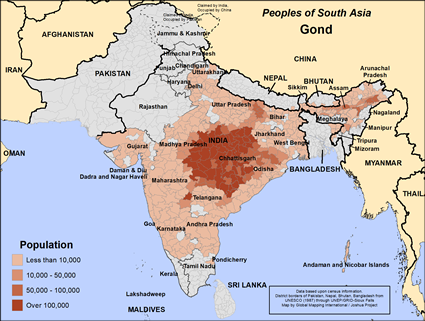
Source: Joshua Project — Gond unspecified in India Profile · joshuaproject.net
Question Connection
This UPSC question tests knowledge of tribe-specific ecological practices. The month-long tree-planting festival is unique to Gond and Korku communities of central India, distinguishing them from other tribal pairs listed in the options.
Geographic confusion: Don't mix Gond-Korku (central India) with Bhutia-Lepcha (Northeast)
Tree-planting specificity: Only Gond-Korku have this month-long fruit sapling festival
Tribal pairing: UPSC often tests specific tribe combinations — memorize correct pairs
Ecological practices: Not all tribes have famous tree-planting traditions — this is Gond-Korku specialty
Other Tribal Communities in Options
Art And Culture Bhutia Lepcha Irula Toda Sahariya Agariya
Tribal Pairs: Geographic Distribution & Key Features
Bhutia-Lepcha: Sikkim and Northeast Himalayan tribes
Irula-Toda: Tamil Nadu Nilgiri Hills tribes
Sahariya-Agariya: Madhya Pradesh and Uttar Pradesh tribes
Tribal Pairs Geographic Classification
Tribal Pair | Primary Location | Key Characteristics | UPSC Relevance |
|---|---|---|---|
Bhutia & Lepcha | Sikkim, Darjeeling hills | Buddhist culture, high-altitude adaptation | Northeast tribal studies |
Irula & Toda | Tamil Nadu (Nilgiris) | Honey hunting (Irula), Buffalo herding (Toda) | South India tribal diversity |
Sahariya & Agariya | Madhya Pradesh, Uttar Pradesh | Particularly Vulnerable tribal groups | Central India tribal welfare |
Gond & Korku | Madhya Pradesh (central) | Tree-planting festival, forest conservation | Tribal ecological practices |
Distinctive Tribal Features
Bhutias: Tibeto-Burman origin, practice Tibetan Buddhism, traditional yak herding
Lepchas: Indigenous to Sikkim, known as 'Rong people', nature worshippers
Irulas: Tamil Nadu's snake-catching specialists, expert in honey collection
Todas: Polyandrous society, sacred buffalo (Arjuna), distinctive barrel-shaped huts
Sahariyas: PVTG status, primarily in Rajasthan-MP border, shifting cultivators
UPSC Pairing Strategy
UPSC frequently pairs tribes from the same geographic region in options to test precise knowledge. Notice the pattern: Bhutia-Lepcha (Northeast), Irula-Toda (South), Sahariya-Agariya (Central), Gond-Korku (Central). Each pair shares regional proximity but has distinct cultural practices.
Regional mixing: Don't confuse Nilgiri tribes (Irula-Toda) with Sikkim tribes (Bhutia-Lepcha)
Central India overlap: Both Gond-Korku and Sahariya-Agariya are from MP — distinguish by specific practices
PVTG confusion: Sahariyas are Particularly Vulnerable, Gonds are not — don't mix status
Cultural specificity: Only Gond-Korku have the tree-planting festival — other pairs have different traditions
Traditional Ecological Practices of Indian Tribes
Environment ecologically important campaign plant samplings fruit-bearing trees
Tribal Communities & Indigenous Conservation Practices
Tribes possess traditional ecological knowledge developed over centuries
Community-based conservation predates modern environmental movements
Sacred groves and seasonal festivals maintain biodiversity
Forest-dwelling tribes are natural ecosystem guardians
Indigenous Conservation Wisdom
Indian tribal communities have developed sophisticated traditional ecological knowledge (TEK) systems over millennia. Their conservation practices — like the Gond-Korku tree-planting festival — represent community-driven environmental stewardship that maintains both ecological balance and cultural identity.
Tribal Conservation Practices Across India
Practice Type | Tribal Community | Region | Conservation Impact |
|---|---|---|---|
Tree Plantation Festival | Gond, Korku | Central India | Afforestation, fruit biodiversity |
Sacred Groves (Devrai) | Warli, Bhil | Maharashtra, Gujarat | Biodiversity hotspots preservation |
Jhum with Fallow | Khasi, Garo | Northeast | Soil regeneration, forest cycling |
Community Forest Rights | Baiga, Sahariya | Madhya Pradesh | Forest protection, NTFP conservation |
Seasonal Taboos | Irula, Kota | Tamil Nadu | Wildlife breeding protection |
Water Conservation | Bishnoi | Rajasthan | Groundwater recharge, wildlife protection |
Elements of Tribal Ecological Systems
# Traditional Ecological Knowledge
## Conservation Practices
- Sacred Groves
- Seasonal Festivals
- Community Forestry
- Sustainable Harvesting
## Knowledge Systems
- Oral Traditions
- Seasonal Calendars
- Species Classification
- Weather Prediction
## Institutional Framework
- Village Councils
- Traditional Leaders
- Community Rules
- Inter-generational Transfer
## Modern Recognition
- Forest Rights Act 2006
- Biodiversity Act 2002
- PVTG Welfare
- Eco-tourism Initiatives
Scientific Validation of Tribal Practices
Biodiversity hotspots: Sacred groves often contain rare and endemic species
Carbon sequestration: Community forests show higher carbon storage than protected areas
Soil conservation: Traditional shifting cultivation maintains soil fertility cycles
Water management: Indigenous water harvesting sustains ecosystems during droughts
Genetic diversity: Tribal seed varieties preserve crop genetic resources
Policy Integration
India's Forest Rights Act 2006 recognizes tribal communities as forest guardians, granting them legal rights over ancestral lands. Modern conservation increasingly integrates traditional ecological knowledge with scientific approaches, acknowledging that tribal practices often achieve better conservation outcomes than top-down protection models.
Madhya Pradesh Tribal Communities
Art And Culture
Madhya Pradesh: India's Tribal Heartland
Madhya Pradesh has India's largest tribal population (21.1% of state population)
Gond is the largest tribe, Bhil is the second largest in MP
Scheduled Areas cover tribal-dominated districts like Jhabua, Dhar, Mandla
Tribal Concentration Hub
Madhya Pradesh is India's tribal heartland, home to the country's largest absolute tribal population. The state's central location and dense forest cover have sustained diverse tribal communities for centuries, making it a crucial region for understanding India's indigenous heritage.
Major Tribes of Madhya Pradesh
Tribe | Population Rank | Key Districts | Distinctive Features |
|---|---|---|---|
Gond | Largest | Mandla, Dindori, Balaghat | Gondwana kingdom, tree-planting festival, art traditions |
Bhil | Second largest | Jhabua, Dhar, Barwani | Archery skills, Bhili language, Holi celebrations |
Korku | Third largest | Khandwa, Burhanpur | Austro-Asiatic language, ecological practices |
Sahariya | PVTG status | Shivpuri, Guna, Morena | Particularly vulnerable, shifting cultivation |
Baiga | PVTG status | Mandla, Balaghat, Dindori | Bewar cultivation, traditional healers |
Bhariya | PVTG status | Chhindwara | Smallest PVTG, forest-dependent |
MP Tribal Districts
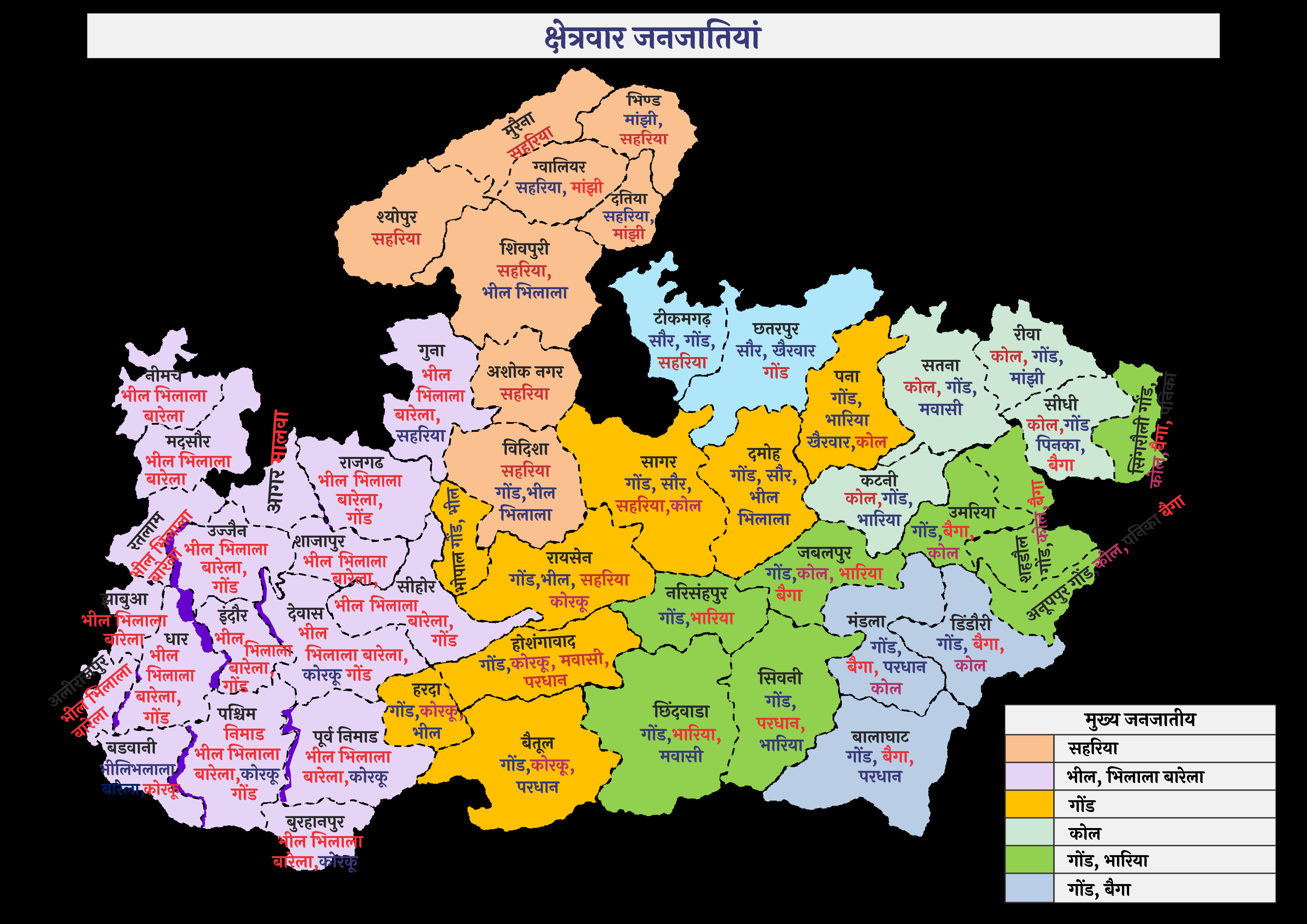
Source: Vanya MP - Tribal — Vanya MP - Tribal · vanya.codecartel.co.in
Tribal Administration in MP
Tribal Affairs Department: Dedicated ministry for tribal welfare and development
Scheduled Areas: PESA Act 1996 provides self-governance in tribal areas
Forest Rights: Extensive community forest rights granted under FRA 2006
PVTG Focus: Special programs for 3 Particularly Vulnerable Tribal Groups
Cultural Preservation: State support for tribal languages, arts, and festivals
Largest tribe confusion: Gond is largest in MP, Bhil is largest overall in India
PVTG identification: Sahariya, Baiga, Bhariya have PVTG status — Gond, Korku do not
Geographic zones: Gond-Korku in central-eastern MP, Bhil in western MP districts
Language families: Gond (Dravidian), Korku (Austro-Asiatic), Bhil (Indo-Aryan) — don't mix