With reference to India's culture and tradition, what is 'Kalaripayattu'?
Contents11
- AIt is an ancient Bhakti cult of Shaivism still prevalent in some parts of South India.
- BIt is an ancient style bronze and brasswork still found in southern part of Coromandel area.
- CIt is an ancient form of dance-drama and a living tradition in the northern part of Malabar.
- DIt is an ancient martial art and a living tradition in some parts of South India.
Show answer
Answer: (D) It is an ancient martial art and a living tradition in some parts of South India.
Kalaripayattu is one of the oldest martial arts in the world, originating in Kerala (South India).
'Kalari' = training ground/gymnasium,
'Payattu' = fight/exercise.
It includes strikes, kicks, weapons training (swords, shields, spears), and knowledge of vital pressure points (marma).
It is still practised as a living tradition in Kerala and parts of Tamil Nadu and Karnataka.
Why other options are wrong:
(a) It's not a Bhakti/Shaivism cult.
(b) It's not metalwork/bronze casting.
(c) It's not a dance-drama — Kathakali is the dance-drama from the same region.
Kalaripayattu is considered one of the world's oldest martial arts, originating in Kerala and still practiced as a living tradition in South India.
UPSC often confuses students by offering options about other Kerala traditions like Kathakali dance-drama, testing whether students can distinguish between the state's different cultural forms.
The question tests knowledge of India's living martial traditions, which UPSC includes under the broader cultural heritage and intangible traditions syllabus.
Kalaripayattu Martial Art
Art And Culture Kalaripayattu
Kalaripayattu: World's Oldest Martial Art from Kerala
Kalaripayattu is one of the world's oldest martial arts from Kerala
Kalari = training ground, Payattu = fight/exercise
Still practiced as living tradition in Kerala, Tamil Nadu, Karnataka
Includes strikes, kicks, weapons training, and marma (vital pressure points)
Etymology & Origins
Kalaripayattu combines two Malayalam words: Kalari (training ground or gymnasium) and Payattu (fight or exercise). This ancient martial art originated in Kerala and is considered one of the oldest fighting systems in the world, with roots tracing back over 3,000 years.
Key Components
Component | Description | Purpose |
|---|---|---|
Meythari | Body conditioning & flexibility | Physical preparation |
Kolthari | Wooden weapon training | Staff, sword, spear combat |
Angathari | Metal weapon training | Sword, shield, dagger combat |
Verumkai | Empty hand techniques | Strikes, kicks, grappling |
Marma | Vital pressure points | Healing & combat knowledge |
Current Status
Living tradition still practiced in Kerala, Tamil Nadu, and Karnataka
Traditional Kalari training centers operate across South India
Combines martial training with Ayurvedic healing knowledge
Influenced other martial arts like Kung Fu through Bodhidharma's travels
Recognized by UNESCO as intangible cultural heritage
Training Demonstration
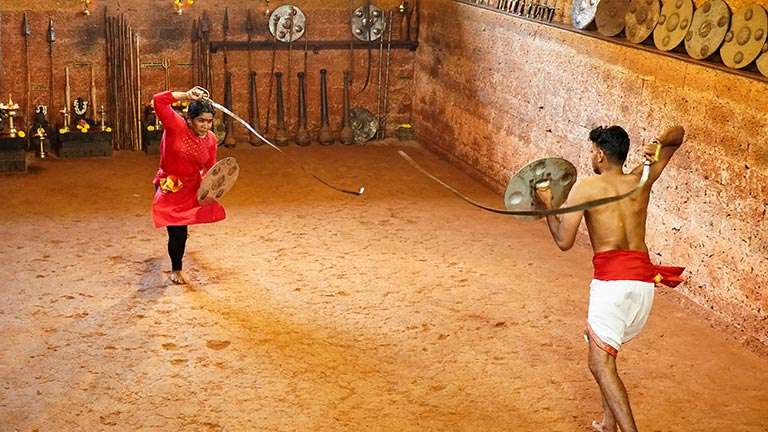
Source: Kerala Tourism — Urumi Weapon in Kalaripayattu | Training Techniques in Sharp ... · www.keralatourism.org
Trap: Confusing with Kathakali - both from Kerala but Kathakali is dance-drama, not martial art
Trap: Option A mentions Shaivism cult - Kalaripayattu is martial art, not religious practice
Trap: Option B mentions bronze work - completely unrelated craft tradition
Trap: Option C says northern Malabar - it's from Kerala (southern Malabar coast)
Kerala's Classical Art Forms
Art And Culture Malabar South India
Kerala's Major Classical Art Traditions
Kathakali is Kerala's famous dance-drama tradition
Mohiniyattam is Kerala's classical solo dance form
Theyyam is ritualistic art form from northern Kerala
Major Art Forms
Art Form | Type | Characteristics | Region |
|---|---|---|---|
Kathakali | Dance-drama | Elaborate costumes, facial makeup, stories from epics | Central Kerala |
Mohiniyattam | Solo dance | Graceful movements, white/gold costume, Lasya style | All Kerala |
Theyyam | Ritual performance | Divine impersonation, colorful costumes | Northern Kerala |
Kalaripayattu | Martial art | Combat techniques, weapons, flexibility | All Kerala |
Ottamthullal | Solo performance | Satirical, commentary on society | All Kerala |
Kerala's Cultural Identity
Malabar coast fostered diverse artistic traditions due to trade connections
Malayalam language and Dravidian culture influence all art forms
Many forms blend martial, spiritual, and aesthetic elements
Living traditions still performed in temples and cultural centers
Trap: Don't confuse Kalaripayattu (martial art) with Kathakali (dance-drama)
Trap: Both Kathakali and Kalaripayattu are from Kerala, but serve different purposes
Trap: Malabar region refers to Kerala's coast, not a separate state
Indian Martial Arts Traditions
Art And Culture martial art ancient living tradition
Traditional Martial Arts Across India
Kalaripayattu (Kerala) is the oldest and most systematic
Each region developed martial arts suited to local warfare needs
Many forms combine physical training with spiritual practices
Regional Martial Arts
Martial Art | Region | Key Features | Weapons Used |
|---|---|---|---|
Kalaripayattu | Kerala | Flexibility, marma knowledge | Sword, spear, shield |
Silambam | Tamil Nadu | Staff fighting, animal forms | Bamboo staff, sword |
Gatka | Punjab | Sikh warrior tradition | Sword, stick, chakram |
Thang-ta | Manipur | Dance-like movements | Sword, spear |
Lathi | North India | Stick fighting | Bamboo staff |
Mardani Khel | Maharashtra | Maratha warrior art | Sword, patta (gauntlet) |
Common Characteristics
Guru-shishya tradition for knowledge transmission
Integration with Ayurveda and Yoga for holistic development
Ritualistic aspects including prayers and ceremonies
Emphasis on mental discipline alongside physical training
Many are living traditions still practiced today
Trap: Don't assume all Indian martial arts are from South India - they exist across regions
Trap: Kalaripayattu is specifically from Kerala, not all of South India
Trap: These are martial arts, not dance forms or religious cults