Who among the following rulers of Vijayanagara Empire constructed a large dam across Tungabhadra River and a canal-cum-aqueduct several kilometres long from the river to the capital city?
Contents12
- ADevaraya I
- BMallikarjuna
- CVira Vijaya
- DVirupaksha
Show answer
Answer: (A) Devaraya I
Devaraya I of the Vijayanagara Empire built a dam (barrage) across the Tungabhadra River around 1410 AD and constructed a 24 km long canal-aqueduct from the river to the capital city.
This is recorded in the account of Nuniz.
Answer is (a) Devaraya I.
Devaraya I built a 24-kilometer canal system from Tungabhadra River to Vijayanagara capital around 1410 AD, demonstrating advanced hydraulic engineering that sustained the empire's urban center.
The question tests knowledge of specific infrastructure achievements by individual Vijayanagara rulers, requiring students to connect engineering projects with particular kings rather than just knowing general empire history.
Devaraya I & His Achievements
Ancient And Medieval History Devaraya I Tungabhadra River dam canal-cum-aqueduct
Devaraya I: The Engineer King of Vijayanagara (1406-1422 AD)
Devaraya I built a dam across Tungabhadra River and 24 km canal-aqueduct to Vijayanagara city around 1410 AD
Ruled from 1406-1422 AD during the Sangama dynasty period
His engineering projects were recorded by Portuguese chronicler Nuniz
Successfully defended against Bahmani Sultanate attacks
The Engineering Marvel
Devaraya I was the most accomplished ruler of the early Sangama dynasty. Around 1410 AD, he constructed a massive dam (barrage) across the Tungabhadra River and built a sophisticated 24-kilometer canal-aqueduct system that brought water directly to the capital city of Vijayanagara. This engineering feat solved the water supply problem for the growing urban population and demonstrated the advanced hydraulic knowledge of medieval Indian engineers.
Key Achievements of Devaraya I
Achievement | Details | Significance |
|---|---|---|
Tungabhadra Dam | Barrage across river around 1410 AD | Ensured water supply control |
Canal-Aqueduct | 24 km long from river to capital | First major irrigation project of Vijayanagara |
Military Reforms | Strengthened cavalry and artillery | Successfully resisted Bahmani invasions |
Administrative Reforms | Improved revenue collection | Strengthened empire's financial base |
Historical Sources
The detailed account of Devaraya I's engineering projects comes from Domingo Paes and Fernão Nuniz, Portuguese chroniclers who visited Vijayanagara in the 16th century. Nuniz specifically recorded the impressive canal system and described how it transformed the capital's water management.
Vijayanagara Location
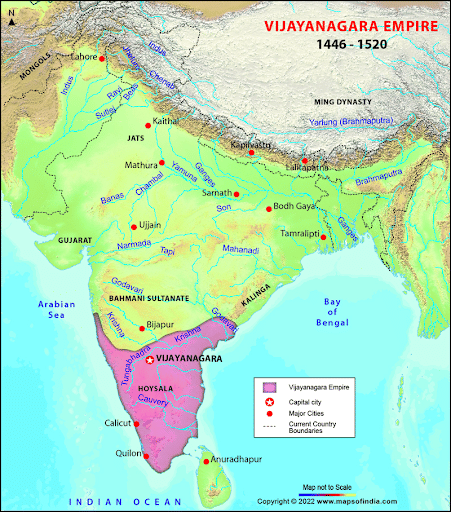
Source: Prepp — Vijayanagara Kingdom (1336 - 1672 CE) - Medieval India History Notes · prepp.in
Trap: Confusing Devaraya I (dam builder, 1406-22) with Devaraya II (1424-46) who employed foreign experts
Trap: Mixing up Portuguese chroniclers - Nuniz recorded the dam, Paes described the city's grandeur
Trap: The question asks about canal-cum-aqueduct - this specific term refers to Devaraya I's project, not general irrigation
Other Vijayanagara Rulers in Options
Ancient And Medieval History Mallikarjuna Vira Vijaya Virupaksha
Vijayanagara Rulers: Mallikarjuna, Vira Vijaya & Virupaksha
Mallikarjuna (1446-65) faced Bahmani attacks and lost northern territories
Virupaksha (1465-85) was the last effective Sangama dynasty ruler
Vira Vijaya was a minor ruler during transition periods
Comparison of Option Rulers
Ruler | Dynasty | Period | Key Events | Major Achievements |
|---|---|---|---|---|
Devaraya I | Sangama | 1406-1422 | Built Tungabhadra dam | Engineering projects, military reforms |
Mallikarjuna | Sangama | 1446-1465 | Bahmani invasions | Defended core territories |
Virupaksha | Sangama | 1465-1485 | Dynasty decline begins | Last strong Sangama ruler |
Vira Vijaya | Various periods | Multiple reigns | Transitional ruler | Limited historical records |
Why Others Are Incorrect
Mallikarjuna is famous for military campaigns against Bahmani Sultanate, not engineering projects
Virupaksha ruled during the decline phase when resources were focused on defense, not infrastructure
Vira Vijaya appears in multiple contexts but no major construction projects are attributed to him
Only Devaraya I has documented evidence of the specific Tungabhadra dam and canal system
Trap: Mallikarjuna sounds impressive but he was focused on warfare, not water management
Trap: Virupaksha was an important ruler but came after the major infrastructure phase
Trap: Multiple rulers had similar names - always check the specific achievement being asked
Portuguese Chronicles of Vijayanagara
Ancient And Medieval History Nuniz
Portuguese Chronicles: Primary Sources on Vijayanagara Empire
Fernão Nuniz and Domingo Paes were Portuguese chroniclers who documented Vijayanagara
Nuniz specifically recorded Devaraya I's dam and canal system
Their accounts are crucial primary sources for Vijayanagara history
Portuguese Presence
Portuguese traders and chroniclers visited the Vijayanagara Empire in the 15th-16th centuries during the height of European exploration of the Indian Ocean trade routes. Their detailed accounts provide invaluable insights into the empire's administration, architecture, and engineering achievements that Indian sources sometimes lack.
Key Portuguese Chroniclers
Chronicler | Period of Visit | Focus Area | Key Contributions |
|---|---|---|---|
Domingo Paes | 1520s | City description, royal court | Detailed account of Vijayanagara's grandeur |
Fernão Nuniz | 1535-37 | History, engineering works | Recorded Devaraya I's dam project |
Barbosa | Early 16th century | Trade and commerce | Economic activities of the empire |
Importance as Historical Sources
Provide external perspective on Vijayanagara Empire during its peak period
Document engineering achievements like dams and canals that Indian inscriptions may not detail
Describe daily life, trade practices and court ceremonies from European viewpoint
Help cross-verify information from Indian sources like inscriptions and literary works
Trap: Confusing Nuniz (who wrote about the dam) with Paes (who described the city)
Trap: These are 16th century sources writing about earlier events - not contemporary to Devaraya I
Trap: Portuguese chronicles are secondary sources for Devaraya I's time, but primary sources for 16th century Vijayanagara