The FAO accords the status of ‘Globally Important Agricultural Heritage System (GIAHS)’ to traditional agricultural systems. What is the overall goal of this initiative? 1. To provide modern technology, training in modern farming methods and financial support to local communities of identified GIAHS so as to greatly enhance their agricultural productivity. 2. To identify and safeguard eco-friendly traditional farm practices and their associated landscapes, agricultural biodiversity and knowledge systems of the local communities 3. The provide Geographical Indication status to all the varieties of agricultural produce in such identifies GIAHS Select the correct answer using the code given below.
Contents22
- A1 and 3 only
- B2 only
- C2 and 3 only
- D1, 2 and 3
Show answer
Answer: (B) 2 only
Answer: (b) 2 only
Statement 1 (✗ WRONG):
GIAHS does NOT provide modern technology - it does the OPPOSITE.
It aims to PRESERVE traditional farming, not replace it with modern methods.
Statement 2 (✓ CORRECT):
GIAHS identifies and safeguards eco-friendly traditional farm practices and their associated landscapes, biodiversity, and knowledge systems.
Statement 3 (✗ WRONG):
GIAHS does NOT provide GI (Geographical Indication) status.
GI is an intellectual property right under WTO's TRIPS agreement - totally different.
GIAHS = Globally Important Agricultural Heritage Systems, managed by FAO.
India's GIAHS site includes Kuttanad (Kerala) - rice cultivation below sea level.
Key insight: 'Heritage' in the name = PRESERVATION of old methods, not MODERNIZATION.
GIAHS preserves traditional farming methods that are eco-friendly and sustainable, rather than replacing them with modern technology.
The word 'Heritage' in GIAHS signals preservation of old practices, not modernization - this is the key conceptual trap in the question.
FAO's GIAHS Program
Indian Economy GIAHS Globally Important Agricultural Heritage System FAO
GIAHS: Preserving Traditional Agricultural Systems
Quick Facts
FAO accords GIAHS status to preserve traditional agricultural systems
Focus on eco-friendly practices and agricultural biodiversity
GIAHS does NOT provide modern technology or GI status
India has Kuttanad Below Sea Level Farming System (Kerala) as GIAHS site
What is GIAHS
GIAHS (Globally Important Agricultural Heritage Systems) is a FAO initiative that identifies and conserves traditional agricultural systems worldwide. The keyword 'Heritage' indicates preservation of old practices, not modernization.
GIAHS vs Common Misconceptions
Aspect | What GIAHS Actually Does | What GIAHS Does NOT Do |
|---|---|---|
Technology | Preserves traditional methods | Does NOT provide modern technology |
Training | Documents indigenous knowledge | Does NOT train in modern farming |
Financial Support | May provide conservation funding | Does NOT give direct productivity loans |
Legal Status | Gives heritage recognition | Does NOT provide GI status |
Goal | Safeguard biodiversity & practices | Does NOT aim to enhance productivity |
Core Objectives
Identify traditional agricultural systems with global significance
Safeguard eco-friendly farming practices and associated landscapes
Preserve agricultural biodiversity and local knowledge systems
Support dynamic conservation through sustainable use
Promote public understanding of agricultural heritage
GIAHS Sites Globally
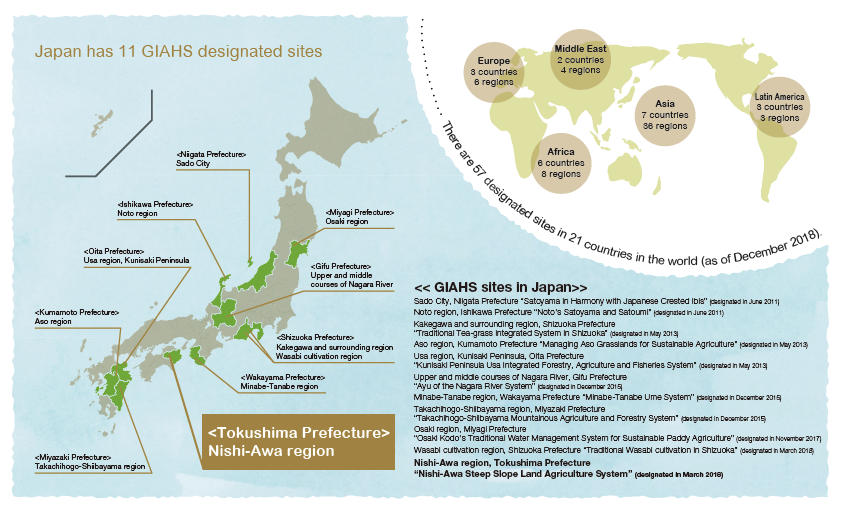
Source: にし阿波の傾斜地農耕システム — GIAHS "Nishi-Awa Steep Slope Land Agriculture System" | にし ... · giahs-tokushima.jp
Question Connection
This question tested understanding of GIAHS core philosophy. Statement 1 was the key trap - GIAHS preserves traditional methods, it doesn't modernize them. Statement 3 confused GIAHS with GI (Geographical Indication) - completely different systems.
Trap: 'Heritage' suggests preservation, not modernization - Statement 1 reverses this
Trap: GIAHS ≠ GI status - different organizations (FAO vs TRIPS/WTO)
Trap: GIAHS focuses on conservation, not productivity enhancement
Confusion: Traditional systems can be eco-friendly AND economically viable
GIAHS Sites in India
Indian Economy Kuttanad
India's Recognized Agricultural Heritage Systems
India's GIAHS
Kuttanad Below Sea Level Farming System (Kerala) - India's first GIAHS site
Rice cultivation 2-3 meters below sea level using traditional methods
Unique pokkali rice variety adapted to saline conditions
Kuttanad System Details
Feature | Description | Significance |
|---|---|---|
Location | Alappuzha & Kottayam districts, Kerala | Backwater region |
Elevation | 2-3 meters below sea level | Unique farming challenge |
Crop | Pokkali rice variety | Salt-tolerant traditional variety |
Season | Virippu (Apr-Sep) cultivation | Adapted to monsoon cycle |
Method | Dykes & canals for water management | Traditional flood control |
Recognition | GIAHS status in 2013 | First Indian agricultural heritage site |
Kuttanad Landscape
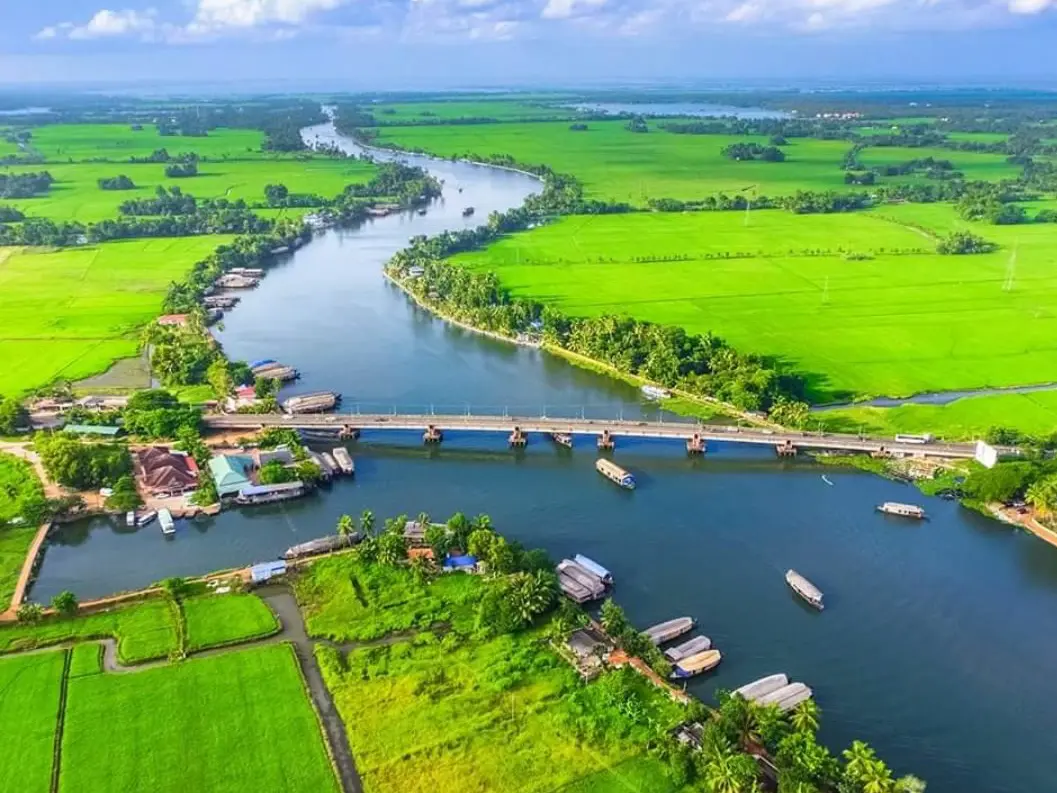
Source: Sanchari — Kuttanad Tourism 2024: Navigate the Rice Bowl of Kerala ... · www.thesanchari.com
Traditional Practices Preserved
Pokkali cultivation - rice-shrimp rotation system using saline water
Community-based water management through traditional kayal system
Indigenous varieties adapted to waterlogged and saline conditions
Seasonal farming calendar synchronized with monsoon and tidal patterns
Remember: Kuttanad is below sea level, not just coastal farming
Don't confuse: Pokkali rice with Basmati - different regional varieties
Kerala connection: Links to backwater tourism and traditional knowledge systems
Geographical Indication vs GIAHS
Indian Economy Geographical Indication
GI Status vs GIAHS Recognition: Key Differences
Critical Distinction
GI = intellectual property right under TRIPS/WTO
GIAHS = heritage conservation program by FAO
GI protects product names, GIAHS preserves farming systems
Completely different purposes and organizations
GI vs GIAHS Comparison
Parameter | Geographical Indication (GI) | GIAHS |
|---|---|---|
Governing Body | TRIPS/WTO framework | FAO (UN agency) |
Purpose | Intellectual property protection | Heritage conservation |
Focus | Product branding & market access | Traditional farming systems |
Legal Status | Trademarked protection | Recognition only |
Beneficiary | Producers/manufacturers | Farming communities |
Examples in India | Darjeeling Tea, Basmati Rice | Kuttanad farming system |
Criteria | Quality linked to geography | Traditional & sustainable practices |
Why This Confusion Occurs
Both relate to agriculture and traditional practices
Both provide some form of official recognition
Both have geographical connections to specific regions
Both aim to preserve something valuable from the past
Key difference: GI protects products, GIAHS protects processes
UPSC's Testing Strategy
UPSC often creates confusion between GI status and GIAHS recognition because both involve agricultural heritage. Remember: GI = product protection (like Darjeeling Tea trademark), GIAHS = system preservation (like traditional farming methods).
False claim: 'GIAHS provides GI status to agricultural produce'
Reality: GIAHS recognizes farming systems, not individual products
Different scope: GI covers specific varieties, GIAHS covers entire agricultural landscapes
Remember: One system can have GIAHS recognition without any GI-protected products
Traditional vs Modern Agricultural Approaches
Indian Economy traditional agricultural systems modern farming methods
Traditional Agriculture vs Modernization: The GIAHS Perspective
Core Philosophy
Traditional systems emphasize sustainability over productivity
Modern agriculture focuses on yield maximization through technology
GIAHS preserves traditional methods, not modern ones
Both approaches have distinct advantages and limitations
Traditional vs Modern Agriculture
Aspect | Traditional Systems (GIAHS Focus) | Modern Agriculture |
|---|---|---|
Primary Goal | Sustainability & biodiversity | Productivity & efficiency |
Technology | Indigenous knowledge & local tools | Mechanization & scientific inputs |
Inputs | Organic manures, local seeds | Chemical fertilizers, HYV seeds |
Water Management | Traditional methods (tanks, wells) | Modern irrigation (drip, sprinkler) |
Crop Varieties | Indigenous & diverse varieties | High Yielding Varieties (HYV) |
Environmental Impact | Eco-friendly, low carbon footprint | Higher chemical residues, energy use |
Knowledge System | Community-based, oral tradition | Scientific, formal education |
Market Orientation | Subsistence + local markets | Commercial & global markets |
Why GIAHS Opposes Modernization
Biodiversity loss: Modern agriculture reduces crop genetic diversity
Knowledge erosion: Traditional practices disappear with modernization
Ecosystem disruption: Chemical inputs affect soil and water systems
Cultural loss: Farming traditions linked to community identity
Sustainability concerns: Modern methods may not be long-term viable
Statement 1 Analysis
The question's Statement 1 suggested GIAHS provides 'modern technology and training in modern farming methods.' This directly contradicts GIAHS philosophy - it preserves traditional knowledge, not replaces it with modern methods.
False assumption: All agricultural programs aim to modernize farming
Key insight: 'Heritage' in GIAHS means preservation, not replacement
Don't assume: Traditional = backward; many traditional practices are scientifically sound
Remember: GIAHS may support communities financially but NOT for modernization