Consider the following pairs:
Contents17
Consider the following pairs:
| Medieval Indian State | Present Region | |
|---|---|---|
| 1. | Champaka | Central India |
| 2. | Durgara | Jammu |
| 3. | Kuluta | Malabar |
Which of the above pairs is/are correctly matched?
- A1 and 2
- B2 only
- C1 and 3
- D3 only
Show answer
Answer: (B) 2 only
This is a difficult question about ancient/medieval Indian historical geography.
Pair 1 (Champaka — Central India): INCORRECT. Champaka (or Champa) is the ancient name for the modern Chamba district in Himachal Pradesh, which is in the northwestern Himalayas, NOT in Central India. Many students confuse it with Champa/Anga in Bihar, but this is a different place.
Pair 2 (Durgara — Jammu): CORRECT. Durgara is the old name for the Jammu region. The Dogra dynasty, which ruled Jammu and Kashmir, derives its name from 'Durgara'. This is a fairly well-known identification.
Pair 3 (Kuluta — Malabar): INCORRECT. Kuluta is the ancient name for the Kullu valley in Himachal Pradesh (notice the phonetic similarity: Kuluta → Kullu). Malabar is on the Kerala coast, which is a completely different region in South India.
So only Pair 2 is correctly matched.
This question tests knowledge that goes beyond standard textbooks. The trick is to notice phonetic connections:
- Champaka → Chamba
- Durgara → Dogra/Jammu
- Kuluta → Kullu.
If you knew even one pair for sure (like Durgara = Jammu), you could eliminate options and get the right answer.
These three kingdoms - Champaka (modern Chamba), Durgara (modern Jammu), and Kuluta (modern Kullu) - were all located in the northwestern Himalayan region, not scattered across India as the options suggest.
UPSC tests whether students can recognize that many ancient Indian place names evolved phonetically into modern names: Champaka became Chamba, Durgara became the Dogra region of Jammu, and Kuluta became Kullu valley.
Champaka (Ancient Chamba)
Ancient And Medieval History Champaka Central India
Champaka: Ancient Name of Chamba, Himachal Pradesh
Champaka is the ancient name for modern Chamba district in Himachal Pradesh
Located in northwestern Himalayas, not Central India
Phonetic evolution: Champaka → Chamba
Geographic Location
Champaka was an ancient kingdom in the northwestern Himalayas, corresponding to the present-day Chamba district of Himachal Pradesh. The phonetic similarity makes the connection clear: Champaka evolved into Chamba over centuries.
Key Historical Facts
Chamba was founded around the 6th century CE by Raja Sahil Varman
The kingdom controlled important trans-Himalayan trade routes
Known for its unique Chamba paintings and temple architecture
Remained independent until it joined the Indian Union in 1948
Location Map
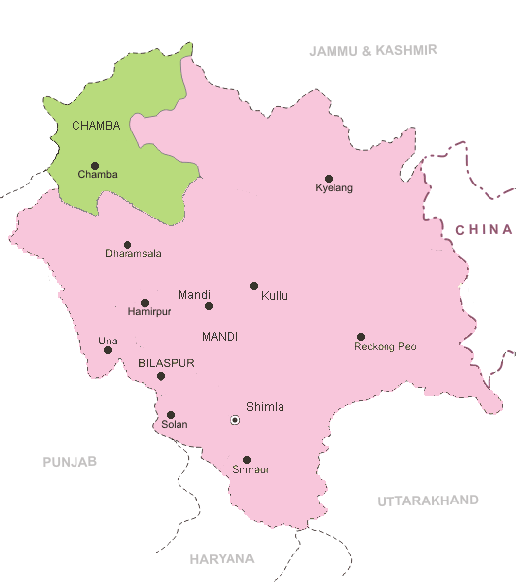
Source: Indyatour — Himachal Pradesh - Chamba District · www.indyatour.com
Trap: Confusing Champaka (Chamba, HP) with Champa/Anga kingdom in Bihar-Bengal region
Location trap: Champaka is in northwestern Himalayas, not Central India
Phonetic clue: Listen for sound similarities - Champaka → Chamba
Durgara (Ancient Jammu)
Ancient And Medieval History Durgara Jammu
Durgara: Ancient Name of Jammu Region
Durgara is the ancient name for the Jammu region
Dogra dynasty name derives from Durgara
Correctly matched pair in the question
Etymology & Connection
Durgara was the ancient name for the Jammu region. The famous Dogra dynasty that ruled Jammu and Kashmir derives its name from this ancient term - Durgara evolved into Dogra over time.
Dogra Dynasty Key Facts
Aspect | Details |
|---|---|
Founder | Gulab Singh (1846) |
Capital | Jammu (winter), Srinagar (summer) |
Territory | Jammu, Kashmir, Ladakh |
End | 1947 - Accession to India |
Famous Ruler | Maharaja Hari Singh (last ruler) |
Historical Significance
Strategic location controlling routes to Central Asia and Tibet
Sikh Empire connection - Gulab Singh was a general under Ranjit Singh
Treaty of Amritsar (1846) - British recognized Dogra rule over J&K
Accession controversy in 1947 led to first Indo-Pak war
Easy identification: Durgara = Jammu is one of the clearer ancient name connections
Dogra connection: Remember Dogra dynasty name comes from ancient Durgara
Modern relevance: This is the only correct pair in the given question
Kuluta (Ancient Kullu)
Ancient And Medieval History Kuluta Malabar
Kuluta: Ancient Name of Kullu Valley, Not Malabar
Kuluta is the ancient name for Kullu valley in Himachal Pradesh
NOT located in Malabar (Kerala coast) as question suggests
Clear phonetic connection: Kuluta → Kullu
Correct Location
Kuluta was an ancient kingdom in the Kullu valley of present-day Himachal Pradesh. The phonetic evolution is obvious: Kuluta became Kullu. The question incorrectly places it in Malabar (Kerala coast), which is geographically impossible.
Kuluta vs Malabar Comparison
Aspect | Kuluta (Actual) | Malabar (Question's Error) |
|---|---|---|
Location | Kullu Valley, Himachal Pradesh | Kerala Coast |
Region | Northwestern Himalayas | Southwest India |
Modern Name | Kullu | Kozhikode region |
Geography | Mountain valley | Coastal plain |
Climate | Temperate/Alpine | Tropical |
Kullu Valley Facts
Famous for Dussehra festival - unique celebration lasting 7 days
Valley of Gods - numerous ancient temples
Beas River flows through the valley
Capital is Kullu town, tourist hub is Manali
Geographic Contrast

Source: Leverage Edu — Similarities between Kerala and Himachal Pradesh · leverageedu.com
Geographic trap: Kuluta is in Himalayas, not Malabar coast (Kerala)
Phonetic clue: Kuluta sounds like Kullu - listen for connections
Wrong pairing: Malabar is 2000+ km away from actual Kuluta location
Ancient Indian Historical Geography
Ancient And Medieval History
Mastering Ancient Name-Location Matching for UPSC
Phonetic connections often reveal ancient name origins
Learn one pair correctly to eliminate wrong options
Focus on well-documented ancient kingdoms first
UPSC Strategy
Ancient historical geography questions test specialized knowledge. Even knowing one correct pair can help eliminate options. Focus on phonetic similarities between ancient and modern names - they often provide the key clue.
Common Phonetic Patterns
Champaka → Chamba (Himachal Pradesh)
Kuluta → Kullu (Himachal Pradesh)
Durgara → Dogra/Jammu (J&K region)
Kalinga → Kalinga/Odisha (coastal Odisha)
Kamrupa → Kamarupa/Assam (Assam)
High-Yield Ancient Kingdoms
Ancient Name | Modern Location | Key Identifier |
|---|---|---|
Gandhara | Afghanistan-Pakistan border | Taxila, Buddhist art |
Kalinga | Coastal Odisha | Ashoka's war |
Avanti | Malwa, Madhya Pradesh | Ujjain capital |
Kosala | Eastern UP | Ayodhya, Rama's kingdom |
Magadha | South Bihar | Pataliputra, Mauryan base |
Don't guess blindly - even one confirmed pair helps eliminate options
Beware of similar names - Champa (HP) vs Champa (Bengal) vs Champa (Vietnam)
Use elimination - if you know pair 2 is correct, check which options include it