Who of the following founded a new city on the south bank of a tributary to river Krishna and undertook to rule his new kingdom as the agent of a deity to whom all the land south of the river Krishna was supposed to belong?
Contents10
- AAmoghavarsha I
- BBallala II
- CHarihara I
- DPrataparudra II
Show answer
Answer: (C) Harihara I
As per NCERT 'Themes in Indian History Part II' (pg 170):
This question describes the founding of the Vijayanagara Empire.
Vijayanagara (meaning 'City of Victory') was founded in 1336 CE by two brothers — Harihara I and Bukka I — on the south bank of the river Tungabhadra, which is a tributary of the river Krishna.
They established the city as the capital of their new kingdom.
The question mentions ruling 'as the agent of a deity' — Harihara I claimed to rule as a representative of Lord Virupaksha (a form of Shiva), the presiding deity of Hampi/Pampa region.
All the land south of the river Krishna was considered to belong to this deity, and the king ruled as the deity's agent or representative.
This concept of ruling in the name of God gave the kingdom religious legitimacy.
Why are the other options wrong?
(a) Amoghavarsha I — he was a Rashtrakuta king (9th century), famous for his literary work Kavirajamarga.
(b) Ballala II — he was a Hoysala king (12th century).
(d) Prataparudra II — he was the last king of the Kakatiya dynasty of Warangal, defeated by the Delhi Sultanate.
None of them founded Vijayanagara.
Vijayanagara was founded in 1336 CE by Harihara I and Bukka I on the south bank of river Tungabhadra, a tributary of Krishna, and became the largest empire in South India for over 200 years.
The rulers claimed to rule as agents of Lord Virupaksha, making all land south of Krishna belong to the deity - this religious legitimacy helped distinguish Vijayanagara from other medieval kingdoms.
The question tests whether students can connect the specific geographic detail (south bank of Krishna tributary) with the unique theocratic claim (ruling as deity's agent) that defined Vijayanagara's foundation.
Vijayanagara Empire Foundation
Ancient And Medieval History Harihara I south bank tributary river Krishna agent of a deity
Foundation of Vijayanagara Empire: Harihara I & Divine Mandate
Harihara I and Bukka I founded Vijayanagara in 1336 CE on the Tungabhadra's south bank
Vijayanagara means 'City of Victory' - became capital of the empire
Tungabhadra River is a major tributary of river Krishna
Kings ruled as agents of Lord Virupaksha (form of Shiva) - divine legitimacy
All land south of Krishna river belonged to the deity, king was representative
The Vijayanagara Empire was established in 1336 CE by two brothers who created a unique political system combining territorial control with religious authority. Their capital became the largest city in South India and a major center of Hindu culture.
Founding Details
Aspect | Details |
|---|---|
Founders | Harihara I and Bukka I (brothers) |
Year | 1336 CE |
Location | South bank of Tungabhadra River |
River System | Tungabhadra is tributary of Krishna River |
Name Meaning | Vijayanagara = City of Victory |
Presiding Deity | Lord Virupaksha (form of Shiva) |
Territory Claimed | All land south of Krishna River |
Ruling Principle | King as agent/representative of deity |
Geographic Location
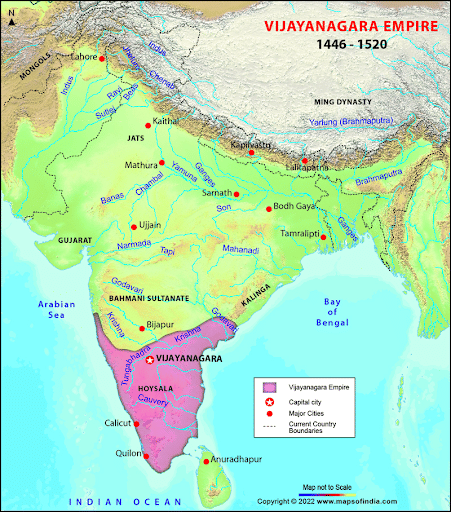
Source: Prepp — Vijayanagara Kingdom (1336 - 1672 CE) - Medieval India History Notes · prepp.in
The divine mandate theory was central to Vijayanagara's legitimacy. By claiming to rule as representatives of Lord Virupaksha, the founders transformed a political conquest into a religious mission, making their kingdom the protector of Hindu dharma in South India.
Harihara I founded Vijayanagara - not Harihara II or other Vijayanagara rulers
Tungabhadra is the tributary, Krishna is the main river - don't reverse this
Founded in 1336 CE - not 1336 BCE or other dates
Two brothers founded it - Harihara I and Bukka I together
Ruled as agent of deity - not direct divine rule but representative rule
Medieval South Indian Rulers
Ancient And Medieval History Amoghavarsha I Ballala II Prataparudra II
Pre-Vijayanagara South Indian Dynasties & Rulers
Amoghavarsha I - Rashtrakuta king (9th century), wrote Kavirajamarga
Prataparudra II - last Kakatiya king, defeated by Delhi Sultanate
All three ruled before Vijayanagara foundation (1336 CE)
Ballala II - Hoysala dynasty ruler (12th century)
Dynasty Comparison
Ruler | Dynasty | Period | Key Facts | Capital/Region |
|---|---|---|---|---|
Amoghavarsha I | Rashtrakuta | 9th century | Author of Kavirajamarga (Kannada literature) | Manyakheta |
Ballala II | Hoysala | 12th century | Expanded Hoysala territory | Halebidu |
Prataparudra II | Kakatiya | 13th-14th century | Last king, defeated by Malik Kafur (1309-1323) | Warangal |
Harihara I | Vijayanagara | 14th century | Founded Vijayanagara Empire (1336 CE) | Vijayanagara |
These dynasties represent the political landscape of South India before the Vijayanagara Empire. The Rashtrakutas, Hoysalas, and Kakatiyas were major powers that declined due to internal conflicts and Delhi Sultanate invasions, creating the political vacuum that Harihara I and Bukka I filled.
Amoghavarsha I wrote Kavirajamarga - not Amoghavarsha III
Prataparudra II was Kakatiya - not Chalukya or Chola
Ballala II was Hoysala - not confused with Ballala III
All three ruled before 1336 CE - none founded Vijayanagara
Malik Kafur defeated Prataparudra II - important Delhi Sultanate connection
Tungabhadra-Krishna River System
Geography tributary river Krishna
Tungabhadra-Krishna River System & Geographic Significance
Tungabhadra is a major tributary of Krishna River
Krishna is one of the largest peninsular rivers in India
Tungabhadra formed by confluence of Tunga and Bhadra rivers
Strategic location for kingdoms - fertile land and water access
The Krishna River system is the second-largest peninsular river basin in India. The Tungabhadra, formed by the confluence of Tunga and Bhadra rivers in the Western Ghats, is its most important tributary in the Deccan region.
River System Details
Feature | Krishna River | Tungabhadra River |
|---|---|---|
Type | Main peninsular river | Major tributary of Krishna |
Origin | Western Ghats (Maharashtra) | Confluence of Tunga & Bhadra |
Length | ~1400 km | ~531 km |
States Covered | Maharashtra, Karnataka, Telangana, AP | Karnataka, Andhra Pradesh |
Historical Importance | Major river system of Deccan | Vijayanagara Empire capital location |
Flow Direction | East to Bay of Bengal | Northeast to join Krishna |
River Course
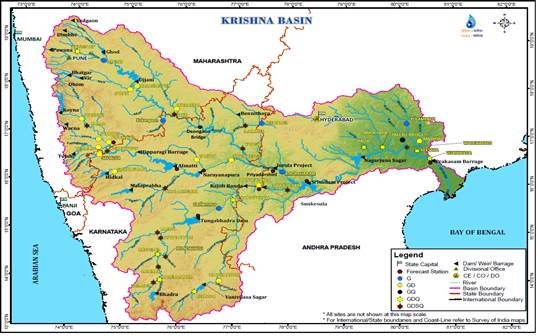
Source: Profile of Rivers in Karnataka — Profile of Rivers in Karnataka · wgbis.ces.iisc.ac.in
Tungabhadra is tributary, Krishna is main river - don't reverse this relationship
Vijayanagara was on south bank of Tungabhadra - not north bank
Tunga + Bhadra = Tungabhadra - remember the confluence
Krishna flows east to Bay of Bengal - not west to Arabian Sea
Peninsular river - not Himalayan river system
Divine Kingship in Medieval India
Ancient And Medieval History agent of a deity
Divine Kingship & Religious Legitimacy in Medieval India
Divine mandate theory - kings rule as representatives of gods
Lord Virupaksha (Shiva form) was Vijayanagara's presiding deity
Land south of Krishna belonged to deity, king was agent
Provided religious legitimacy to political rule
Medieval Indian kingdoms often used divine sanction to legitimize their rule. Rather than claiming to be gods themselves, rulers presented themselves as representatives or agents of deities, making their political authority a religious duty.
Divine Kingship Elements
# Divine Mandate Theory
## Religious Basis
- King as deity's agent
- Land belongs to god
- Religious legitimacy
- Temple patronage
## Vijayanagara Model
- Lord Virupaksha
- Hampi/Pampa region
- South of Krishna
- Hindu dharma protection
## Political Benefits
- Legitimizes conquest
- Unifies diverse subjects
- Sacred kingship
- Religious duty to rule
This system was particularly important for the Vijayanagara Empire as it positioned the kingdom as the protector of Hindu culture against Islamic invasions from the north. The divine mandate made resistance to enemies a religious obligation, not just political ambition.
Agent of deity - not direct divine rule or god-king concept
Virupaksha is form of Shiva - not Vishnu or other deities
Land south of Krishna river - not Tungabhadra or other rivers
Religious legitimacy - not just political conquest
Representative rule - king serves the deity, not replaces the deity