With reference to the Indian History, Alexander Rea, A. H. Longhurst, Robert Sewell, James Burgess and Walter Elliot were associated with
Contents11
- Aarchaeological excavations
- Bestablishment of English Press in Colonial India
- Cestablishment of Churches in Princely States
- Dconstruction of railways in Colonial India
Show answer
Answer: (A) archaeological excavations
All these people — Alexander Rea, A.H. Longhurst, Robert Sewell, James Burgess, and Walter Elliot — were associated with archaeological excavations in India.
They worked on important sites like Nagarjunakonda, Amaravati stupa, and other South Indian sites during the British colonial period.
Answer is (a) Archaeological excavations.
These five archaeologists conducted major excavations at South Indian Buddhist sites like Amaravati and Nagarjunakonda during British rule.
UPSC is testing whether students can distinguish between different categories of British-era scholars and administrators rather than just knowing political figures.
British Colonial Archaeologists in India
Modern Indian History Alexander Rea A. H. Longhurst Robert Sewell James Burgess Walter Elliot
British Colonial Archaeologists: Key Figures & Their Work
Alexander Rea excavated Nagarjunakonda and other Buddhist sites in South India
A.H. Longhurst worked on Amaravati stupa and Vijayanagara empire sites
James Burgess founded the Archaeological Survey of Western India in 1874
Robert Sewell documented Vijayanagara ruins and wrote historical accounts
Walter Elliot collected South Indian sculptures and coins for British Museum
These British colonial administrators and archaeologists worked extensively in South India during the 19th and early 20th centuries. Their excavations and documentation formed the foundation of systematic archaeological study in colonial India, particularly focusing on Buddhist and Hindu heritage sites.
Key Archaeological Contributions
Archaeologist | Major Sites/Work | Period | Specialization |
|---|---|---|---|
Alexander Rea | Nagarjunakonda, Jaggayyapeta | 1900-1915 | Buddhist stupas & monasteries |
A.H. Longhurst | Amaravati stupa, Hampi | 1915-1928 | Buddhist art & Vijayanagara |
James Burgess | Ajanta, Ellora caves survey | 1874-1889 | Rock-cut architecture |
Robert Sewell | Vijayanagara documentation | 1880s-1890s | Historical archaeology |
Walter Elliot | Amaravati collection | 1840s-1880s | Sculpture & numismatics |
Archaeological Significance
Nagarjunakonda excavations revealed one of India's largest Buddhist university complexes
Amaravati stupa discoveries provided crucial insights into Satavahana period Buddhist art
Their work established stratigraphy and systematic excavation methods in Indian archaeology
Collections were often sent to British Museum and Madras Museum for preservation
Nagarjunakonda Site

Source: Journeys across Karnataka — Journeys across Karnataka: Buddhist University Complex ... · karnatakatravel.blogspot.com
Trap: Don't confuse with Alexander Cunningham who worked in North India — these archaeologists focused on South India
Trap: They were archaeologists, not involved in press, churches, or railways
Trap: James Burgess founded Archaeological Survey of Western India, not the main ASI
Trap: Walter Elliot was a collector-administrator, not a professional excavator like the others
Archaeological Survey of India - Colonial Period
Modern Indian History
Archaeological Survey of India: Colonial Foundation & Development
ASI established in 1861 by Alexander Cunningham as first Director-General
James Burgess founded Archaeological Survey of Western India in 1874
John Marshall modernized ASI (1902-1928) and discovered Harappan civilization
Colonial ASI focused on documentation and preservation of Indian monuments
The Archaeological Survey of India was established during British rule to systematically study and preserve India's ancient heritage. Initially fragmented into regional surveys, it became a unified organization that laid the foundation for modern Indian archaeology.
ASI Development Timeline
%%{init: {"flowchart": {"wrappingWidth": 460}}}%%
flowchart TD
  s1["`**1861 - ASI Establishment**
**Alexander Cunningham** appointed as first Director-General`"]
  s2["`**1874 - Regional Expansion**
**James Burgess** establishes Archaeological Survey of **Western India**`"]
  s3["`**1902 - Modernization**
**John Marshall** becomes Director-General, introduces scientific methods`"]
  s4["`**1920s - Major Discoveries**
**Harappan civilization** discovered at **Harappa** and **Mohenjo-daro**`"]
  s1 --> s2
  s2 --> s3
  s3 --> s4
Colonial ASI Achievements
Systematic documentation of monuments through photography and detailed drawings
Conservation of major sites like Taj Mahal, Ajanta, and Ellora caves
Publication of annual reports and archaeological findings
Training of Indian archaeologists in European excavation methods
Legal framework for monument protection through Ancient Monuments Act
Trap: Alexander Cunningham founded main ASI in North India — James Burgess founded Western India branch
Trap: John Marshall discovered Harappan sites, not the South Indian archaeologists in the question
Trap: Don't confuse ASI with Geological Survey of India (1851) which studied minerals, not archaeology
Amaravati & Nagarjunakonda Buddhist Sites
Art And Culture Nagarjunakonda Amaravati stupa
Amaravati & Nagarjunakonda: Major Buddhist Archaeological Sites
Amaravati stupa belongs to Satavahana period (2nd century BCE - 3rd century CE)
Nagarjunakonda was a major Buddhist university complex with multiple stupas
Both sites located in Andhra Pradesh along Krishna river valley
Famous for distinctive Amaravati school of art with narrative sculptures
Amaravati and Nagarjunakonda represent the pinnacle of Buddhist art and architecture in South India during the Satavahana and Ikshvaku periods. These sites showcase the evolution of stupa architecture and Buddhist sculpture over several centuries.
Site Comparison
Aspect | Amaravati | Nagarjunakonda |
|---|---|---|
Period | 2nd century BCE - 14th century CE | 3rd-4th century CE |
Dynasty | Satavahana, later Pallavas | Ikshvaku dynasty |
Main Structure | Mahachaitya (Great Stupa) | Multiple stupas & monasteries |
Art Style | Amaravati school - narrative panels | Influenced by Amaravati style |
Current Status | Partially preserved, museum | Submerged under Nagarjuna Sagar |
Archaeological Significance
Amaravati sculptures show Jataka tales and Buddha's life in detailed narrative form
Nagarjunakonda had 30+ Buddhist monasteries making it a major learning center
Both sites demonstrate Mahayana Buddhism influence in South India
Limestone sculptures from both sites are now in major museums worldwide
Sites show Indo-Roman trade connections through foreign artistic influences
Amaravati Stupa Sculpture
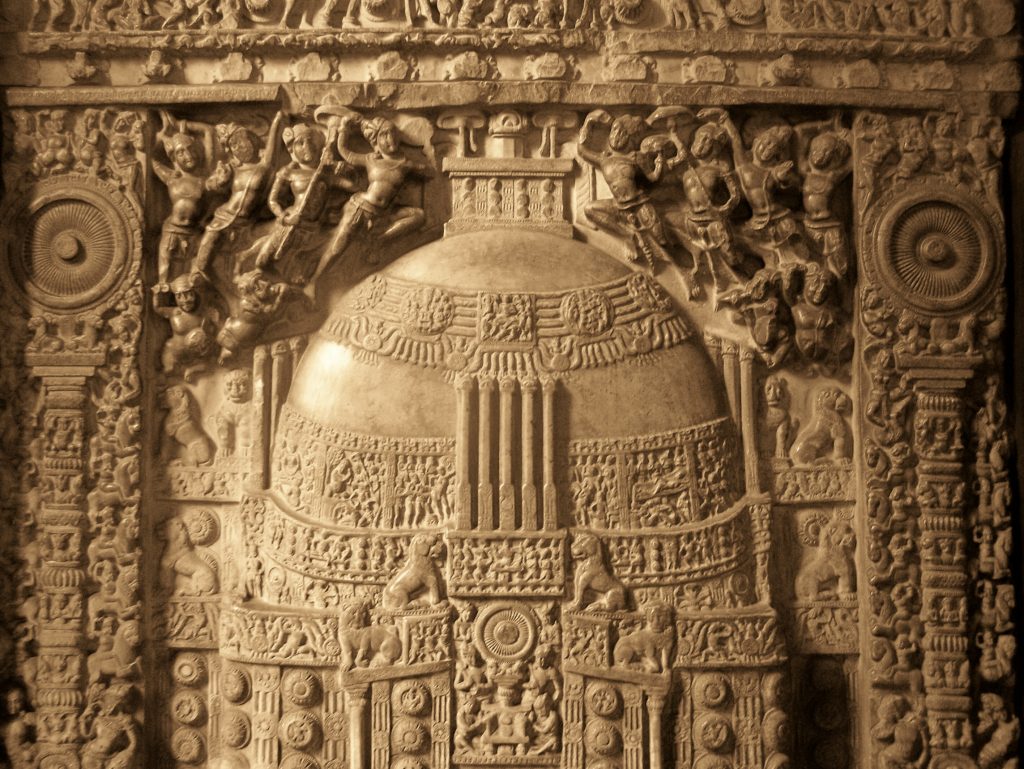
Source: Tricycle: The Buddhist Review — Amaravati Stupa: Origin of Origins · tricycle.org
Trap: Amaravati is in Andhra Pradesh, not the Amaravati city in same state
Trap: Nagarjunakonda is now underwater due to Nagarjuna Sagar dam construction
Trap: Both are Buddhist sites, not Hindu or Jain despite being in South India
Trap: Amaravati school is distinct from Gandhara and Mathura schools of Buddhist art