‘Belt and Road Initiative’ is sometimes mentioned in the news in the context of the affairs of
Contents15
- AAfrican Union
- BBrazil
- CEuropean Union
- DChina
Show answer
Answer: (D) China
Answer: (d) China
The 'Belt and Road Initiative' (BRI), also known as 'One Belt One Road' (OBOR), is associated with China.
Key facts about BRI:
• Unveiled by Chinese President Xi Jinping in 2013
• Has two main components:
- Silk Road Economic Belt (SREB) — land-based route through Central Asia to Europe
- 21st Century Maritime Silk Road (MSR) — sea route through Southeast Asia, Indian Ocean, to Africa and Europe
• Aims to improve connectivity and cooperation across Asia, Europe, and Africa
• Involves building roads, railways, ports, pipelines, fiber-optic cables, and other infrastructure
• The China-Pakistan Economic Corridor (CPEC) is one of its most prominent projects
• India has opposed BRI because CPEC passes through Pakistan-Occupied Kashmir (PoK)
Why other options are wrong:
• (a) African Union — has its own development agenda (Agenda 2063), not BRI
• (b) Brazil — not associated with BRI
• (c) European Union — has its own connectivity strategy, different from BRI
The correct answer is (d) China.
The Belt and Road Initiative is China's flagship foreign policy project launched in 2013, involving infrastructure development across Asia, Europe, and Africa worth hundreds of billions of dollars.
India has consistently opposed BRI since its launch because the China-Pakistan Economic Corridor passes through Pakistan-Occupied Kashmir, making this a key India-China friction point that UPSC regularly tests.
The question tests whether students can distinguish between major powers and their signature international initiatives rather than just memorizing BRI as a China project.
Belt and Road Initiative (BRI)
World Affairs (International Relations) Belt and Road Initiative
Belt and Road Initiative: China's Global Connectivity Project
Belt and Road Initiative (BRI) is China's massive connectivity project launched by Xi Jinping in 2013
Has two components: Silk Road Economic Belt (land) and 21st Century Maritime Silk Road (sea)
China-Pakistan Economic Corridor (CPEC) is the flagship project worth $62 billion
India opposes BRI because CPEC passes through Pakistan-Occupied Kashmir
The Belt and Road Initiative is China's trillion-dollar infrastructure strategy to connect Asia, Europe, and Africa through massive infrastructure projects. It represents China's vision of creating a modern version of the ancient Silk Road trade routes.
Two Components of BRI
Component | Route | Coverage | Key Infrastructure |
|---|---|---|---|
Silk Road Economic Belt (SREB) | Land-based | China → Central Asia → Europe | Railways, roads, pipelines, fiber optics |
21st Century Maritime Silk Road (MSR) | Sea-based | China → Southeast Asia → Indian Ocean → Africa → Europe | Ports, shipping lanes, naval facilities |
Key Features
Covers over 60 countries representing 60% of global population
Total investment estimated at $1 trillion over multiple decades
Focuses on connectivity infrastructure: ports, railways, roads, airports, power plants
China provides funding through Asian Infrastructure Investment Bank (AIIB) and bilateral loans
Aims to boost trade, economic growth, and Chinese influence globally
Major BRI Projects
Project | Countries | Investment | Significance |
|---|---|---|---|
China-Pakistan Economic Corridor (CPEC) | China-Pakistan | $62 billion | Flagship project, connects Gwadar Port to Xinjiang |
Piraeus Port | Greece | $600 million | China's gateway to Europe through Mediterranean |
Jakarta-Bandung High Speed Rail | Indonesia | $6 billion | First high-speed rail in Southeast Asia |
Djibouti Naval Base | Djibouti | $590 million | China's first overseas military base |
BRI Route Map

Source: BYJU'S — The Silk Road Economic Belt (Belt and Road Initiative) · byjus.com
India's Opposition to BRI
CPEC passes through Pakistan-Occupied Kashmir (PoK), violating India's sovereignty claims
India boycotted BRI Forum in 2017 citing sovereignty concerns
Fears debt trap diplomacy where countries mortgage strategic assets to China
Promotes alternative connectivity through International North-South Transport Corridor (INSTC)
Supports Indo-Pacific Strategy as counter to Chinese dominance
BRI vs OBOR: Same project, BRI is the current official name, OBOR was the original name
Don't confuse with AIIB: AIIB is the funding mechanism, BRI is the connectivity strategy
Maritime Silk Road is NOT only about ships: includes ports, coastal railways, and inland connections
CPEC is part of BRI: It's not a separate Chinese initiative but the flagship BRI corridor
China-Pakistan Economic Corridor (CPEC)
World Affairs (International Relations)
CPEC: The Flagship BRI Project & India's Sovereignty Concerns
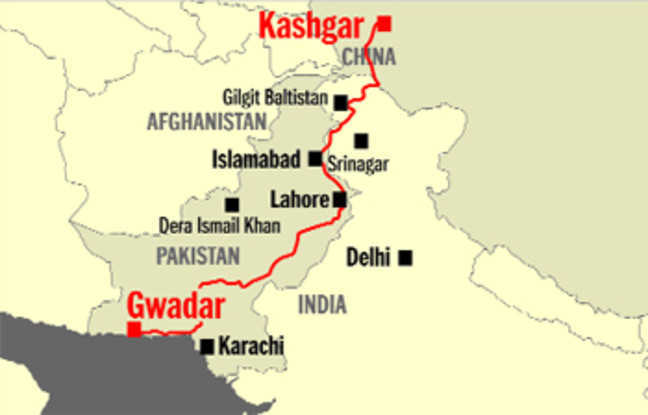
CPEC is a $62 billion corridor connecting China's Xinjiang to Pakistan's Gwadar Port
Part of CPEC passes through Pakistan-Occupied Kashmir (PoK), violating India's territorial claims
Gwadar Port gives China access to Arabian Sea and Indian Ocean
The China-Pakistan Economic Corridor is the flagship project of China's Belt and Road Initiative, creating a direct trade route from China's western regions to the Arabian Sea. However, it has become a major source of India-China tensions due to sovereignty issues.
CPEC Route
%%{init: {"flowchart": {"wrappingWidth": 460}}}%%
flowchart TD
  s1["`****Kashgar, Xinjiang** (China)**
Starting point in China's western province`"]
  s2["`****Karakoram Highway** through PoK**
Passes through Pakistan-Occupied Kashmir - India's objection point`"]
  s3["`****Islamabad & Lahore****
Major Pakistani cities with infrastructure upgrades`"]
  s4["`****Gwadar Port, Balochistan****
Deep-water port on Arabian Sea - China's strategic asset`"]
  s1 --> s2
  s2 --> s3
  s3 --> s4
CPEC Components
Component | Investment | Strategic Value | Concerns |
|---|---|---|---|
Gwadar Port | $1.6 billion | China's naval access to Indian Ocean | Encirclement of India |
Karakoram Highway upgrade | $27 billion | All-weather China-Pakistan connectivity | Passes through PoK |
Power projects | $28 billion | Addresses Pakistan's energy crisis | Debt sustainability issues |
Railways & roads | $5.5 billion | Improved inland connectivity | Chinese worker influx |
India's Strategic Concerns
Sovereignty violation: CPEC legitimizes Pakistani occupation of Kashmir
String of Pearls: Part of China's strategy to encircle India through naval bases
Economic dependence: Pakistan's growing debt to China affects regional balance
Military implications: Gwadar Port can host Chinese naval vessels near Indian waters
CPEC Route Map
Source: Drishti IAS — China Pakistan Economic Corridor (CPEC) · www.drishtiias.com
CPEC ≠ entire BRI: CPEC is one corridor within the broader Belt and Road Initiative
Gwadar is in Balochistan, NOT Sindh: Location matters for understanding regional dynamics
India opposes BRI because of CPEC, not vice versa: The sovereignty issue drives the broader opposition
India's Position on BRI
World Affairs (International Relations)
India's Strategic Response to China's Belt and Road Initiative
India boycotted BRI Forum 2017 citing sovereignty and territorial integrity concerns
Promotes alternative connectivity initiatives like INSTC and Asia-Africa Growth Corridor
Partners with USA, Japan, Australia in Indo-Pacific strategy to counter Chinese influence
India has consistently opposed the Belt and Road Initiative, making it the only major power to boycott BRI summits. This opposition stems from both sovereignty concerns and broader strategic competition with China in the Indo-Pacific region.
India's Objections to BRI
Concern | Specific Issue | India's Stand | Impact |
|---|---|---|---|
Sovereignty | CPEC through PoK | Violates territorial integrity | Complete rejection of BRI |
Debt Trap | Unsustainable Chinese loans | Fears strategic asset seizure | Warns partner countries |
Transparency | Lack of open bidding | Demands inclusive processes | Promotes multilateral alternatives |
Environmental | Ecological damage in projects | Seeks sustainable development | Supports green financing |
India's Alternative Connectivity Strategy
# India's Connectivity Vision
## **Westward**
- International North-South Transport Corridor (INSTC)
- Chabahar Port (Iran)
- India-Middle East-Europe Corridor
## **Eastward**
- Act East Policy
- India-Myanmar-Thailand Highway
- Kaladan Multi-Modal Project
## **Maritime**
- Sagarmala Project
- Asia-Africa Growth Corridor
- Indo-Pacific Maritime Domain
## **Multilateral**
- QUAD Connectivity
- International Solar Alliance
- Coalition for Disaster Resilient Infrastructure
Strategic Partnerships Against BRI
QUAD partnership with USA, Japan, Australia for Indo-Pacific connectivity
Japan partnership in Asia-Africa Growth Corridor as BRI alternative
European Union cooperation in sustainable connectivity projects
ASEAN engagement through Act East Policy and infrastructure partnerships
India hasn't joined BRI: Unlike most countries, India remains completely outside BRI framework
INSTC is NOT anti-China: It's an alternative route, not specifically designed to counter China
Chabahar vs Gwadar: India's Chabahar Port (Iran) competes with China's Gwadar Port (Pakistan)
Act East ≠ BRI opposition: Act East Policy predates BRI but serves as connectivity alternative