Consider the following types of vehicles: I. Full battery electric vehicles II. Hydrogen fuel cell vehicles III. Fuel cell-electric hybrid vehicles How many of the above are considered as alternative powertrain vehicles?
Contents18
- AOnly one
- BOnly two
- CAll the three
- DNone
Show answer
Answer: (C) All the three
A powertrain is the complete system in a vehicle that generates power and delivers it to the wheels — it includes the engine, transmission, and drivetrain.
An 'alternative powertrain' simply means any powertrain that is NOT the traditional Internal Combustion Engine (ICE).
Now let's check each option:
(I) Full battery electric vehicles (BEVs) — These run entirely on electricity stored in batteries. There is no ICE at all. So this is clearly an alternative powertrain. ✓
(II) Hydrogen fuel cell vehicles (FCEVs) — These use hydrogen fuel cells to generate electricity, which then powers electric motors. Again, no ICE involved. This is an alternative powertrain. ✓
(III) Fuel cell-electric hybrid vehicles — These combine a fuel cell with a battery or other electric storage system. They still don't use a conventional ICE. So this too is an alternative powertrain. ✓
Since all three use non-ICE propulsion systems, all three are alternative powertrain vehicles. The answer is (c).
India's National Hydrogen Mission (2021) and PLI schemes for battery manufacturing have made alternative powertrains a priority policy area with significant government investment.
The question tests understanding that 'alternative powertrain' simply means any non-ICE system, so all electric and hydrogen-based vehicles qualify regardless of their specific configuration.
Alternative Powertrain Vehicles
Science And Technology alternative powertrain vehicles Full battery electric vehicles Hydrogen fuel cell vehicles Fuel cell-electric hybrid vehicles
Alternative Powertrain Vehicles: Types & Technology
Alternative powertrain = any vehicle propulsion system that is NOT a traditional Internal Combustion Engine (ICE)
BEVs, FCEVs, and hybrids are ALL alternative powertrains since they avoid conventional ICE
Powertrain = complete system that generates power and delivers it to wheels (engine + transmission + drivetrain)
Fuel cells generate electricity from hydrogen to power electric motors
What is a Powertrain?
A powertrain is the complete system in a vehicle that generates power and delivers it to the wheels. It includes the engine, transmission, and drivetrain components. An alternative powertrain simply means any propulsion system that replaces the traditional Internal Combustion Engine (ICE) with cleaner technology.
Types of Alternative Powertrains
Vehicle Type | Power Source | Key Technology | ICE Present? |
|---|---|---|---|
Battery Electric Vehicle (BEV) | Electricity from battery | Electric motor + lithium-ion battery | No |
Hydrogen Fuel Cell Vehicle (FCEV) | Hydrogen fuel cell | Fuel cell stack + electric motor | No |
Fuel Cell-Electric Hybrid | Fuel cell + battery/supercapacitor | Combined fuel cell + electric storage | No |
How Each Technology Works
BEVs store electricity in large batteries and use electric motors for propulsion — zero direct emissions
FCEVs convert hydrogen gas into electricity through fuel cells, producing only water vapor as exhaust
Hybrid fuel cell vehicles combine fuel cells with batteries or supercapacitors for better efficiency and performance
All three avoid burning fossil fuels directly in the vehicle, making them zero-emission at the point of use
Question Analysis
This question tested the fundamental definition of alternative powertrain. The trap was thinking some hybrid systems might still count as conventional vehicles. Since all three options use electric propulsion without traditional ICE, all qualify as alternative powertrains.
Trap: Thinking hybrids always mean ICE + electric — fuel cell hybrids are fuel cell + battery, no ICE
Trap: Confusing alternative fuel (CNG, LPG) with alternative powertrain (non-ICE systems)
Trap: Assuming hydrogen vehicles are not 'electric' — FCEVs are actually electric vehicles powered by fuel cells
Hydrogen Fuel Cell Technology
Science And Technology Hydrogen fuel cell vehicles fuel cell
Hydrogen Fuel Cell Technology: Mechanism & Applications
Fuel cells convert hydrogen and oxygen into electricity through electrochemical reaction
Only byproduct is water vapor — completely clean at point of use
FCEVs refuel with hydrogen gas in 3-5 minutes, similar to conventional vehicles
Range typically 300-400 km per fill, competing with ICE vehicles
How Fuel Cells Work
A fuel cell is an electrochemical device that converts hydrogen and oxygen into electricity. Unlike batteries that store energy, fuel cells generate electricity as long as hydrogen fuel is supplied. The only byproduct is pure water vapor.
Fuel Cell Operation
%%{init: {"flowchart": {"wrappingWidth": 460}}}%%
flowchart TD
  s1["`**Hydrogen Input**
**H₂** gas enters fuel cell stack`"]
  s2["`**Electrochemical Reaction**
Hydrogen splits into **protons + electrons** at anode`"]
  s3["`**Electricity Generation**
Electrons flow through circuit creating **electric current**`"]
  s4["`**Water Formation**
Protons + electrons + oxygen = **H₂O** (water vapor)`"]
  s5["`**Motor Power**
Electricity powers **electric motor** for propulsion`"]
  s1 --> s2
  s2 --> s3
  s3 --> s4
  s4 --> s5
Advantages of FCEVs
Fast refueling — hydrogen tanks fill in 3-5 minutes vs hours for battery charging
Long range — typically 300-400 km per fill, matching conventional vehicles
Zero emissions — only water vapor produced during operation
All-weather performance — fuel cells work efficiently in cold temperatures unlike batteries
Fuel Cell System
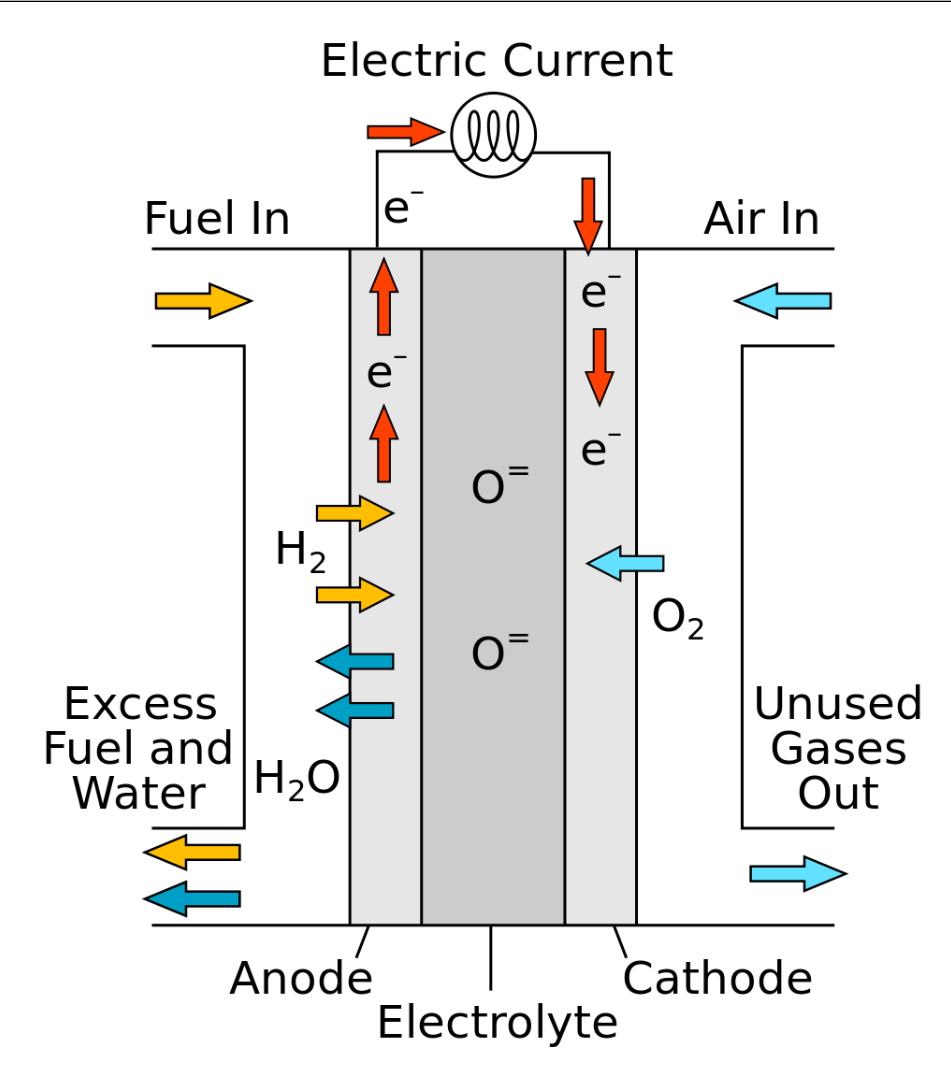
Source: Stargate Hydrogen — The Basics of Hydrogen Electrolysis · stargatehydrogen.com
Trap: Thinking fuel cells burn hydrogen — they use electrochemical conversion, not combustion
Trap: Confusing hydrogen ICE (burns H₂) with fuel cell vehicles (electrochemical H₂)
Trap: Assuming FCEVs are not electric vehicles — they ARE electric, powered by fuel cell-generated electricity
Electric Vehicle Classification
Science And Technology Full battery electric vehicles hybrid
Electric Vehicle Types: BEV, HEV & Hybrid Classifications
BEV (Battery Electric Vehicle) runs entirely on stored electricity — no ICE
HEV (Hybrid Electric Vehicle) combines ICE + electric motor + battery
PHEV (Plug-in Hybrid) = HEV that can charge from external power source
Fuel cell hybrids combine fuel cells with batteries — no ICE involved
Electric Vehicle Categories
Type | Power Source | ICE Present | Charging Method | Example |
|---|---|---|---|---|
BEV | Battery only | No | Plug-in charging | Tesla Model 3 |
HEV | ICE + Battery | Yes | Regenerative braking | Toyota Prius |
PHEV | ICE + Battery | Yes | Plug-in + regenerative | Chevrolet Volt |
FCEV | Fuel cell + Battery | No | Hydrogen refueling | Toyota Mirai |
FC-Hybrid | Fuel cell + Battery | No | H₂ + regenerative | Bus applications |
Key Distinctions
BEVs have the largest batteries (40-100+ kWh) since they rely entirely on stored electricity
Traditional hybrids cannot plug in — they only charge through regenerative braking and ICE
Fuel cell hybrids use small batteries to store excess fuel cell energy and regenerative braking power
Range anxiety decreases: BEV (150-500 km) → PHEV (50+ km electric) → FCEV (300-400 km)
Electric Propulsion Systems
# Electric Propulsion
## Battery-Only
- BEV (pure electric)
- No ICE
- Plug-in charging
- Large battery pack
## ICE Hybrid
- HEV (parallel/series)
- PHEV (plug-in)
- Small battery
- Regenerative braking
## Fuel Cell
- FCEV (hydrogen)
- FC-Hybrid (H₂+battery)
- No ICE
- H₂ refuelingTrap: Thinking all hybrids have ICE — fuel cell hybrids are fuel cell + battery with no ICE
Trap: Confusing HEV vs PHEV — PHEVs can plug in, regular HEVs cannot
Trap: Assuming BEV means any battery-powered vehicle — FCEVs also have batteries but aren't BEVs
India's Electric Vehicle Policy
Indian Economy
India's Electric Vehicle Mission: Policies & Targets
FAME II scheme provides subsidies for electric vehicle purchase and charging infrastructure
Target: 30% EV adoption by 2030 across all vehicle segments
PLI scheme for battery manufacturing to reduce import dependence
National Hydrogen Mission launched 2021 for hydrogen fuel cell development
Policy Framework
India launched the National Electric Mobility Mission Plan (NEMMP) 2020 to promote electric vehicles for energy security and reduced emissions. The FAME (Faster Adoption and Manufacturing of Electric Vehicles) scheme is the flagship program providing financial incentives.
Key EV Initiatives
Scheme | Focus Area | Budget/Target | Key Benefit |
|---|---|---|---|
FAME II | EV adoption + infrastructure | ₹10,000 crore | Purchase subsidies + charging stations |
PLI - Battery | Domestic manufacturing | ₹18,100 crore | 50 GWh battery capacity by 2030 |
National Hydrogen Mission | Green hydrogen production | ₹19,744 crore | Fuel cell vehicle development |
Saarthi Portal | EV awareness | Information hub | Buyer guidance + incentives |
Vehicle Scrappage Policy | Old vehicle replacement | Incentive-based | EV adoption boost |
India's EV Targets
30% electric mobility by 2030 across all vehicle categories
1 million charging stations to support EV infrastructure by 2030
50 GWh battery manufacturing capacity through PLI scheme incentives
Green hydrogen production of 5 MMT annually by 2030 for fuel cell vehicles
Trap: Confusing FAME I (2015-2019, ₹895 crore) with FAME II (2019-2024, ₹10,000 crore)
Trap: Mixing up National Hydrogen Mission (2021) with National Solar Mission (different program)
Trap: Assuming India only focuses on battery EVs — hydrogen fuel cell development is also prioritized