Regarding Peacock tarantula (Gooty tarantula), consider the following statements: I. It is an omnivorous crustacean. II. Its natural habitat in India is only limited to some forest areas. III. In its natural habitat, it is an arboreal species. Which of the statements given above is/are correct?
Contents17
- AI only
- BI and III
- CII only
- DII and III
Show answer
Answer: (D) II and III
Let's evaluate each statement about the Peacock tarantula (Gooty tarantula, scientific name: Poecilotheria metallica):
(I) 'It is an omnivorous crustacean' — INCORRECT on two counts.
First, a tarantula is an arachnid (spider), NOT a crustacean.
Crustaceans include crabs, shrimp, and lobsters — a completely different class of arthropods.
Second, tarantulas are carnivores/insectivores — they eat insects, small lizards, and other small animals.
They are NOT omnivores. ✗ (Two mistakes in one statement!)
(II) 'Its natural habitat in India is limited to some forest areas' — CORRECT.
The Gooty tarantula is found only in a very small area of deciduous forest near Giddalur and Nandyal in Andhra Pradesh.
It has an extremely restricted range, which is why it is classified as Critically Endangered on the IUCN Red List. ✓
(III) 'In its natural habitat, it is an arboreal species' — CORRECT.
The Gooty tarantula lives in trees (arboreal), making its home in holes and crevices in tall trees.
This is unusual because many tarantula species are ground-dwelling.
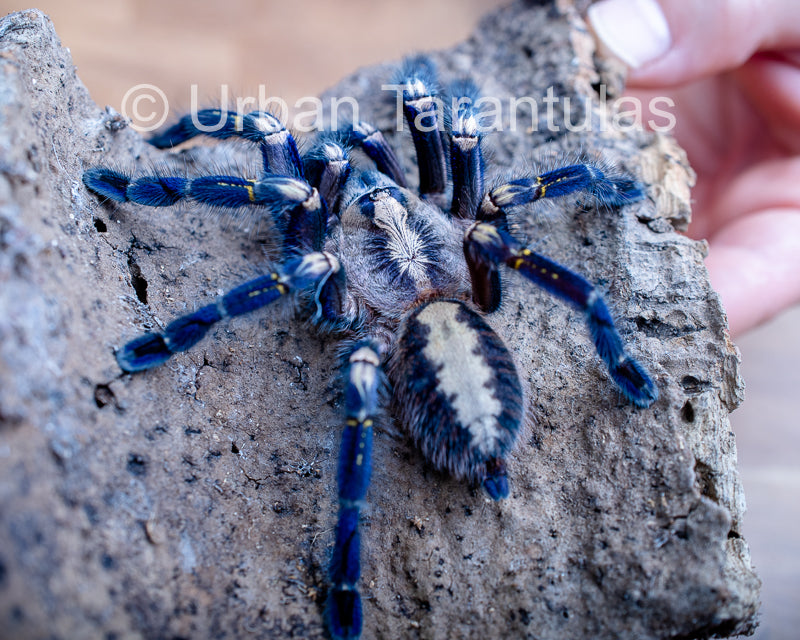
Its striking metallic blue coloration makes it one of the most visually spectacular spiders in the world. ✓
Statements II and III are correct. Answer is (d).
The Gooty tarantula is found only in a tiny area of Andhra Pradesh forests and is Critically Endangered on the IUCN Red List due to habitat loss and illegal collection for the pet trade.
UPSC is testing basic taxonomy knowledge by including a false statement that calls a spider (arachnid) a crustacean, which are completely different classes of arthropods.
The question combines conservation status with biological classification, requiring students to know both endangered species geography and animal taxonomy.
Gooty Tarantula (Peacock Tarantula)
Environment Peacock tarantula Gooty tarantula
Gooty Tarantula: India's Critically Endangered Arboreal Spider
Poecilotheria metallica found only in Andhra Pradesh forests near Giddalur and Nandyal
Arboreal species living in tree holes, unlike most ground-dwelling tarantulas
Critically Endangered on IUCN Red List due to extremely restricted range
Carnivorous arachnid feeding on insects and small animals
Basic Identity
The Gooty tarantula (Poecilotheria metallica) is one of India's most spectacular endemic spiders, known for its metallic blue coloration. Despite its common name suggesting peacock-like beauty, it belongs to the arachnid class - specifically spiders, not crustaceans.
Key Characteristics
Aspect | Details |
|---|---|
Scientific Name | Poecilotheria metallica |
Classification | Arachnid (Class: Arachnida, Order: Araneae) |
Diet | Carnivorous - insects, small lizards, frogs |
Habitat Type | Arboreal (tree-dwelling) |
Location in India | Andhra Pradesh - Giddalur and Nandyal forests |
Conservation Status | Critically Endangered (IUCN Red List) |
Distinctive Feature | Metallic blue leg coloration |
Habitat & Behavior
Unlike most tarantula species that are ground-dwelling, the Gooty tarantula is strictly arboreal. It creates webs and shelters in tree holes and bark crevices of tall deciduous trees. Its extremely restricted range covers less than 100 square kilometers of forest area.
Visual Identification
Source: Urban Tarantulas — Gooty Sapphire Ornamental Tarantula for Sale | Poecilotheria ... · www.urbantarantulas.com
Trap: Statement I calls it a crustacean - tarantulas are arachnids (8 legs), not crustaceans (10+ legs like crabs)
Trap: Statement I calls it omnivorous - all tarantulas are carnivorous predators
Common confusion: Thinking all spiders are ground-dwelling - Gooty tarantula is arboreal (tree-living)
UPSC pattern: Testing classification confusion between arthropod classes (arachnids vs crustaceans vs insects)
Arachnids vs Crustaceans Classification
Environment
Arthropod Classification: Distinguishing Arachnids from Crustaceans
Arachnids: 8 legs, 2 body segments, terrestrial (spiders, scorpions)
Crustaceans: 10+ legs, 3 body segments, mostly aquatic (crabs, shrimp)
Both belong to Phylum Arthropoda but different classes
Classification Context
Both arachnids and crustaceans belong to Phylum Arthropoda (joint-legged animals) but represent distinct evolutionary lineages with different body plans and ecological adaptations.
Key Differences
Feature | Arachnids | Crustaceans |
|---|---|---|
Number of Legs | 8 legs | 10+ legs (usually) |
Body Segments | 2 segments (cephalothorax + abdomen) | 3 segments (head + thorax + abdomen) |
Antennae | No antennae | 2 pairs of antennae |
Habitat | Mostly terrestrial | Mostly aquatic/marine |
Breathing | Book lungs or tracheae | Gills |
Examples | Spiders, scorpions, ticks, mites | Crabs, lobsters, shrimp, barnacles |
Class Name | Arachnida | Crustacea |
Memory Aids
"8-legged spiders" - arachnids always have 8 legs (except when injured)
"Crab = Crustacea" - crabs are the classic crustacean with 10 walking legs
"No antenna on arachnids" - spiders have no feelers, crabs have 4 antennae total
"Water = Crustacea" - most crustaceans live in water, most arachnids on land
UPSC loves this confusion: Calling spiders/scorpions "crustaceans" or vice versa
Counting legs wrong: Arachnids = exactly 8, insects = exactly 6, crustaceans = 10 or more
Habitat assumption: Not all arthropods are insects - spiders are terrestrial arachnids, not aquatic
Arboreal vs Terrestrial Adaptations
Environment arboreal species
Ecological Adaptations: Arboreal vs Terrestrial Lifestyles
Arboreal = tree-dwelling species adapted for life in forest canopy
Terrestrial = ground-dwelling species adapted for surface/soil life
Different body adaptations for climbing vs ground movement
Habitat Definitions
Arboreal species spend most of their lives in trees, while terrestrial species live primarily on or in the ground. These represent fundamentally different ecological strategies within forest ecosystems.
Comparative Adaptations
Adaptation | Arboreal Species | Terrestrial Species |
|---|---|---|
Movement | Climbing, jumping between branches | Walking, running, burrowing on ground |
Body Build | Lighter, more flexible limbs | Heavier, stronger legs for support |
Grip/Claws | Sharp claws, adhesive pads for branches | Broad feet, digging claws for ground |
Shelter | Tree holes, leaf nests, bark crevices | Burrows, ground nests, rock cracks |
Feeding Strategy | Ambush from trees, aerial hunting | Ground foraging, pursuit hunting |
Examples (Spiders) | Gooty tarantula, jumping spiders | Wolf spiders, trap-door spiders |
Examples (Mammals) | Monkeys, squirrels, sloths | Elephants, tigers, deer |
UPSC Context
Habitat questions often test whether students know if a species is arboreal or terrestrial
Conservation implications: Arboreal species need intact forest canopy, terrestrial species need ground cover
Ecosystem roles: Arboreal species connect vertical forest layers, terrestrial species cycle ground nutrients
Endemic & Endangered Species in India
Environment
India's Endemic & Endangered Fauna: Conservation Challenges
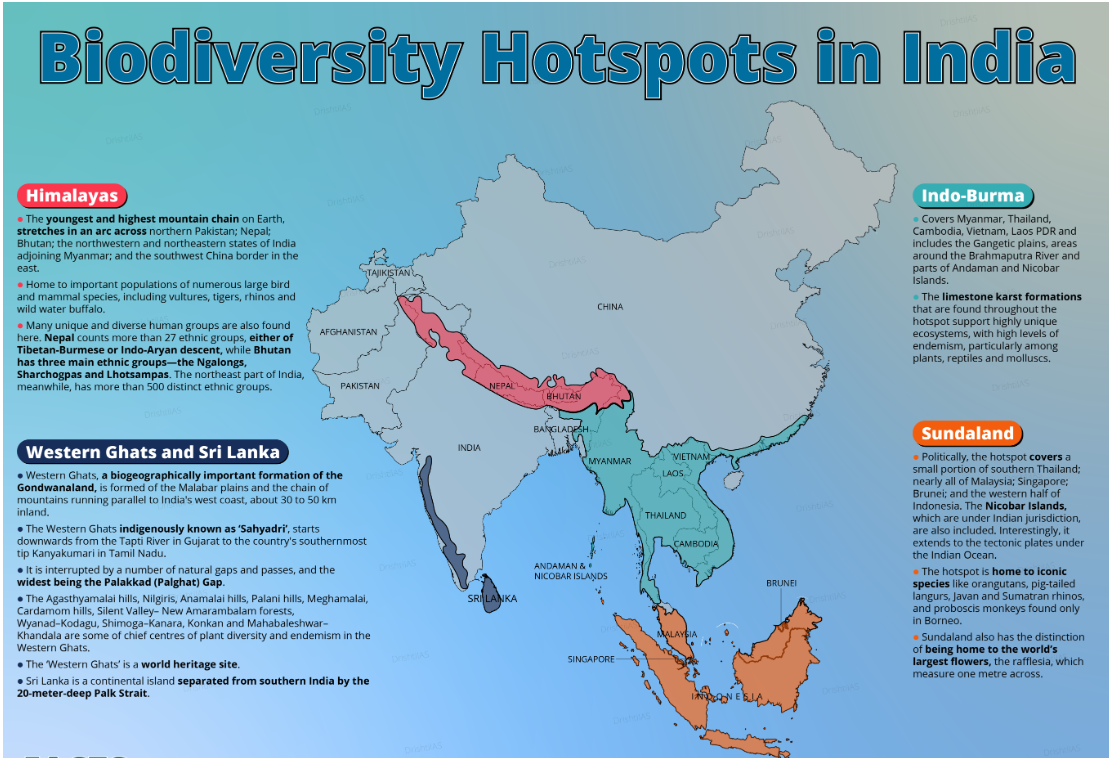
India has 36 biodiversity hotspots with high endemism rates
Western Ghats and Eastern Himalayas are mega-diversity regions
Habitat loss is primary threat to endemic species survival
Endemism in India
India's diverse ecosystems support numerous endemic species - those found nowhere else in the world. The Western Ghats alone hosts over 5,000 flowering plant species with 40% endemism rate.
Notable Endemic Species by Region
Region | Endemic Species Examples | Conservation Status | Threats |
|---|---|---|---|
Western Ghats | Lion-tailed macaque, Nilgiri tahr | Endangered | Habitat fragmentation |
Eastern Himalayas | Red panda, Hoolock gibbon | Endangered | Deforestation, climate change |
Andhra Pradesh | Gooty tarantula | Critically Endangered | Forest clearance |
Northeast India | Manipur bush quail, Arunachal macaque | Vulnerable | Hunting, habitat loss |
Andaman Islands | Andaman day gecko, Nicobar pigeon | Near Threatened | Tourism pressure |
Biodiversity Hotspots
Source: Drishti CUET — Biodiversity Hotspot · www.drishticuet.com
Geographic confusion: Gooty tarantula is Andhra Pradesh endemic, not Western Ghats
Status mixing: Endemic (geographic restriction) vs Endangered (population threat) are different concepts
Habitat assumptions: Not all Indian endemics are forest species - some are grassland/wetland specialists