Consider the following statements in respect of the Non-Cooperation Movement: I. The Congress declared the attainment of 'Swaraj' by all legitimate and peaceful means to be its objective. II. It was to be implemented in stages with civil disobedience and non-payment of taxes for the next stage only if 'Swaraj' did not come within a year and the Government resorted to repression. Which of the statements given above is/are correct?
Contents24
- AI only
- BII only
- CBoth I and II
- DNeither I nor II
Show answer
Answer: (C) Both I and II
Let's evaluate both statements about the Non-Cooperation Movement:
(I) 'Congress declared attainment of Swaraj by all legitimate and peaceful means as its objective' — CORRECT.
At the Nagpur session of the Indian National Congress in December 1920, the Congress formally adopted the goal of 'Swaraj' (self-rule) to be achieved by peaceful and legitimate means.
This was a significant shift from the earlier goal of seeking reforms within the British system.
The word 'Swaraj' was left deliberately vague — it could mean dominion status or complete independence, depending on interpretation. ✓
(II) 'It was to be implemented in stages with civil disobedience and non-payment of taxes as the next stage' — CORRECT.
Gandhi planned the movement in phases.
The first phase involved the surrender of titles, boycott of schools/courts/legislatures, and promotion of swadeshi.
The NEXT stage — civil disobedience including mass non-payment of taxes — was planned for later, to be launched only if Swaraj was not achieved within a year or if the government resorted to repression.
However, this second phase was never fully implemented because Gandhi called off the movement after the Chauri Chaura incident in February 1922. ✓
Both statements are correct. Answer is (c).
The Nagpur Congress session of 1920 marked the first time Congress officially adopted 'Swaraj' as its goal, replacing the earlier moderate demand for reforms within British rule.
Gandhi's phased approach to non-cooperation shows his strategic thinking - he planned escalation to civil disobedience and tax resistance only if the initial boycotts failed to achieve Swaraj within one year.
The question tests whether students understand that the Non-Cooperation Movement had a deliberate escalation strategy, not just random protest tactics.
Non-Cooperation Movement (1920-22)
Modern Indian History Non-Cooperation Movement Swaraj civil disobedience non-payment of taxes
Non-Cooperation Movement: Strategy, Phases & UPSC Facts
Quick Revision
Nagpur Congress Session (December 1920) adopted Swaraj as objective through peaceful means
Planned in two phases — first phase actual implementation, second phase civil disobedience reserved
Called off after Chauri Chaura incident (February 1922) — second phase never fully launched
Gandhi's first mass movement — combined with Khilafat Movement for Hindu-Muslim unity
Context & Launch
The Non-Cooperation Movement marked Gandhi's first nationwide mass movement in India. Launched in 1920, it combined opposition to British rule with support for the Khilafat Movement, creating unprecedented Hindu-Muslim unity. The movement represented a shift from elite constitutional politics to mass mobilization using satyagraha principles.
Two-Phase Strategy
Phase | Activities | Timeline | Status |
|---|---|---|---|
Phase I | Surrender titles, boycott schools/courts/legislatures, promote swadeshi | 1920-1922 | Implemented |
Phase II | Civil disobedience, mass non-payment of taxes | After 1 year or if repression | Never launched |
Key Decisions & Changes
Nagpur Congress (Dec 1920): Adopted Swaraj as objective — term deliberately kept vague (could mean dominion status or complete independence)
Peaceful means only: Congress committed to achieving Swaraj through legitimate, non-violent methods
Conditional escalation: Second phase (civil disobedience) planned only if Swaraj not achieved within one year OR government used repression
Mass participation: Unlike earlier elite movements, this mobilized students, women, peasants, and urban middle class
Movement Timeline
%%{init: {"flowchart": {"wrappingWidth": 460}}}%%
flowchart TD
  s1["`****August 1920****
Gandhi launches movement, calls for boycott of British institutions`"]
  s2["`****December 1920****
**Nagpur Congress** formally adopts Swaraj objective and movement strategy`"]
  s3["`****1921****
Mass participation — boycott of schools, courts, foreign cloth; khadi promotion`"]
  s4["`****February 1922****
**Chauri Chaura incident** — violence breaks out, Gandhi calls off movement`"]
  s5["`****Result****
Phase II (civil disobedience) never implemented due to premature suspension`"]
  s1 --> s2
  s2 --> s3
  s3 --> s4
  s4 --> s5
Question Connection
This PYQ tests understanding of the planned vs actual implementation of the movement. Many students confuse what Gandhi outlined as strategy with what actually happened — the second phase was planned but never executed due to Chauri Chaura.
Trap: Assuming civil disobedience was fully implemented — it was only planned for Phase II
Trap: Confusing Non-Cooperation (1920-22) with Civil Disobedience Movement (1930-34) which actually implemented mass civil disobedience
Trap: Thinking Swaraj meant only complete independence — Congress kept it deliberately ambiguous
Trap: Missing that movement was called off before the conditional triggers (1 year deadline/repression) for Phase II
Swaraj: Meaning & Evolution
Modern Indian History Swaraj
Swaraj Concept: From Tilak to Gandhi's Strategic Ambiguity
Quick Revision
Swaraj = self-rule, first popularized by Bal Gangadhar Tilak
Nagpur Congress (1920) made Swaraj official Congress objective — kept deliberately vague
Could mean dominion status (like Canada) OR complete independence depending on interpretation
Lahore Congress (1929) clarified it as Purna Swaraj (complete independence)
Strategic Ambiguity
When Congress adopted Swaraj as its objective in 1920, the term was kept deliberately ambiguous. This allowed both moderates (who preferred dominion status within the British Empire) and radicals (who wanted complete independence) to support the same goal while interpreting it differently.
Evolution of Congress Objectives
Period | Objective | Meaning | Key Session |
|---|---|---|---|
1885-1905 | Constitutional reforms | Greater Indian participation in governance | Early Congress |
1906-1919 | Self-government | Dominion status within British Empire | Various sessions |
1920-1929 | Swaraj | Deliberately ambiguous — dominion OR independence | Nagpur 1920 |
1929 onwards | Purna Swaraj | Complete independence from British Empire | Lahore 1929 |
Why Ambiguity Worked
Unity: Allowed moderates and extremists to work together under one banner without splitting the party
Flexibility: Congress could negotiate for dominion status while keeping complete independence as backup
Mass appeal: Simple word 'Swaraj' resonated with common people who understood it as 'our rule'
British concern: Vague demand made it harder for British to dismiss as unreasonable separatism
Trap: Assuming Swaraj always meant complete independence — it was strategically ambiguous until 1929
Trap: Crediting Gandhi with coining 'Swaraj' — Tilak popularized it first
Trap: Confusing Nagpur 1920 (adopted Swaraj) with Lahore 1929 (clarified as Purna Swaraj)
Khilafat Movement & Alliance
Modern Indian History Khilafat Movement
Khilafat Movement: Gandhi's Hindu-Muslim Unity Strategy
Quick Revision
Movement to restore Ottoman Caliph's authority after WWI — led by Ali Brothers
Gandhi supported Khilafat to build Hindu-Muslim unity for independence struggle
Combined with Non-Cooperation Movement (1920-1922) — unprecedented communal harmony
Ended when Mustafa Kemal Ataturk abolished Caliphate (1924) — issue became irrelevant
Background & Gandhi's Strategy
After World War I, the British and Allies dismantled the Ottoman Empire and reduced the Caliph's (Islamic religious head) temporal powers. Indian Muslims, led by the Ali Brothers (Muhammad Ali and Shaukat Ali), launched the Khilafat Movement to restore the Caliph's authority. Gandhi saw this as an opportunity to unite Hindus and Muslims in a common struggle against British rule.
Khilafat-Non-Cooperation Alliance
Aspect | Khilafat Movement | Non-Cooperation Movement | Combined Impact |
|---|---|---|---|
Leadership | Ali Brothers, Maulana Azad | Gandhi, Congress | Joint leadership structure |
Objective | Restore Caliph's authority | Achieve Swaraj | Anti-British unity |
Community | Primarily Muslim | Primarily Hindu | Hindu-Muslim alliance |
Methods | Boycott, protests | Boycott, satyagraha | Coordinated resistance |
Significance & Outcomes
Unprecedented unity: First time Hindus and Muslims collaborated massively in a political movement
Mass mobilization: Combined strength made it the largest anti-British movement till then
Gandhi's credibility: His support for Muslim religious cause earned him respect across communities
Strategic success: Proved that religious and political issues could be combined for independence
Tragic end: Chauri Chaura violence (1922) led Gandhi to call off both movements simultaneously
Movement Geography
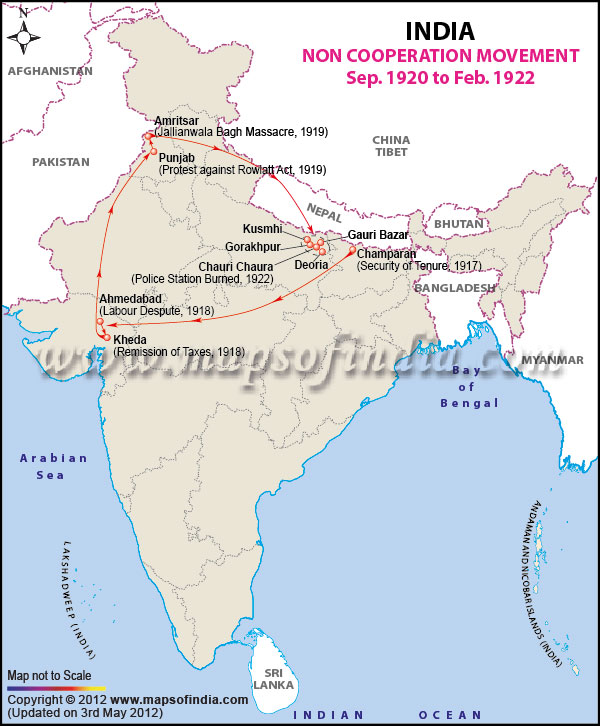
Source: India Map — Non Cooperation Movement - Mahatma Gandhi · www.mapsofindia.com
Trap: Thinking Khilafat was purely religious — it became a political anti-British tool
Trap: Assuming Gandhi initiated Khilafat — he supported the Ali Brothers' existing movement
Trap: Confusing end of movement — Khilafat ended when Ataturk abolished Caliphate (1924), not due to Chauri Chaura alone
Chauri Chaura Incident (1922)
Modern Indian History Chauri Chaura
Chauri Chaura: Gandhi's Non-Violence Test & Movement End
Quick Revision
February 4, 1922 — violent incident at Chauri Chaura (Uttar Pradesh) police station
Protesters burned police station, 22 policemen died — violated non-violence principle
Gandhi immediately called off entire Non-Cooperation Movement despite mass protests
Demonstrated Gandhi's uncompromising commitment to ahimsa over political gains
The Incident & Decision
On February 4, 1922, at Chauri Chaura in Gorakhpur district (UP), a peaceful procession of Non-Cooperation protesters clashed with police. When police opened fire, the crowd turned violent, burned the police station, and killed 22 policemen. Despite the movement's unprecedented success, Gandhi immediately suspended it, arguing that Indians were not yet ready for mass satyagraha.
Gandhi's Response Chain
%%{init: {"flowchart": {"wrappingWidth": 460}}}%%
flowchart TD
  s1["`****Violence erupts****
Chauri Chaura protesters kill 22 policemen, burn police station`"]
  s2["`****Gandhi's reaction****
Declares movement a 'Himalayan blunder', takes moral responsibility`"]
  s3["`****Immediate suspension****
Calls off entire Non-Cooperation Movement despite leader opposition`"]
  s4["`****Gandhi's arrest****
British arrest Gandhi (March 1922) — he gets 6 years imprisonment`"]
  s5["`****Movement collapse****
Without Gandhi's leadership, movement loses momentum completely`"]
  s1 --> s2
  s2 --> s3
  s3 --> s4
  s4 --> s5
Reactions to Gandhi's Decision
Group | Reaction | Reasoning | Long-term Impact |
|---|---|---|---|
Gandhi | Immediate suspension | Violence violated satyagraha principles | Maintained moral authority |
Congress leaders | Shocked opposition | Movement was succeeding, one incident shouldn't end it | Some lost faith in methods |
British | Relief | Avoided major confrontation, arrested Gandhi safely | Regained control temporarily |
Masses | Disappointment | Felt betrayed after massive sacrifice for movement | Disillusionment with non-violence |
Historical Significance
Ahimsa over politics: Gandhi chose moral principles over immediate political advantage — defining moment of his leadership
Mass movement lessons: Showed challenges of maintaining non-violence in large-scale movements with diverse participants
Strategic debate: Created lasting debate — should isolated violence derail entire peaceful movement?
British relief: Gave British breathing space to consolidate control without major confrontation
Future planning: Led Gandhi to focus on individual satyagraha and constructive program before next mass movement
Trap: Confusing date — February 4, 1922 (not 1921 or other years)
Trap: Mixing up casualties — 22 policemen died, not protesters
Trap: Assuming movement failed due to Chauri Chaura — it was succeeding when Gandhi called it off
Trap: Thinking other leaders supported suspension — most opposed Gandhi's decision