Consider the following statements: I. Without the atmosphere, temperature would be well below freezing point everywhere on the Earth's surface. II. Heat absorbed and trapped by the atmosphere maintains our planet's average temperature. III. Atmosphere's gases, like carbon dioxide, are particularly good at absorbing and trapping radiation. Which of the statements given above are correct?
Contents14
- AI and III only
- BI and II only
- CI, II and III
- DII and III only
Show answer
Answer: (C) I, II and III
(I) 'Without atmosphere, temperature would be below freezing everywhere' — CORRECT.
Without the atmosphere's greenhouse effect, Earth's average surface temperature would be about -18°C (compared to the actual average of about +15°C).
The Moon, which has virtually no atmosphere, has average surface temperature of about -23°C despite being at the same distance from the Sun as Earth. ✓
(II) 'Heat trapped by atmosphere maintains average temperature' — CORRECT.
The atmosphere absorbs outgoing infrared (heat) radiation from Earth's surface and re-radiates it in all directions, including back toward the surface.
This 'greenhouse effect' traps heat and maintains Earth's temperature at a level suitable for life.
Without this, all the heat from sunlight would escape back into space at night. ✓
(III) 'Gases like CO₂ are good at absorbing and trapping radiation' — CORRECT.
Greenhouse gases (CO₂, methane, water vapor, nitrous oxide) are particularly effective at absorbing infrared radiation.
Their molecular structure allows them to vibrate and absorb specific wavelengths of heat radiation that other gases (like N₂ and O₂, which make up 99% of the atmosphere) cannot absorb.
This is why even small concentrations of CO₂ have a significant warming effect. ✓
All three statements are correct. Answer is (c).
Without the atmosphere's greenhouse effect, Earth's average temperature would be about -18°C instead of +15°C, making the planet uninhabitable.
Climate change discussions since 2021 have focused heavily on greenhouse gas concentrations and the Paris Agreement commitments, making atmospheric heat balance a priority topic.
The question tests understanding of the fundamental greenhouse effect mechanism - how specific gases trap infrared radiation while others like nitrogen and oxygen cannot.
Greenhouse Effect Mechanism
Geography atmosphere temperature heat absorbed trapped
Greenhouse Effect: How Atmosphere Maintains Earth's Temperature
Without atmosphere, Earth's average temperature would be -18°C instead of +15°C
Atmosphere absorbs outgoing infrared radiation and re-radiates it back to surface
Greenhouse gases are particularly effective at trapping heat radiation
Even small concentrations of CO₂ have significant warming effect
What is Greenhouse Effect
The greenhouse effect is the process by which Earth's atmosphere traps heat from the Sun. Without this natural phenomenon, our planet would be a frozen wasteland unsuitable for life.
Solar radiation reaches Earth's surface and heats it
Earth re-radiates this energy as infrared (heat) radiation
Atmosphere absorbs and re-radiates this heat in all directions
Some heat returns to surface, some escapes to space
How Heat Gets Trapped
%%{init: {"flowchart": {"wrappingWidth": 460}}}%%
flowchart TD
  s1["`**Solar radiation hits Earth**
Sun's energy reaches Earth's surface as visible light`"]
  s2["`**Surface heats up and re-radiates**
Earth's surface converts solar energy to infrared (heat) radiation`"]
  s3["`**Atmosphere absorbs infrared**
Greenhouse gases absorb outgoing heat radiation`"]
  s4["`**Heat re-radiated in all directions**
Atmosphere sends heat both to space and back to Earth's surface`"]
  s5["`**Surface temperature increases**
Returned heat maintains Earth's average temperature at +15°C`"]
  s1 --> s2
  s2 --> s3
  s3 --> s4
  s4 --> s5
Earth vs Moon Temperature Comparison
Factor | Earth | Moon |
|---|---|---|
Distance from Sun | Same (~150 million km) | Same (~150 million km) |
Atmosphere | Dense atmosphere with greenhouse gases | Virtually no atmosphere |
Average Surface Temperature | +15°C | -23°C |
Temperature without atmosphere | -18°C (calculated) | -23°C (actual) |
Greenhouse Effect Diagram

Source: NIWA — What is the greenhouse effect? | Earth Sciences New Zealand ... · niwa.co.nz
Trap: Confusing greenhouse effect with ozone layer depletion — they're separate phenomena
Trap: Thinking atmosphere blocks incoming solar radiation — it actually allows most sunlight through
Trap: Assuming all atmospheric gases trap heat equally — only greenhouse gases are effective
Trap: Statement III uses 'radiation' generally — UPSC means infrared radiation specifically
Greenhouse Gases Properties
Geography carbon dioxide gases absorbing trapping radiation
Greenhouse Gases: Why Some Gases Trap Heat Better
CO₂, CH₄, H₂O vapor, N₂O are major greenhouse gases
N₂ and O₂ (99% of atmosphere) cannot absorb infrared radiation
Molecular structure determines heat-trapping ability
Even trace amounts of greenhouse gases have large warming effect
Why Only Some Gases Trap Heat
Not all atmospheric gases can absorb heat radiation. Greenhouse gases have specific molecular structures that allow them to vibrate when hit by infrared radiation. Nitrogen and oxygen — which make up 99% of the atmosphere — cannot absorb infrared radiation due to their simpler molecular structure.
Major Greenhouse Gases
Gas | Chemical Formula | Atmospheric % | Heat-Trapping Ability | Sources |
|---|---|---|---|---|
Water Vapor | H₂O | 0.1-4% | Strong | Evaporation, transpiration |
Carbon Dioxide | CO₂ | 0.04% | Moderate | Fossil fuels, deforestation |
Methane | CH₄ | 0.0002% | 25x stronger than CO₂ | Agriculture, livestock |
Nitrous Oxide | N₂O | 0.00003% | 300x stronger than CO₂ | Fertilizers, combustion |
Nitrogen | N₂ | 78% | None | Natural atmospheric component |
Oxygen | O₂ | 21% | None | Natural atmospheric component |
Key Properties
Small concentrations, big impact: CO₂ is only 0.04% of atmosphere but drives major temperature changes
Molecular vibration: Greenhouse gas molecules vibrate when hit by infrared radiation, absorbing the energy
Re-radiation in all directions: Absorbed heat is re-emitted randomly — some goes to space, some returns to Earth
Cumulative effect: Multiple greenhouse gases work together to maintain Earth's temperature
Trap: Assuming all atmospheric gases contribute equally to greenhouse effect
Trap: Thinking greenhouse gases are 'bad' — the natural greenhouse effect is essential for life
Trap: Confusing atmospheric percentage with warming impact — methane is tiny but very potent
Trap: Statement III mentions 'radiation' — context shows it means infrared/heat radiation
Earth Temperature Without Atmosphere
Geography without atmosphere below freezing everywhere
Earth's Temperature Budget: With vs Without Atmosphere
Earth without atmosphere would average -18°C instead of +15°C
33°C temperature difference due to greenhouse effect
Moon's average temperature is -23°C (no atmosphere)
All surface water would be permanently frozen without atmosphere
Temperature Calculations
Scientists calculate Earth's temperature without atmosphere using the solar constant (amount of solar energy received) and blackbody radiation principles. The calculation assumes Earth absorbs solar radiation during day and radiates heat to space at night, with no atmospheric interference.
Temperature Scenarios Comparison
Scenario | Average Temperature | Day Temperature | Night Temperature | Life Possible? |
|---|---|---|---|---|
Earth with atmosphere | +15°C | +30 to +50°C | -10 to +10°C | Yes |
Earth without atmosphere | -18°C | +120°C | -170°C | No |
Moon (no atmosphere) | -23°C | +127°C | -173°C | No |
Mars (thin atmosphere) | -63°C | +35°C | -143°C | No |
Why Temperature Drops So Much
No heat retention: Without atmosphere, all heat radiates directly to space after sunset
Extreme day-night variation: No atmosphere means no heat distribution — scorching days, frozen nights
No weather systems: No atmospheric circulation to moderate temperatures across the planet
Permanently frozen water: Average -18°C means all surface water would be ice year-round
Earth's Heat Budget
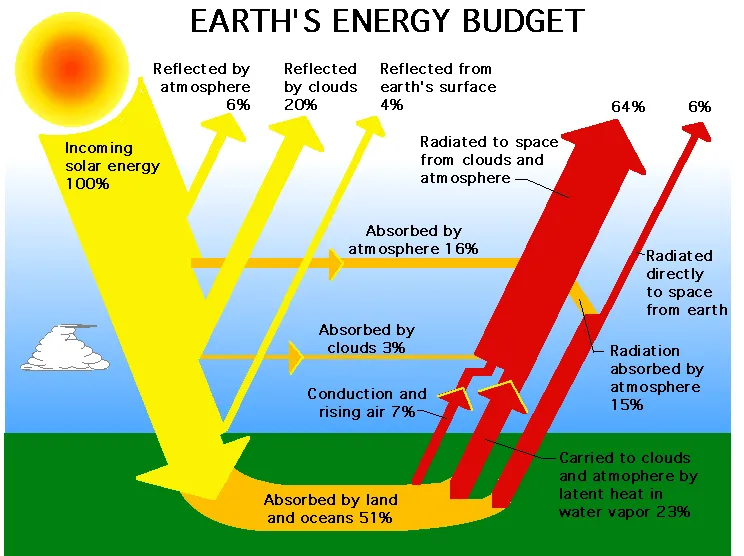
Source: UCAR Center for Science Education - University Corporation ... — The Energy Budget | Center for Science Education · scied.ucar.edu
Trap: Thinking 'below freezing everywhere' is exaggeration — it's scientifically accurate at -18°C
Trap: Confusing day/night temperatures with average temperature — average is what matters for climate
Trap: Assuming Earth's distance from Sun is the main factor — atmosphere makes the crucial difference
Trap: Statement I says 'well below freezing' — -18°C definitely qualifies as well below 0°C