Consider the following statements: Statement I: In the context of effect of water on rocks, chalk is known as a very permeable rock whereas clay is known as quite an impermeable or least permeable rock. Statement II: Chalk is porous and hence can absorb water. Statement III: Clay is not at all porous. Which one of the following is correct in respect of the above statements?
Contents20
- ABoth Statement II and Statement III are correct and both of them explain Statement I
- BBoth Statement II and Statement III are correct but only one of them explains Statement I
- COnly one of the Statements II and III is correct and that explains Statement I
- DNeither Statement II nor Statement III is correct
Show answer
Answer: (C) Only one of the Statements II and III is correct and that explains Statement I
Statement I:
'Chalk is very permeable, clay is impermeable/least permeable.' — This is correct as a general fact.
Statement II:
'Chalk is porous and can absorb water.' — CORRECT.
Chalk is a soft, white limestone made of calcium carbonate.
It has a porous structure with many interconnected tiny spaces between its particles.
Water can enter and pass through these pores relatively easily, making chalk both porous AND permeable.
This explains why chalk downlands have dry surfaces — water quickly seeps through the chalk into underground aquifers. ✓
This explains why chalk is permeable (Statement I).
Statement III:
'Clay is not at all porous.' — INCORRECT.
This is a tricky but important distinction.
Clay IS actually quite porous — it has many tiny spaces between particles and can hold a lot of water.
However, clay is IMPERMEABLE because these pore spaces are so tiny that water cannot flow through them easily.
The clay particles swell when wet and seal the pores.
So clay absorbs water (porous) but doesn't let it pass through (impermeable).
Saying 'not at all porous' is factually wrong. ✗
Only Statement II is correct, and it explains Statement I.
Answer is (c).
Understanding the difference between porosity (ability to hold water) and permeability (ability to let water flow through) is crucial for geography — chalk has both, clay has porosity but lacks permeability.
The question tests a common misconception that students confuse porosity with permeability, especially regarding clay which can absorb water but prevents its flow due to tiny sealed pores.
Rock Permeability vs Porosity
Geography permeable impermeable porous
Rock Permeability vs Porosity: Critical UPSC Distinction
Porosity = ability to hold water in pore spaces; Permeability = ability to let water flow through
Chalk is both porous and permeable — absorbs and transmits water easily
Clay is porous but impermeable — holds water but blocks flow
A rock can be porous without being permeable (like clay)
The Crucial Difference
Porosity and permeability are completely different rock properties that UPSC loves to test. Porosity measures how much empty space exists between rock particles for water storage. Permeability measures how easily water can flow through those spaces.
Chalk vs Clay Properties
Property | Chalk | Clay |
|---|---|---|
Porosity | High — many interconnected pores | High — many tiny pores between particles |
Permeability | High — water flows through easily | Low/Zero — pores too small for flow |
Water absorption | Absorbs and lets water pass through | Absorbs but traps water inside |
Particle size | Larger particles, bigger pore spaces | Very fine particles, microscopic pores |
When wet | Remains permeable | Particles swell and seal pores |
Why Clay Confuses Students
Clay IS porous — it has lots of empty spaces and can hold significant amounts of water
Clay particles are extremely fine, creating microscopic pore spaces
When clay gets wet, particles swell and block the tiny passages between pores
Result: water gets trapped inside clay but cannot flow through it
This makes clay an excellent aquitard (water-blocking layer) in geology
Question Connection
This PYQ tested the exact trap: Statement III incorrectly claimed clay is 'not at all porous.' Only Statement II correctly explained chalk's permeability through its porosity. Understanding that clay is porous but impermeable would have immediately eliminated the wrong options.
Trap: Assuming porous always means permeable — clay proves this wrong
Trap: Statement III says clay is 'not at all porous' — clay IS porous, just not permeable
Trap: Confusing water absorption (porosity) with water transmission (permeability)
Common error: Thinking impermeable rocks cannot hold any water
Chalk: Structure & Properties
Geography chalk
Chalk: Formation, Structure & Hydrogeological Properties
Chalk is soft white limestone made of calcium carbonate (CaCO₃)
Highly porous and permeable — excellent aquifer rock
Formed from compressed marine microorganisms (coccolithophores)
Creates dry surface landscapes due to rapid water infiltration
Formation & Composition
Chalk is a sedimentary limestone formed from the accumulated remains of marine microorganisms called coccolithophores. These tiny organisms had calcium carbonate shells that settled on ancient sea floors and compressed over millions of years.
Physical Characteristics
Soft and friable — easily crumbles when handled
Pure white color — high calcium carbonate content (90%+)
Fine-grained texture — smooth feel due to microscopic particles
Interconnected pore network — allows water movement through the rock mass
Low density — lighter than most other limestones
Hydrogeological Significance
Forms major aquifers in England, Northern France, and parts of Europe
High porosity (30-50%) allows significant water storage
High permeability enables groundwater flow and spring formation
Creates chalk downlands — rolling hills with dry surfaces and underground streams
Important for water supply in regions where chalk formations occur
Chalk Structure
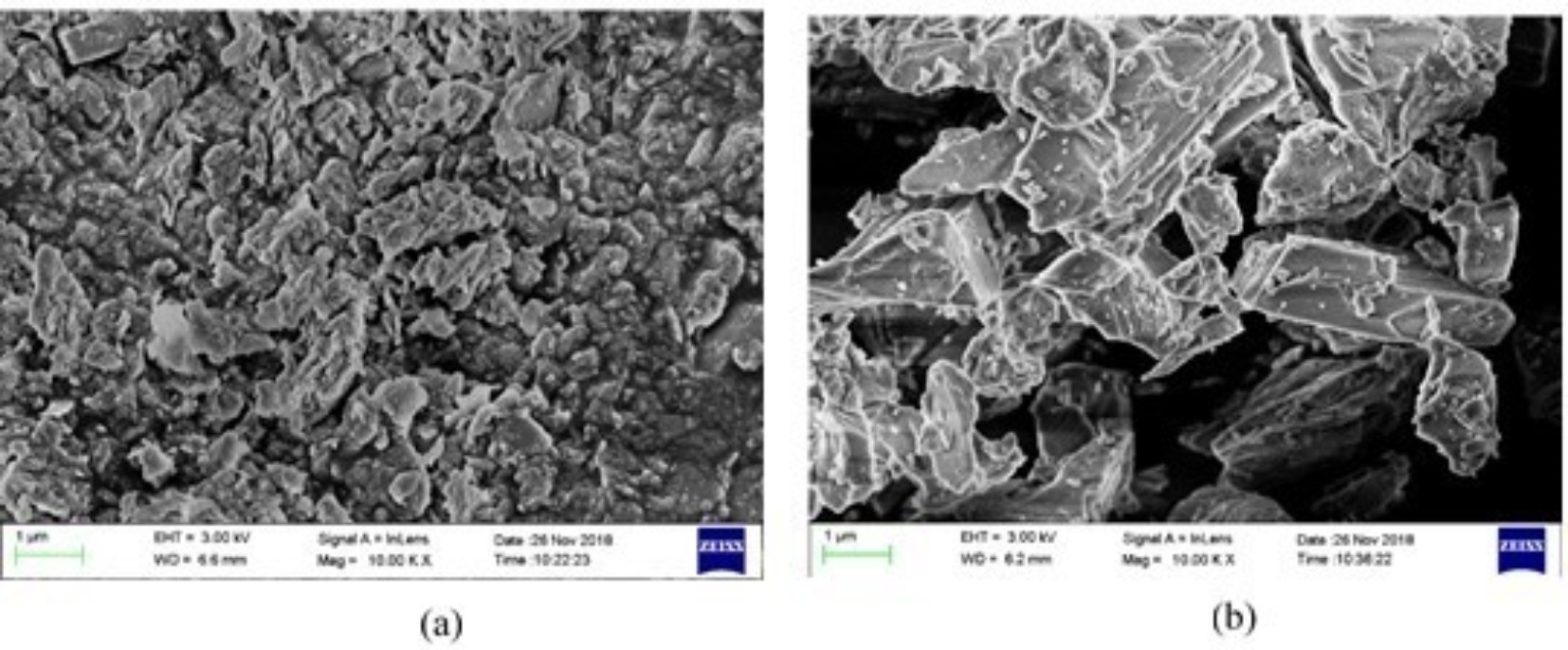
Source: Nature — Study on microscopic pores and physico-mechanical properties ... · www.nature.com
Clay: Structure & Water Behavior
Geography clay
Clay: Particle Structure, Porosity & Impermeability
Clay has finest particles (<0.002mm) among soil types
Porous but impermeable — holds water but blocks flow
Clay particles swell when wet, sealing pore spaces
Acts as aquitard — natural barrier to groundwater movement
Particle Characteristics
Clay consists of extremely fine mineral particles, primarily aluminum silicates, with diameters less than 0.002mm. These microscopic particles create a complex structure with high surface area and numerous tiny pore spaces.
How Clay Becomes Impermeable
%%{init: {"flowchart": {"wrappingWidth": 460}}}%%
flowchart TD
  s1["`**Dry Clay**
Fine particles with tiny pore spaces between them`"]
  s2["`**Water Contact**
Clay particles absorb water and begin to swell`"]
  s3["`**Particle Expansion**
Swelling particles reduce pore space size dramatically`"]
  s4["`**Pore Sealing**
Expanded particles block water movement through pores`"]
  s5["`**Impermeable Barrier**
Water trapped inside, cannot flow through clay layer`"]
  s1 --> s2
  s2 --> s3
  s3 --> s4
  s4 --> s5
Clay vs Other Soil Types
Soil Type | Particle Size | Porosity | Permeability | Water Behavior |
|---|---|---|---|---|
Gravel | 2mm | Low | Very High | Water flows rapidly |
Sand | 0.05-2mm | Medium | High | Good drainage |
Silt | 0.002-0.05mm | High | Medium | Moderate water retention |
Clay | <0.002mm | High | Very Low | Retains water, poor drainage |
Geological & Engineering Implications
Natural aquitard — prevents groundwater contamination by blocking pollutant movement
Foundation challenges — swelling clays cause structural problems in construction
Agricultural significance — retains nutrients and water for plant roots
Waterproofing applications — used to line ponds and landfills
Landslide risk — saturated clays become unstable on slopes
Aquifers & Aquitards
Geography
Groundwater Systems: Aquifers, Aquitards & Water Movement
Aquifer = permeable rock/soil that stores and transmits groundwater
Aquitard = impermeable layer that blocks groundwater flow
Chalk forms excellent aquifers; clay forms natural aquitards
Groundwater moves from aquifers through springs and wells
Groundwater System Components
Groundwater systems consist of aquifers (water-bearing formations) separated by aquitards (water-blocking layers). The interaction between permeable and impermeable rocks controls where groundwater flows and where it can be accessed.
Aquifer vs Aquitard Properties
Type | Permeability | Function | Common Rock Types | Water Behavior |
|---|---|---|---|---|
Aquifer | High | Stores & transmits water | Sandstone, limestone, chalk, gravel | Water flows freely |
Aquitard | Very Low | Blocks water movement | Clay, shale, unfractured granite | Water trapped/confined |
Aquiclude | Zero | Completely impermeable | Solid granite, quartzite | No water penetration |
Aquifuge | Zero | Neither stores nor transmits | Dense igneous rocks | Water cannot enter |
Types of Aquifers
Unconfined aquifer — water table at top, recharged directly by rainfall
Confined aquifer — trapped between two aquitards, water under pressure
Perched aquifer — small water body above main water table, sitting on aquitard
Artesian aquifer — confined aquifer where water rises in wells due to pressure
Groundwater System

Source: SERC (Carleton) — Types of aquifers · serc.carleton.edu