With reference to India, consider the following pairs:
Contents14
With reference to India, consider the following pairs:
| Organization | Union Ministry | |
|---|---|---|
| I. | The National Automotive Board | Ministry of Commerce and Industry |
| II. | The Coir Board | Ministry of Heavy Industries |
| III. | The National Centre for Trade Information | Ministry of Micro, Small and Medium Enterprises |
How many of the above pairs are correctly matched?
- AOnly one
- BOnly two
- CAll the three
- DNone
Show answer
Answer: (D) None
This question tests knowledge of which boards/organizations fall under which ministry:
(I) National Automotive Board — Ministry of Commerce and Industry: INCORRECT. The National Automotive Board is actually under the Ministry of Heavy Industries, not Commerce and Industry. The Ministry of Heavy Industries oversees the automotive sector, EV policy, and related manufacturing. ✗
(II) Coir Board — Ministry of Heavy Industries: INCORRECT. The Coir Board is actually under the Ministry of Micro, Small and Medium Enterprises (MSME), not Heavy Industries. Coir (coconut fiber) products are largely produced by small-scale and cottage industries, hence the MSME connection. ✗
(III) National Centre for Trade Information — Ministry of MSME: INCORRECT. The National Centre for Trade Information is actually under the Ministry of Commerce and Industry, not MSME. Trade information and trade facilitation fall under Commerce. ✗
Interestingly, the question has cleverly rotated the correct ministries — each organization is paired with another organization's correct ministry! None of the pairs are correctly matched. Answer is (d).
Statutory boards are created by Parliament through specific acts and each board reports to a designated ministry based on its sectoral focus.
UPSC cleverly rotated the correct ministries in this question - each organization is paired with another organization's actual ministry, creating a perfect mismatch trap.
The question tests whether students can distinguish between ministries that sound similar or handle related sectors, like Heavy Industries versus MSME for manufacturing boards.
National Automotive Board
Indian Polity National Automotive Board
National Automotive Board: Role & Ministry Linkage
National Automotive Board comes under Ministry of Heavy Industries
Common trap: confusing with Ministry of Commerce and Industry
Focuses on automotive sector development and EV policy implementation
Why Heavy Industries?
The National Automotive Board operates under the Ministry of Heavy Industries because automotive manufacturing involves heavy industrial processes, capital-intensive production, and large-scale manufacturing infrastructure.
Key Functions
Promotes automotive sector growth and competitiveness
Implements Production Linked Incentive (PLI) schemes for automotive components
Oversees electric vehicle policy and charging infrastructure development
Coordinates with state governments on automotive manufacturing hubs
Trap: National Automotive Board is under Heavy Industries, not Commerce and Industry
Confusion: Commerce handles trade policy, Heavy Industries handles manufacturing
Remember: Automotive = manufacturing = Heavy Industries ministry
Coir Board
Indian Polity Coir Board
Coir Board: MSME Ministry Connection & Functions
Coir Board comes under Ministry of Micro, Small and Medium Enterprises
Statutory body established under Coir Industry Act, 1953
Headquartered in Kochi, Kerala
Why MSME Ministry?
Coir (coconut fiber) products are predominantly manufactured by small-scale and cottage industries, particularly in coastal areas of Kerala, Karnataka, and Tamil Nadu. This makes it a natural fit under the MSME ministry's mandate.
Core Functions
Promotes coir and coir products in domestic and export markets
Provides technical assistance and training to coir workers
Implements quality control measures and standardization
Supports research and development in coir technology
Facilitates export promotion and market development
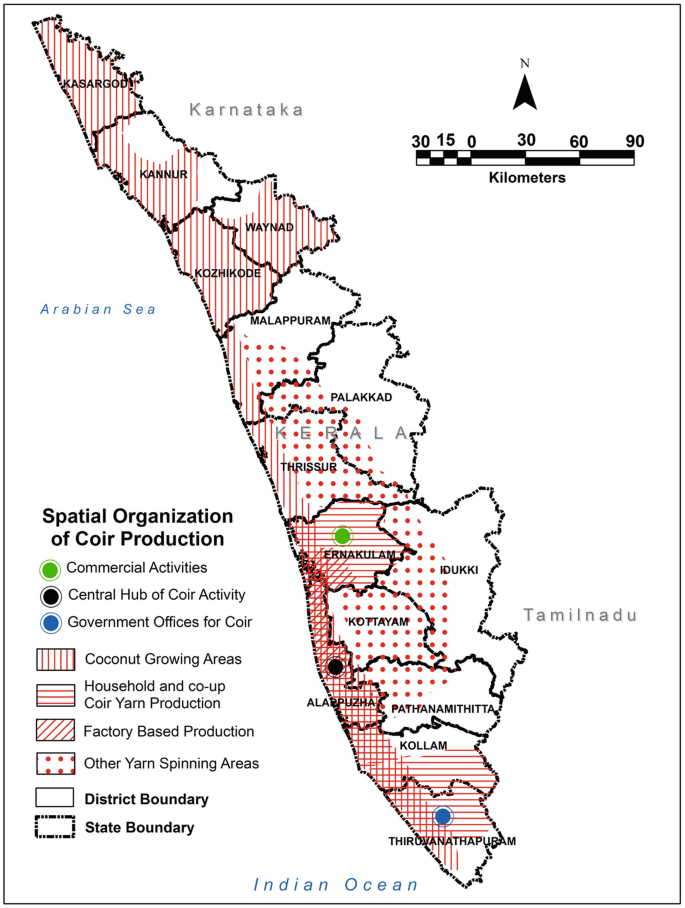
Source: Springer Nature - Publication — The Coir Industry and Its Social Relations of Production ... · link.springer.com
Trap: Coir Board is under MSME Ministry, not Heavy Industries
Logic: Coir = cottage/small industries = MSME ministry
Don't confuse: Heavy Industries handles large manufacturing, MSME handles traditional crafts
National Centre for Trade Information
Indian Polity National Centre for Trade Information
National Centre for Trade Information: Commerce Ministry Role
National Centre for Trade Information comes under Ministry of Commerce and Industry
Trap question paired it with MSME ministry
Focuses on trade facilitation and information dissemination
Why Commerce Ministry?
The National Centre for Trade Information falls under Ministry of Commerce and Industry because trade information, export-import data, and trade facilitation are core functions of the Commerce ministry's mandate.
Primary Functions
Maintains comprehensive trade statistics and databases
Provides market intelligence to exporters and importers
Facilitates trade policy formulation through data analysis
Supports export promotion through information dissemination
Trap: Trade Information Centre is under Commerce Ministry, not MSME
Logic: Trade = Commerce ministry's core function
Pattern: Questions often swap correct ministries between similar-sounding organizations
Ministry-wise Statutory Bodies Classification
Indian Polity Ministry of Commerce and Industry Ministry of Heavy Industries Ministry of Micro, Small and Medium Enterprises
Key Statutory Bodies: Ministry-wise Classification
Each ministry oversees bodies aligned with its functional mandate
Heavy Industries: manufacturing and automotive sector
MSME: small-scale and cottage industries
Commerce: trade, export-import, and commercial policy
Corrected Ministry Mapping
Organization | Correct Ministry | Wrong Option Given | Logic |
|---|---|---|---|
National Automotive Board | Heavy Industries | Commerce & Industry | Manufacturing focus |
Coir Board | MSME | Heavy Industries | Cottage industry |
National Centre for Trade Information | Commerce & Industry | MSME | Trade facilitation |
Ministry Logic Patterns
Heavy Industries: Large-scale manufacturing, automotive, steel, machinery
MSME: Traditional crafts, cottage industries, small businesses, handlooms
Commerce & Industry: Trade policy, export-import, commercial intelligence
Textiles: Handlooms, powerlooms, jute, silk production
Rotation trap: Question swapped each organization with another's correct ministry
Pattern: UPSC often creates plausible but wrong ministry pairings
Strategy: Think functional logic — what does this organization actually do?
Red flag: When ALL pairs seem questionable, consider 'None' as answer
UPSC Pairing Question Strategy
Indian Polity
Mastering UPSC Pairing Questions: Strategy & Traps
Check each pair independently before looking at options
'None' is often correct when all pairs have subtle errors
UPSC creates rotation traps — swapping correct answers between pairs
Pairing Question Approach
%%{init: {"flowchart": {"wrappingWidth": 460}}}%%
flowchart TD
  s1["`**Read each pair separately**
Don't look at options yet — evaluate each pairing on its own merit`"]
  s2["`**Apply functional logic**
Ask: What does this organization do? Which ministry handles this function?`"]
  s3["`**Mark each as ✓ or ✗**
Be definitive — avoid 'maybe' or 'probably correct'`"]
  s4["`**Count correct pairs**
Only now match your count with the given options`"]
  s5["`**Double-check if answer is 'None'**
UPSC often makes ALL pairs wrong through subtle swaps`"]
  s1 --> s2
  s2 --> s3
  s3 --> s4
s4 --> s5Rotation trap: Each wrong pairing uses another organization's correct ministry
Plausibility trap: Wrong pairings sound reasonable but fail functional logic test
Option bias: Students avoid 'None' thinking UPSC wouldn't make all pairs wrong
Speed trap: Rushing through pairs without checking each one thoroughly