"Sedition has become my religion" was the famous statement given by Gandhiji at the time of
Contents17
- Athe Champaran Satyagraha
- Bpublicly violating Salt Law at Dandi
- Cattending the Second Round Table Conference in London
- Dthe launch of the Quit India Movement
Show answer
Answer: (B) publicly violating Salt Law at Dandi
The statement 'Sedition has become my religion' was made by Mahatma Gandhi during the Civil Disobedience Movement, specifically at the time of publicly violating the Salt Law at Dandi in 1930.
Context: After the Lahore Congress (December 1929) declared Purna Swaraj (complete independence) as the goal, Gandhi launched the Civil Disobedience Movement with the famous Dandi March (March 12 - April 6, 1930).
By deliberately breaking the Salt Law (which gave the British a monopoly over salt production and taxation), Gandhi was committing an act of civil disobedience — which the British government classified as sedition.
Gandhi's statement was a powerful declaration that defying unjust laws had become a moral duty for him.
It framed resistance to British rule not as criminality but as a matter of conscience and faith.
This did NOT happen during:
- Champaran (1917, which was about indigo farmers)
- The Second Round Table Conference (1931, London)
- The Quit India Movement (1942, which had the slogan 'Do or Die').
Answer is (b).
The Salt Law gave the British a complete monopoly over salt production and taxation, making it illegal for Indians to produce or sell salt independently.
Gandhi's statement redefined civil disobedience as a religious duty rather than criminal activity, turning legal sedition into moral righteousness.
The question tests precise chronology of Gandhi's famous statements across different movements from 1917 to 1942.
Dandi March & Salt Satyagraha (1930)
Modern Indian History Dandi Salt Law publicly violating sedition has become my religion
Dandi March & Salt Satyagraha (1930): Gandhi's Famous Sedition Statement
Gandhi made 'Sedition has become my religion' statement while violating Salt Law at Dandi (April 6, 1930)
Dandi March lasted 24 days (March 12 - April 6, 1930) covering 240 miles
Salt Law gave British monopoly over salt production and imposed heavy taxation
This launched the Civil Disobedience Movement as part of the freedom struggle
Context & Significance
After the Lahore Congress (December 1929) declared Purna Swaraj as the goal, Gandhi chose salt as the symbol of resistance. The British Salt Act made it illegal for Indians to collect or sell salt independently, forcing them to buy expensive, heavily-taxed salt from British merchants.
Gandhi's statement 'Sedition has become my religion' was a powerful declaration that defying unjust colonial laws had become a moral and spiritual duty, not a crime.
Key Events & Timeline
Date | Event | Significance |
|---|---|---|
March 12, 1930 | Dandi March begins from Sabarmati Ashram | 78 selected satyagrahis started the journey |
April 6, 1930 | Gandhi picks salt at Dandi Beach | Symbolic violation of Salt Law - 'Sedition has become my religion' |
April 6 onwards | Mass civil disobedience spreads | Millions across India began making salt illegally |
May 5, 1930 | Gandhi arrested | Movement continued under other leaders |
Dandi March Route
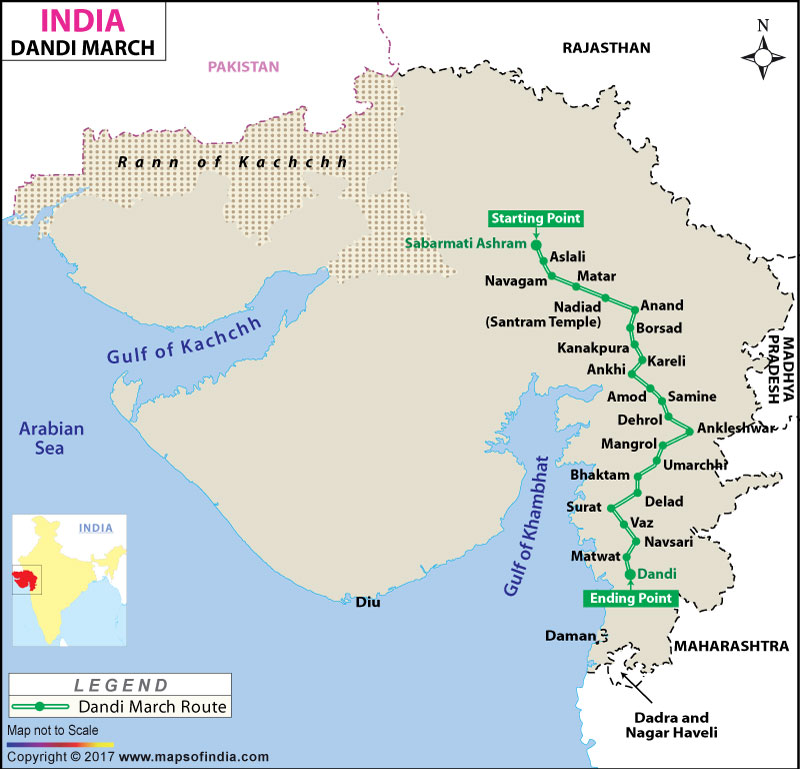
Source: India Map — Dandi March · www.mapsofindia.com
Why Salt as Symbol
Universal necessity - every Indian needed salt regardless of class or religion
Economic exploitation - British taxed an essential commodity heavily
Simple act of defiance - anyone could make salt and join the movement
Moral clarity - easy to understand the injustice of taxing a natural resource
Mass participation - enabled women and common people to join freedom struggle
Trap: Confusing with Champaran (1917) - that was about indigo farmers, not salt
Trap: Mixing with Quit India (1942) - that had slogan 'Do or Die', not sedition statement
Trap: Associating with Round Table Conference (1931) - Gandhi went to London for negotiations, not civil disobedience
Date confusion: Dandi March was 1930, not 1929 when Purna Swaraj was declared
Civil Disobedience Movement (1930-34)
Modern Indian History Civil Disobedience Movement
Civil Disobedience Movement (1930-34): Features & Phases
Two phases: 1930-31 and 1932-34, separated by Gandhi-Irwin Pact (March 1931)
Started with Salt Satyagraha and included boycott of foreign goods, taxes, and government institutions
Mass participation including women, peasants, and business classes
Nature & Scope
Unlike Non-Cooperation Movement (1920-22) which focused on withdrawal, Civil Disobedience involved active violation of colonial laws. It combined Gandhian principles of non-violence with direct challenge to British authority through breaking unjust laws.
Two Phases Comparison
Phase | Period | Key Features | Outcome |
|---|---|---|---|
First Phase | 1930-31 | Salt Satyagraha, forest laws violation, tax refusal | Gandhi-Irwin Pact - temporary truce |
Second Phase | 1932-34 | Resumed after London failure, government repression | Gradually withdrawn, limited success |
Forms of Civil Disobedience
# Civil Disobedience Methods
## Law Breaking
- Salt manufacture
- Forest laws violation
- Picketing liquor shops
## Economic Boycott
- Foreign cloth boycott
- British goods boycott
- Tax refusal
## Social Resistance
- Government school boycott
- Court boycott
- Title surrender
## Symbolic Acts
- Flag hoisting
- Spinning khadi
- Public meetingsTrap: Confusing Civil Disobedience with Non-Cooperation - CDM involved law-breaking, NCM involved withdrawal
Chronology trap: CDM was 1930-34, not to be mixed with Quit India (1942)
Leadership confusion: Gandhi led both phases but was in jail during much of second phase
Champaran Satyagraha (1917)
Modern Indian History Champaran Satyagraha
Champaran Satyagraha (1917): Gandhi's First Major Success in India
Gandhi's first major Satyagraha in India against indigo plantation system in Bihar
Tinkathia system forced peasants to grow indigo on 3/20th of their land
Led to Champaran Agrarian Act and Gandhi's emergence as national leader
Background & Issues
European planters in Champaran district (Bihar) forced peasants into the tinkathia system - growing indigo on 3/20th of their best land. When synthetic indigo was developed in Germany, demand fell but planters still extracted illegal taxes and sharahbeshi (additional levies) from farmers.
Champaran Movement Timeline
%%{init: {"flowchart": {"wrappingWidth": 460}}}%%
flowchart TD
  s1["`****Raj Kumar Shukla** meets Gandhi**
Local peasant leader requests Gandhi's help (1916-17)`"]
  s2["`**Gandhi arrives in **Champaran (April 1917)****
Despite government order to leave, Gandhi stays`"]
  s3["`****Civil disobedience** begins**
Gandhi refuses to leave, courts arrest`"]
  s4["`****Government inquiry** ordered**
Gandhi becomes member of investigation committee`"]
  s5["`****Victory achieved****
Tinkathia system abolished, compensation paid`"]
  s1 --> s2
  s2 --> s3
  s3 --> s4
  s4 --> s5
Significance & Methods
First application of Satyagraha principles on Indian soil
Fact-finding approach - Gandhi investigated conditions thoroughly before acting
Local leadership development - trained peasants in non-violent resistance
Constructive programme - included education, sanitation, and village development
Legal victory - achieved through combination of pressure and negotiation
Quit India Movement (1942)
Modern Indian History Quit India Movement
Quit India Movement (1942): 'Do or Die' - The August Revolution
Launched August 8, 1942 with Gandhi's 'Do or Die' slogan, not sedition statement
Immediate demand for British withdrawal from India during World War II
Leaderless resistance after mass arrests - underground and violent activities
Context & Launch
With World War II intensifying and Cripps Mission (1942) failure, Gandhi launched the most radical mass movement. The AICC session in Bombay (August 8, 1942) passed the Quit India resolution demanding immediate British withdrawal.
Quit India vs Other Movements
Movement | Year | Key Slogan | Nature | Leadership |
|---|---|---|---|---|
Quit India | 1942 | 'Do or Die' | Immediate independence demand | Underground after arrests |
Civil Disobedience | 1930 | 'Sedition has become my religion' | Constitutional protest | Gandhi-led throughout |
Non-Cooperation | 1920 | 'Swaraj in one year' | Withdrawal from British institutions | Organized leadership |
Unique Features
Wartime context - demanded independence while Britain fought World War II
Spontaneous uprising - continued despite arrest of all major leaders
Underground activities - parallel governments, sabotage, and secret communication
Mass participation - students, workers, peasants joined without central coordination
Government repression - severe crackdown, firing on crowds, mass arrests
Slogan confusion: Quit India had 'Do or Die', NOT 'Sedition has become my religion'
Date trap: Quit India was 1942, much later than Dandi (1930)
Context difference: Quit India was wartime emergency, Dandi was planned civil disobedience