Consider the following statements regarding a No-Confidence Motion in India: 1. There is no mention of a No-Confidence Motion in the Constitution of India 2. A motion of No-Confidence can be introduced in the Lok Sabha only Which of the statements given above is/are correct?
Contents15
- A1 only
- B2 only
- CBoth 1 and 2
- DNeither 1 nor 2
Show answer
Answer: (C) Both 1 and 2
Both statements are correct.
Statement 1 — CORRECT: The Constitution does NOT explicitly mention 'No-Confidence Motion.'
It only says in Article 75 (3) that the Council of Ministers is collectively responsible to the Lok Sabha.
The no-confidence motion procedure comes from Rule 198 of the Rules of Procedure of Lok Sabha — it's a parliamentary convention, not a constitutional provision.
Statement 2 — CORRECT: A no-confidence motion can ONLY be introduced in the Lok Sabha because the Council of Ministers is responsible to Lok Sabha (not Rajya Sabha).
Even if Rajya Sabha disapproves, the government doesn't need to resign.
Minimum 50 MPs must support the motion for it to be admitted.
(Ref: Laxmikanth)
The Constitution establishes collective responsibility to Lok Sabha in Article 75(3) but leaves the actual procedure for no-confidence motions to parliamentary rules, not constitutional text.
No-confidence motions can only target the Lok Sabha because the Council of Ministers is responsible only to the directly elected house, not to Rajya Sabha which represents states.
The question tests whether students distinguish between constitutional provisions versus parliamentary procedures that implement constitutional principles.
No-Confidence Motion
Indian Polity No-Confidence Motion
No-Confidence Motion: Constitutional Basis & Procedure
Not mentioned in Constitution - comes from Rule 198 of Lok Sabha Rules
Can only be moved in Lok Sabha, not Rajya Sabha
Requires support of minimum 50 MPs for admission
Based on Article 75(3) - collective responsibility to Lok Sabha
Constitutional Foundation
The Constitution does not explicitly mention 'No-Confidence Motion' anywhere. Article 75(3) only establishes that the Council of Ministers is collectively responsible to the Lok Sabha. The actual procedure for no-confidence motions comes from parliamentary rules and conventions, not constitutional provisions.
No-Confidence vs Other Motions
Motion Type | Constitutional Mention | House | Purpose |
|---|---|---|---|
No-Confidence Motion | Not mentioned | Lok Sabha only | Remove entire government |
Censure Motion | Not mentioned | Both Houses | Express disapproval |
Cut Motion | Not mentioned | Lok Sabha only | Reduce budget allocation |
Adjournment Motion | Not mentioned | Both Houses | Discuss urgent matter |
No-Confidence Procedure
%%{init: {"flowchart": {"wrappingWidth": 460}}}%%
flowchart TD
  s1["`**Notice Given**
Any MP gives written notice to **Lok Sabha Secretary General**`"]
  s2["`**Support Check**
**Minimum 50 MPs** must support for admission`"]
  s3["`**Speaker's Decision**
**Speaker decides** whether to admit the motion`"]
  s4["`**Debate & Vote**
If admitted, debate held and **division** (voting) takes place`"]
  s5["`**Result**
If passed, **entire Council of Ministers must resign**`"]
  s1 --> s2
  s2 --> s3
  s3 --> s4
  s4 --> s5
Why Only Lok Sabha
Article 75(3) makes Council of Ministers collectively responsible only to Lok Sabha
Rajya Sabha disapproval does not require government resignation
Money Bills originate in Lok Sabha - financial accountability lies there
Lok Sabha represents direct popular mandate through elections
Trap: Constitution mentions no-confidence motion - FALSE, only Article 75(3) on collective responsibility
Trap: Can be moved in Rajya Sabha too - FALSE, Lok Sabha only
Trap: Needs simple majority to admit - FALSE, needs 50 MP support first
Trap: Confusing with censure motion which can be moved in both Houses
Collective Responsibility Principle
Indian Polity collectively responsible Lok Sabha
Collective Responsibility: Article 75(3) & Parliamentary Accountability
Article 75(3) - Council of Ministers collectively responsible to Lok Sabha
All ministers resign if government loses confidence vote
Ministers must publicly support government decisions even if privately disagreeing
Constitutional Provision
Article 75(3) states: 'The Council of Ministers shall be collectively responsible to the House of the People (Lok Sabha).' This Westminster principle means the entire ministry stands or falls together - no individual minister can distance themselves from government decisions.
Individual vs Collective Responsibility
Responsibility Type | Constitutional Article | Meaning | Consequence |
|---|---|---|---|
Individual Responsibility | Article 75(2) | Each minister answerable for their ministry | Individual minister resigns |
Collective Responsibility | Article 75(3) | All ministers answerable for government policy | Entire government resigns |
Collective Responsibility Dimensions
# Collective Responsibility
## To Lok Sabha
- Answer questions
- Face no-confidence
- Resign if defeated
## Cabinet Unity
- Public solidarity
- No public dissent
- Collective decisions
## Policy Ownership
- All defend decisions
- No individual blame
- Joint accountability
Practical Applications
Question Hour: Any minister can answer for any ministry's work
Budget Vote: Defeat on budget = no-confidence in entire government
Policy Decisions: All ministers must publicly defend government policies
Resignation: Loss of confidence requires all ministers to quit, not just PM
Trap: Responsible to both Houses - FALSE, only to Lok Sabha
Trap: Only PM resigns on no-confidence - FALSE, entire Council resigns
Trap: Article 74 deals with collective responsibility - FALSE, it's Article 75(3)
Lok Sabha Rules of Procedure
Indian Polity Rule 198 Rules of Procedure
Lok Sabha Rules of Procedure: Beyond Constitutional Text
Rule 198 governs no-confidence motion procedure
Many parliamentary procedures come from Rules, not Constitution
Rules can be amended by Lok Sabha, Constitution needs special procedure
Rules vs Constitution
The Constitution provides the framework for Parliament, but detailed procedures come from Rules of Procedure adopted by each House. Rule 198 of Lok Sabha Rules specifically deals with motions expressing want of confidence in the Council of Ministers.
Key Lok Sabha Rules
Rule Number | Subject | Constitutional Basis | Key Requirement |
|---|---|---|---|
Rule 198 | No-Confidence Motion | Article 75(3) | 50 MP support |
Rule 184 | Short Duration Discussion | Article 118 | 2.5 hours max |
Rule 193 | Discussion under Rule 193 | Article 118 | No voting |
Rule 377 | Matter of Urgent Public Importance | Article 118 | 5 minutes max |
Rule 198 Specifics
Written notice must be given during session to Secretary General
50 members must rise in support when Speaker asks
Speaker's discretion to admit or reject the motion
Debate time allocated as per Speaker's decision
Division (formal voting) must be held if motion is admitted
Parliamentary Procedure Flow
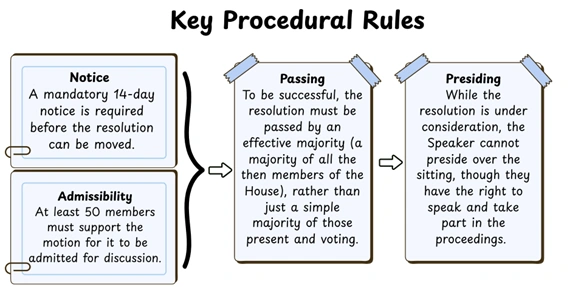
Source: Vajirao IAS Coaching Institute — No-Confidence Motion in Lok Sabha: Congress Targets Om Birla · www.vajiraoinstitute.com
Trap: All parliamentary procedures are in Constitution - FALSE, many in House Rules
Trap: Rules have same status as Constitution - FALSE, Rules can be easily amended
Trap: Rule 184 deals with no-confidence - FALSE, it's Rule 198