In the areas covered under the Panchayat (Extension to the Scheduled Areas) Act, 1996, what is the role/power of Gram Sabha? 1. Gram Sabha has the power to prevent alienation of land in the Scheduled Areas 2. Gram Sabha has the ownership of minor forest produce 3. Recommendation of Gram Sabha is required for granting prospecting lincence or mining lease for any mineral in the Scheduled Areas Which of the statements given above is/are correct?
Contents20
- A1 only
- B1 and 2 only
- C2 and 3 only
- D1, 2 and 3
Show answer
Answer: (B) 1 and 2 only
Under PESA (Article 4K), the Gram Sabha has the power to prevent alienation of land in Scheduled Areas and owns minor forest produce — so statements 1 and 2 are correct.
Statement 3 is tricky: the Act says recommendations of the Gram Sabha 'or the Panchayats at the appropriate level' are required before granting a prospecting licence or mining lease — but only for 'minor minerals', not 'any mineral' as the statement claims.
Two deliberate word changes ('any mineral' instead of 'minor minerals', and dropping 'or Panchayats at the appropriate level') make statement 3 false.
PESA 1996 gives Gram Sabhas in Scheduled Areas special powers over land, forest produce, and mineral licensing that regular Gram Sabhas do not have.
UPSC is testing precise reading skills by changing 'minor minerals' to 'any mineral' and removing 'or Panchayats at appropriate level' from the actual PESA provisions.
The question checks whether students can distinguish between powers exclusively held by Gram Sabha versus powers shared with Panchayats at other levels.
PESA Act 1996
Indian Polity Panchayat (Extension to the Scheduled Areas) Act, 1996 PESA Scheduled Areas
PESA Act 1996: Tribal Self-Governance in Scheduled Areas
PESA Act 1996 extends Panchayati Raj to Fifth Schedule areas with special provisions for tribal autonomy
Gram Sabha gets land alienation prevention powers and ownership of minor forest produce
Mining lease recommendations required from Gram Sabha or appropriate Panchayat for minor minerals only
Does not apply to Sixth Schedule areas (Northeast)
Context
The PESA Act 1996 was enacted to extend Panchayati Raj institutions to Fifth Schedule areas while preserving tribal autonomy. It recognizes the traditional governance systems of tribal communities and gives enhanced powers to Gram Sabhas in Scheduled Areas.
Key Powers of Gram Sabha under PESA
Power/Function | Specific Provision | Significance |
|---|---|---|
Land Alienation Prevention | Power to prevent alienation of land in Scheduled Areas | Protects tribal land rights |
Minor Forest Produce Ownership | Gram Sabha owns minor forest produce | Economic empowerment of tribals |
Mining Recommendations | Consultation required for minor minerals only | Environmental protection with caveats |
Planning & Implementation | Mandatory consultation for development projects | Community participation |
Social Audit | Monitor all social sector programmes | Transparency and accountability |
PESA vs Regular Panchayati Raj
Enhanced autonomy: Gram Sabha has greater powers than in non-tribal areas
Cultural preservation: Respects traditional tribal governance customs and practices
Resource control: Direct ownership and control over natural resources like minor forest produce
Mandatory consultation: All development programmes require Gram Sabha approval
Conflict resolution: Traditional dispute resolution mechanisms are recognized
PESA Coverage
# PESA Act Application
## Geographic Coverage
- Fifth Schedule Areas only
- 9 states covered
- Not applicable to Sixth Schedule
## States Covered
- Andhra Pradesh
- Chhattisgarh
- Gujarat
- Himachal Pradesh
- Jharkhand
- Madhya Pradesh
- Maharashtra
- Odisha
- Rajasthan
## Key Exclusions
- Sixth Schedule areas
- Urban areas
- Cantonment areasTrap: Statement 3 says 'any mineral' but PESA applies only to 'minor minerals'
Trap: Statement 3 says 'Gram Sabha' only but PESA allows 'Gram Sabha or Panchayats at appropriate level'
Common confusion: PESA applies to Fifth Schedule areas, not Sixth Schedule (Northeast)
Word trap: 'Alienation of land' vs 'Transfer of land' — both mean the same but UPSC uses 'alienation'
Geographic trap: Don't confuse tribal areas under Fifth Schedule with autonomous areas under Sixth Schedule
Fifth Schedule Areas
Indian Polity Fifth Schedule Scheduled Areas
Fifth Schedule: Administration of Scheduled Areas & Tribal Welfare
Fifth Schedule provides for administration of Scheduled Areas and welfare of Scheduled Tribes
Governor has special powers to make regulations for peace and good government
Tribes Advisory Council mandatory in states with Scheduled Areas
Covers tribal-majority areas in 9 mainland states
Constitutional Framework
Article 244(1) empowers the Fifth Schedule to govern Scheduled Areas and tribal welfare. The Governor acts as the constitutional head with special regulatory powers, while the Tribes Advisory Council advises on tribal matters.
Fifth vs Sixth Schedule Comparison
Aspect | Fifth Schedule | Sixth Schedule |
|---|---|---|
Geographic Coverage | Mainland India (9 states) | Northeast India (4 states) |
Areas Covered | Scheduled Areas | Autonomous Districts |
Administrative Head | Governor with special powers | Autonomous District Councils |
Legislative Powers | Governor can make regulations | District Councils make laws |
PESA Applicability | Yes - PESA Act applies | No - PESA does not apply |
Key Features | Individual tribal welfare | Community autonomy |
Fifth Schedule Areas Map
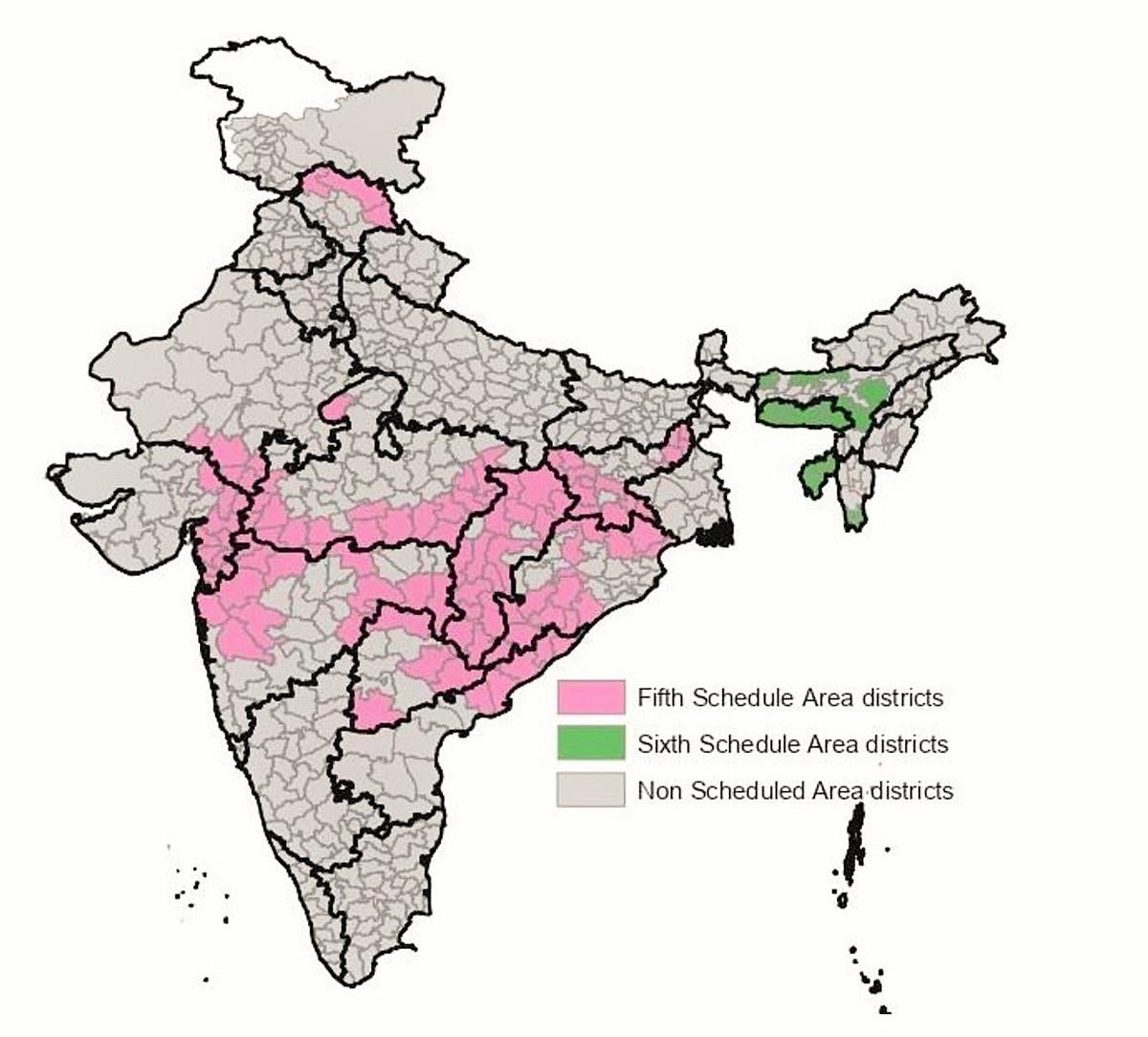
Source: The Hindu — What do the home lands of India's ST communities look like ... · www.thehindu.com
Governor's Special Powers
Regulatory power: Can make regulations for peace and good government of Scheduled Areas
Modification authority: Can modify or suspend application of any Central/State Act
Tribes Advisory Council: Must consult TAC before making regulations
Presidential approval: All regulations require President's assent
Annual reporting: Must report annually to President on administration of Scheduled Areas
Geography trap: Fifth Schedule = mainland tribal areas; Sixth Schedule = Northeast autonomous areas
PESA confusion: PESA applies only to Fifth Schedule areas, never to Sixth Schedule
Administrative trap: Governor has special powers in Fifth Schedule, District Councils in Sixth Schedule
Coverage mistake: Fifth Schedule areas are pockets within states, not entire states
Gram Sabha Powers in Scheduled Areas
Indian Polity Gram Sabha power role
Gram Sabha Powers under PESA: Enhanced Tribal Autonomy
Gram Sabha has enhanced powers in Scheduled Areas compared to regular areas
Land alienation prevention and minor forest produce ownership are key powers
Mandatory consultation required for all development projects and programmes
Powers respect traditional tribal governance systems and customs
Enhanced Authority
Under PESA, Gram Sabha in Scheduled Areas functions as the primary decision-making body with powers that go far beyond regular Panchayati Raj institutions. It serves as the guardian of tribal rights, resources, and cultural practices.
Gram Sabha Powers under PESA
Category | Specific Power | Legal Basis | Impact |
|---|---|---|---|
Land Rights | Prevent land alienation | Article 4K of PESA | Protects tribal land from outsiders |
Forest Resources | Ownership of minor forest produce | Article 4K of PESA | Economic empowerment |
Mining | Consultation for minor minerals | Article 4K of PESA | Environmental protection |
Development | Approval for all programmes | Article 4J of PESA | Community participation |
Social Audit | Monitor implementation | Article 4I of PESA | Transparency |
Mining Lease Process in Scheduled Areas
%%{init: {"flowchart": {"wrappingWidth": 460}}}%%
flowchart TD
  s1["`**Mining Company Application**
Company applies for prospecting/mining lease`"]
  s2["`**Classification Check**
Government determines if it's major or minor mineral`"]
  s3["`**If Minor Mineral**
Gram Sabha OR appropriate Panchayat consultation mandatory`"]
  s4["`**If Major Mineral**
No PESA consultation required (only EIA, forest clearance etc.)`"]
  s5["`**Final Decision**
State government grants or rejects lease`"]
  s1 --> s2
  s2 --> s3
  s3 --> s4
  s4 --> s5
Traditional Governance Integration
Customary practices: PESA respects traditional decision-making processes of tribal communities
Conflict resolution: Traditional dispute resolution mechanisms are formally recognized
Cultural preservation: Gram Sabha can protect tribal customs, traditions, and community resources
Resource management: Community ownership model for natural resources like water bodies, grazing lands
Social control: Power to control institutions and functionaries in all social sectors
Mineral trap: Consultation required for minor minerals only, not all minerals
Authority trap: Gram Sabha OR appropriate Panchayat can give recommendations, not just Gram Sabha
Land power: Gram Sabha can prevent alienation, but doesn't own all land in Scheduled Areas
Ownership vs Control: Gram Sabha owns minor forest produce but controls other resources
Sixth Schedule Areas
Indian Polity
Sixth Schedule: Autonomous Districts in Northeast India
Sixth Schedule provides for Autonomous District Councils in Northeast India
Covers 10 Autonomous Districts in Assam, Meghalaya, Tripura, Mizoram
PESA does not apply to Sixth Schedule areas
District Councils have legislative and executive powers
Autonomous Governance Model
The Sixth Schedule creates Autonomous District Councils with significant legislative and executive powers. Unlike Fifth Schedule's Governor-centric model, here tribal communities govern themselves through elected councils.
Sixth Schedule Coverage
State | Autonomous Districts | Key Tribes | Special Features |
|---|---|---|---|
Assam | Karbi Anglong, Dima Hasao | Karbi, Dimasa | Largest autonomous districts |
Meghalaya | Khasi Hills, Jaintia Hills, Garo Hills | Khasi, Jaintia, Garo | Traditional chiefs recognized |
Tripura | Tripura Tribal Areas | Tripuri, Reang | Covers 70% of state area |
Mizoram | Lai, Mara, Chakma | Lai, Mara, Chakma | Smallest councils |
Autonomous District Council Powers
# District Council Powers
## Legislative
- Make laws on specified subjects
- Land and forest management
- Customary law
- Inheritance matters
## Executive
- Collect taxes
- Maintain law and order
- Development programmes
- Courts administration
## Financial
- Impose taxes
- Receive grants
- Budget preparation
- Fund allocation
Sixth Schedule Areas
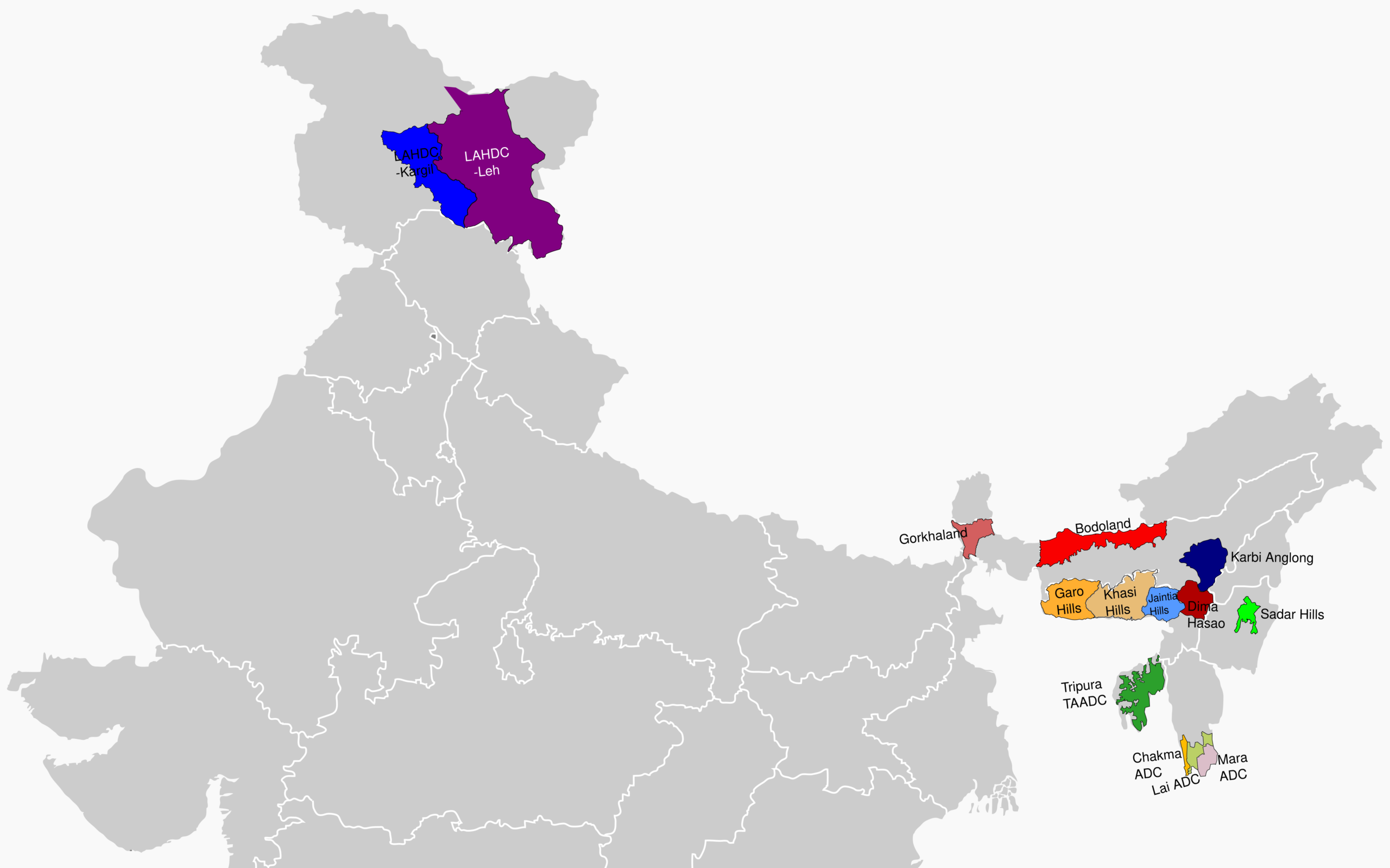
Source: LotusArise — Autonomous District Councils (Sixth Schedule) - UPSC - UPSC Notes ... · lotusarise.com
Geographic confusion: Sixth Schedule = Northeast only; Fifth Schedule = mainland tribal areas
PESA trap: PESA never applies to Sixth Schedule areas — they have different governance
Authority mix-up: District Councils govern in Sixth Schedule, Governors in Fifth Schedule
Autonomy level: Sixth Schedule areas have higher autonomy than Fifth Schedule areas