Aerial metagenomics' best refers to which one of the following situations?
Contents20
- ACollecting DNA samples from air in a habitat at one go
- BUnderstanding the genetic makeup of avian species of a habitat
- CUsing air-borne devices to collect blood samples from moving animals
- DSending drones to inaccessible areas to collect plant and animal samples from land surfaces and water bodies
Show answer
Answer: (A) Collecting DNA samples from air in a habitat at one go
Aerial metagenomics refers to collecting and analyzing environmental DNA (eDNA) from air samples to identify organisms in an area.
Animals shed DNA through breath, saliva, fur, and feces into the environment.
By analyzing these airborne DNA samples, scientists can detect and monitor biodiversity without directly observing the animals.
Answer is (a).
Aerial metagenomics allows scientists to detect animal species in an area by collecting DNA from air samples, without needing to see or capture the animals directly.
This emerged as a breakthrough biodiversity monitoring technique around 2021-2022, making it a current scientific development relevant for UPSC.
The question tests understanding of environmental DNA (eDNA) concepts versus confusion with drone-based sample collection or genetic studies of birds.
Aerial Metagenomics
Science And Technology Aerial metagenomics DNA samples from air
Aerial Metagenomics: Air-Based DNA Collection for Biodiversity
Aerial metagenomics = collecting DNA samples from air to identify organisms in a habitat
Animals shed DNA through breath, saliva, fur, and feces into the environment
Enables non-invasive biodiversity monitoring without direct animal observation
Uses standard air filtration techniques to capture airborne genetic material
Core Concept
Aerial metagenomics is the collection and analysis of environmental DNA (eDNA) from air samples to identify organisms present in a habitat. Animals constantly release genetic material into their surroundings through natural processes.
DNA Sources in Air
Respiratory droplets - exhaled breath containing cellular material
Saliva particles - released during vocalizations and feeding
Shed skin cells and fur - microscopic particles carried by air currents
Fecal matter - dried particles containing gut cell DNA
Pollen and spores - plant genetic material suspended in air
Comparison with Other Sampling Methods
Method | Sample Source | Invasiveness | Coverage Area | Main Use |
|---|---|---|---|---|
Aerial Metagenomics | Air-suspended DNA | Non-invasive | Large habitat | Biodiversity surveys |
Traditional Sampling | Direct tissue/blood | Invasive | Individual animals | Species identification |
Water eDNA | Aquatic DNA traces | Non-invasive | Water bodies only | Aquatic biodiversity |
Soil eDNA | DNA in soil samples | Non-invasive | Ground-level only | Terrestrial organisms |
Applications & Advantages
Monitoring endangered species without physical capture or disturbance
Early detection of invasive species before visual confirmation
Rapid biodiversity assessment of large or inaccessible areas
Disease surveillance by detecting pathogen DNA in air samples
Trap: Option B confuses aerial metagenomics with avian genomics - aerial refers to air sampling, not bird studies
Trap: Option C suggests blood collection - metagenomics analyzes environmental DNA traces, not direct biological samples
Trap: Option D mentions drones for sample collection - the 'aerial' refers to air-suspended DNA, not airborne collection devices
Environmental DNA (eDNA)
Science And Technology DNA samples environmental DNA
Environmental DNA: Genetic Traces in Ecosystems
Environmental DNA (eDNA) = genetic material organisms leave in their environment
Found in water, soil, air, and sediments where organisms live or pass through
Enables species detection without capturing the actual organisms
Degrades quickly, so indicates recent presence of organisms
What is eDNA
Environmental DNA (eDNA) consists of genetic material that organisms shed into their surrounding environment through normal biological processes. Unlike traditional sampling that requires capturing organisms, eDNA allows scientists to detect species presence from traces they leave behind.
eDNA Detection Process
%%{init: {"flowchart": {"wrappingWidth": 460}}}%%
flowchart TD
  s1["`**Sample Collection**
Collect environmental samples (water, soil, air) from target habitat`"]
  s2["`**DNA Extraction**
Extract and purify genetic material from environmental samples`"]
  s3["`**DNA Amplification**
Use PCR to amplify specific DNA sequences for analysis`"]
  s4["`**Sequence Analysis**
Compare sequences with genetic databases to identify species`"]
  s5["`**Species Identification**
Generate biodiversity profiles and species presence maps`"]
  s1 --> s2
  s2 --> s3
  s3 --> s4
  s4 --> s5
eDNA Sources by Environment
Environment | eDNA Sources | Persistence | Best for Detecting |
|---|---|---|---|
Aquatic | Mucus, scales, urine, feces | Days to weeks | Fish, amphibians, aquatic mammals |
Terrestrial Soil | Root cells, decomposing matter, feces | Weeks to months | Plants, soil organisms, burrowing animals |
Air | Breath droplets, skin cells, pollen | Hours to days | Mammals, birds, airborne pathogens |
Sediments | Ancient DNA, preserved tissues | Years to millennia | Historical species, extinct organisms |
Applications in Conservation
Rare species monitoring - detect endangered species without disturbance
Invasive species early warning - identify new arrivals before establishment
Biodiversity assessment - comprehensive species inventories of ecosystems
Population genetics - study genetic diversity within species populations
Trap: eDNA is not the same as ancient DNA - eDNA is from recently living organisms, ancient DNA is from fossils
Trap: eDNA degrades quickly - it indicates recent presence, not permanent records of all past species
Trap: eDNA cannot determine population size accurately - only confirms species presence/absence
Metagenomics vs Traditional Genomics
Science And Technology metagenomics
Metagenomics: Community-Level Genetic Analysis
Metagenomics = studying genetic material from entire communities of organisms
Traditional genomics studies individual species in isolation
Metagenomics reveals species interactions and ecosystem functions
Widely used for microbiome studies and environmental monitoring
Core Distinction
Metagenomics analyzes genetic material from entire biological communities simultaneously, while traditional genomics focuses on individual organisms. This approach reveals how different species interact within ecosystems.
Genomics vs Metagenomics Comparison
Aspect | Traditional Genomics | Metagenomics |
|---|---|---|
Study Focus | Single species genome | Multiple species communities |
Sample Type | Pure cultures, isolated organisms | Mixed environmental samples |
Information Gained | Individual genetic makeup | Community composition & interactions |
Complexity | Relatively simple analysis | Complex, requires advanced bioinformatics |
Applications | Disease research, breeding programs | Ecosystem studies, microbiome research |
Example | Human genome sequencing | Gut microbiome analysis |
Metagenomic Applications
Human microbiome - analyzing gut bacteria communities for health research
Marine ecosystems - studying ocean microbial communities and their roles
Soil metagenomics - understanding agricultural soil health and fertility
Extreme environments - discovering new organisms in harsh conditions
Types of Metagenomic Studies
# Metagenomics
## Environmental
- Soil communities
- Water ecosystems
- Air samples
- Sediment analysis
## Host-Associated
- Human microbiome
- Plant root communities
- Animal gut bacteria
- Coral reef symbionts
## Industrial
- Bioreactor communities
- Waste treatment systems
- Fermentation processes
- Biofilm studiesTrap: Metagenomics is not limited to bacteria - it studies all organisms in a community including fungi, viruses, and small animals
Trap: Meta- prefix means 'beyond' or 'comprehensive', not 'aerial' or 'airborne'
Trap: Metagenomics requires computational analysis - cannot be done with simple PCR like single-species genomics
Modern Biodiversity Monitoring
Environment biodiversity monitoring
Technology-Driven Biodiversity Assessment Methods
Non-invasive methods like eDNA and camera traps are replacing traditional capture-based surveys
Remote sensing and drones enable large-scale habitat monitoring
Acoustic monitoring detects species through their vocalizations
Citizen science platforms crowdsource biodiversity data collection
Technology Revolution
Modern biodiversity monitoring has shifted from invasive capture-based methods to technology-enabled, non-invasive techniques that provide more comprehensive data with minimal ecosystem disturbance.
Biodiversity Monitoring Techniques
Method | Technology Used | Target Organisms | Advantages | Limitations |
|---|---|---|---|---|
eDNA Sampling | DNA sequencing, PCR | All species | Non-invasive, comprehensive | Recent presence only |
Camera Trapping | Motion sensors, infrared | Medium-large mammals | 24/7 monitoring, behavior study | Limited to visible animals |
Acoustic Monitoring | Sound recorders, AI analysis | Birds, bats, frogs, whales | Species identification by calls | Silent species missed |
Satellite Imagery | Remote sensing, GIS | Habitat changes | Large scale, historical data | Cannot detect individual species |
Drone Surveys | Aerial cameras, thermal sensors | Large animals, nesting sites | Access remote areas | Weather dependent, limited flight time |
Emerging Technologies
AI-powered species identification - automated recognition from photos and sounds
Biosensors - real-time detection of specific species or chemicals in environments
Genomic barcoding - rapid species identification using standardized DNA sequences
Internet of Things (IoT) - networked sensors providing continuous environmental data
Technology Integration
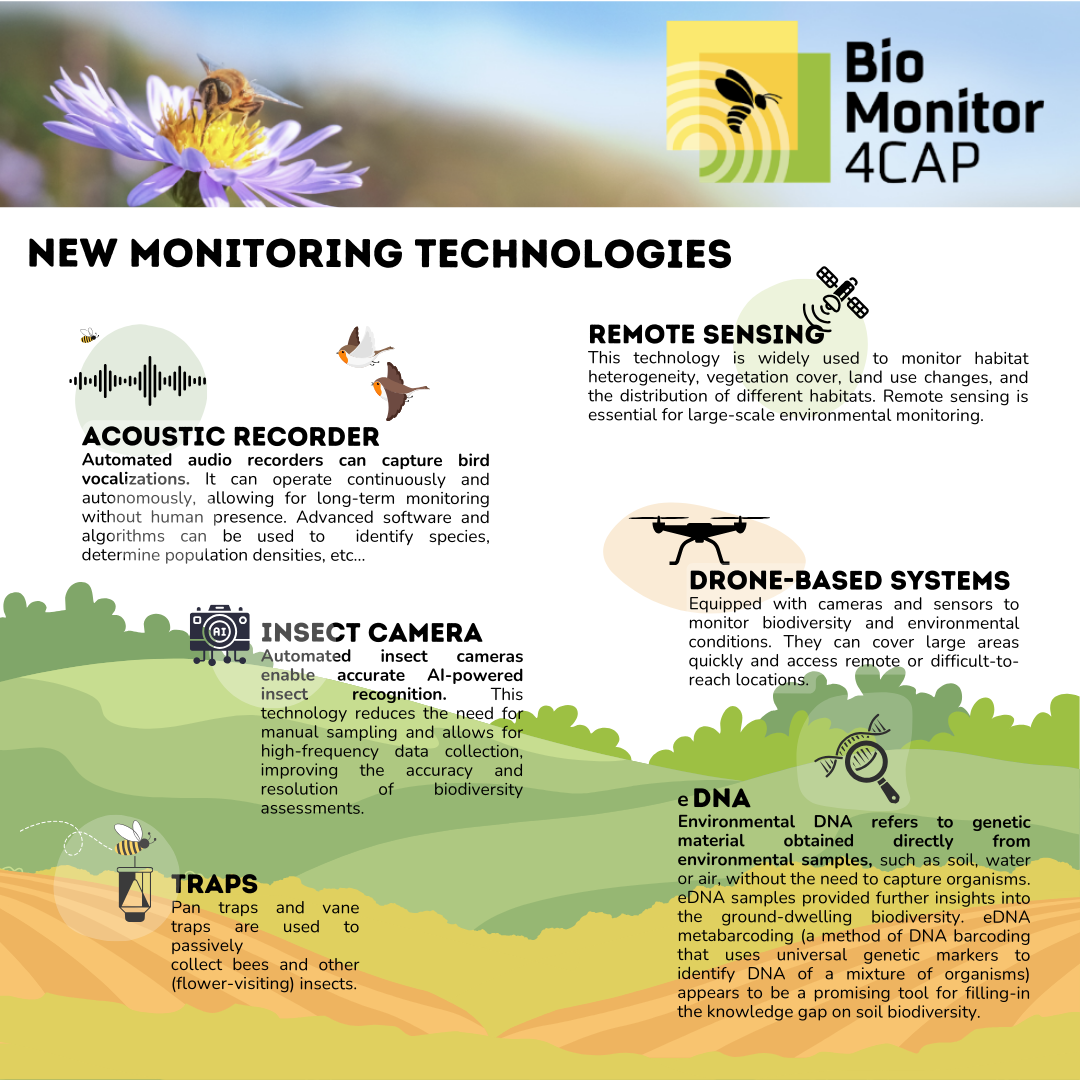
Source: Farm Europe — BioMonitor4CAP: New tools to monitor the Agro-Biodiversity – FarmEurope · www.farm-europe.eu
Trap: Drones are collection platforms, not a monitoring method themselves - they carry cameras, sensors, or sampling equipment
Trap: Camera traps cannot detect all species - small animals, nocturnal species, and arboreal animals may be missed
Trap: Acoustic monitoring works only for vocal species - many insects, reptiles, and silent mammals cannot be detected this way