In the context of the developments in Bioinformatics, the term ‘transcriptome’, sometimes seen in the news, refers to
Contents20
- Aa range of enzymes used in genome editing
- Bthe full range of mRNA molecules expressed by an organism
- Cthe description of the mechanism of gene expression
- Da mechanism of genetic mutations taking place in cells
Show answer
Answer: (B) the full range of mRNA molecules expressed by an organism
Answer: (b) The full range of mRNA molecules expressed by an organism
Think of it this way:
GENOME = complete library of DNA (all genes).
TRANSCRIPTOME = the set of books actually being READ at any time (genes that are active, producing mRNA).
Not all genes are active simultaneously.
Different cells express different genes.
The transcriptome shows WHICH genes are currently 'turned on.'
Why it matters:
Helps understand which genes are active in different tissues or diseases.
Cancer cells have a different transcriptome than normal cells.
Why not others?
(a) Enzymes for genome editing = CRISPR-Cas9 tools.
(c) Mechanism of gene expression = general biology concept.
(d) Genetic mutations = changes in DNA, not mRNA expression.
Simple analogy:
If DNA is the recipe book, mRNA is the list of recipes being cooked right now.
The transcriptome reveals which genes are actively producing proteins at any given time, making it crucial for understanding disease mechanisms and drug targets.
Advances in RNA sequencing technology in the 2010s made transcriptome analysis faster and cheaper, bringing it into mainstream medical research and news coverage.
UPSC is testing whether students can distinguish between static genetic information (genome) and dynamic gene activity (transcriptome).
Transcriptome & Gene Expression
Science And Technology transcriptome mRNA molecules gene expression
Transcriptome: Active Gene Expression Profile
Transcriptome = complete set of mRNA molecules expressed by an organism at a given time
Shows which genes are active, not just which genes exist
Varies between different cell types, tissues, and conditions
Key tool in cancer research and personalized medicine
Core Concept
The transcriptome represents all mRNA molecules actively produced by an organism's cells at any specific moment. Unlike the static genome (complete DNA library), the transcriptome is dynamic — constantly changing based on cell type, developmental stage, and environmental conditions.
From DNA to Transcriptome
%%{init: {"flowchart": {"wrappingWidth": 460}}}%%
flowchart TD
  s1["`**Genome (DNA)**
Complete genetic blueprint - all possible genes`"]
  s2["`**Transcription**
Selected genes copied into mRNA`"]
  s3["`**Transcriptome (mRNA)**
Active gene expression profile at specific time/condition`"]
  s4["`**Translation**
mRNA converted to proteins (proteome)`"]
  s1 --> s2
  s2 --> s3
  s3 --> s4
Genome vs Transcriptome
Aspect | Genome | Transcriptome |
|---|---|---|
Definition | Complete DNA sequence | All mRNA molecules being expressed |
Nature | Static - same in all cells | Dynamic - varies by cell/time |
Content | All genes (active + inactive) | Only currently active genes |
Size | ~25,000 genes in humans | Varies: 10,000-15,000 active genes typically |
Clinical Use | Genetic disorders, ancestry | Cancer profiling, drug response |
Why Transcriptome Matters
Disease research: Cancer cells show dramatically different transcriptomes than normal cells
Drug development: Helps identify which genes respond to specific treatments
Personalized medicine: Tailors treatment based on individual gene expression patterns
Developmental biology: Tracks how gene expression changes during growth and aging
Trap: Confusing transcriptome (mRNA) with genome (DNA) - genome is the blueprint, transcriptome is what's being read
Trap: Thinking transcriptome = proteome - proteins come after mRNA translation
Trap: Option A tries to link with CRISPR-Cas9 enzyme tools - those are for genome editing, not transcriptome analysis
Trap: Option C mentions 'mechanism of gene expression' - transcriptome is the result of expression, not the mechanism itself
Bioinformatics & Omics Technologies
Science And Technology Bioinformatics
Omics Revolution in Bioinformatics
Bioinformatics = computational analysis of biological data using software and algorithms
Omics technologies study biological systems at molecular level
Major branches: Genomics, Transcriptomics, Proteomics, Metabolomics
What is Bioinformatics
Bioinformatics combines biology, computer science, and statistics to analyze massive biological datasets. The explosion of omics technologies has created unprecedented amounts of molecular data requiring computational tools for interpretation.
Omics Technologies Map
# Omics Technologies
## Genomics
- DNA sequencing
- Genome assembly
- Variant analysis
- GWAS studies
## Transcriptomics
- RNA-seq
- Gene expression
- Alternative splicing
- Non-coding RNA
## Proteomics
- Mass spectrometry
- Protein interactions
- Post-translational modifications
## Metabolomics
- Small molecules
- Metabolic pathways
- Biomarkers
- Drug metabolism
Key Omics Comparison
Omics Type | Studies | Key Molecule | UPSC Relevance |
|---|---|---|---|
Genomics | Complete genetic blueprint | DNA | Genetic disorders, crop improvement |
Transcriptomics | Gene expression patterns | mRNA | Cancer research, drug development |
Proteomics | Protein structure & function | Proteins | Drug targets, disease markers |
Metabolomics | Metabolic processes | Small molecules | Nutrition, disease diagnosis |
Indian Bioinformatics Initiatives
Biotechnology Information System (BTIS): National bioinformatics infrastructure network
Indian Biological Data Centre (IBDC): Stores genomic data of Indian population
IndiGen Programme: Whole genome sequencing of 1,000 Indians for precision medicine
CSIR institutes: Advanced bioinformatics research at IGIB, CDRI, and other labs
Genome Editing Technologies
Science And Technology genome editing enzymes
CRISPR & Modern Genome Editing Tools
CRISPR-Cas9 = programmable molecular scissors for precise DNA editing
Uses guide RNA to target specific DNA sequences
Cas9 enzyme cuts DNA at targeted location
Applications: gene therapy, crop improvement, disease modeling
Revolution in Genetic Engineering
Genome editing technologies like CRISPR-Cas9 have revolutionized biotechnology by allowing precise, programmable changes to DNA sequences. Unlike transcriptome analysis (which studies gene expression), genome editing actually modifies the genetic code itself.
How CRISPR-Cas9 Works
%%{init: {"flowchart": {"wrappingWidth": 460}}}%%
flowchart TD
  s1["`**Design guide RNA**
Create RNA sequence matching target DNA region`"]
  s2["`**Deliver CRISPR system**
Introduce guide RNA + Cas9 enzyme into cell`"]
  s3["`**Target recognition**
Guide RNA binds to complementary DNA sequence`"]
  s4["`**DNA cleavage**
Cas9 enzyme cuts both DNA strands`"]
  s5["`**DNA repair**
Cell repairs cut - can insert, delete, or replace genes`"]
  s1 --> s2
  s2 --> s3
  s3 --> s4
  s4 --> s5
Genome Editing Applications
Application Area | Example | Current Status | Key Challenge |
|---|---|---|---|
Medical therapy | Sickle cell disease treatment | Clinical trials ongoing | Delivery to target cells |
Agriculture | Disease-resistant crops | Commercialized in some countries | Regulatory approval |
Research | Disease modeling in lab | Widely used | Off-target effects |
Conservation | Protecting endangered species | Early research stage | Ecological impact assessment |
India & Genome Editing
Guidelines issued: Department of Biotechnology released CRISPR research guidelines in 2022
Agricultural focus: ICAR developing climate-resilient crops using genome editing
Medical applications: Clinical trials for sickle cell disease and thalassemia
Regulatory framework: Genetic Engineering Appraisal Committee oversees approval process
Trap: Don't confuse genome editing enzymes (CRISPR-Cas9) with transcriptome analysis - editing changes DNA, transcriptome studies mRNA
Trap: CRISPR modifies the genome (DNA), not the transcriptome (mRNA expression)
Trap: Other editing tools exist: TALENs, Zinc finger nucleases - CRISPR is newest and most precise
Central Dogma: DNA→RNA→Proteins
Science And Technology mRNA gene expression mechanism
Central Dogma of Molecular Biology
Central Dogma: DNA → RNA → Protein (genetic information flow)
Transcription: DNA copied to mRNA in nucleus
Translation: mRNA decoded to proteins in ribosomes
Gene expression = entire process from gene activation to protein production
Information Flow in Cells
The Central Dogma describes how genetic information flows from DNA to proteins through RNA intermediates. Gene expression refers to this entire process — not just one mechanism, but the complete pathway by which genes produce functional products.
Gene Expression Process
%%{init: {"flowchart": {"wrappingWidth": 460}}}%%
flowchart TD
  s1["`**Gene activation**
Transcription factors bind to promoter region`"]
  s2["`**Transcription**
RNA polymerase copies DNA gene into mRNA`"]
  s3["`**mRNA processing**
Splicing removes introns, adds cap and tail`"]
  s4["`**Nuclear export**
Mature mRNA moves from nucleus to cytoplasm`"]
  s5["`**Translation**
Ribosomes read mRNA codons and synthesize protein`"]
  s6["`**Protein folding**
New protein assumes functional 3D structure`"]
  s1 --> s2
  s2 --> s3
  s3 --> s4
  s4 --> s5
  s5 --> s6
DNA vs RNA vs Proteins
Molecule | Structure | Location | Function | Stability |
|---|---|---|---|---|
DNA | Double helix, A-T-G-C | Nucleus (mainly) | Stores genetic info | Very stable |
mRNA | Single strand, A-U-G-C | Nucleus → Cytoplasm | Carries genetic info | Less stable |
Proteins | Amino acid chains | Throughout cell | Execute cellular functions | Variable |
Central Dogma Diagram
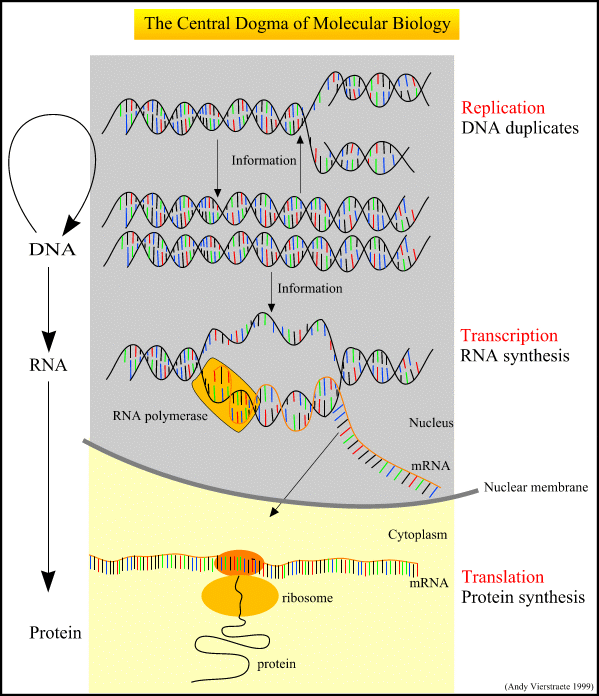
Source: users.ugent.be — Central Dogma of Molecular Biology · users.ugent.be
Trap: 'Mechanism of gene expression' (Option C) sounds correct but is too broad - transcriptome is a specific result of expression
Trap: Don't confuse transcription (DNA→RNA) with translation (RNA→protein)
Trap: mRNA is the messenger, tRNA brings amino acids, rRNA forms ribosome structure
Trap: Gene expression regulation happens at multiple levels - transcriptional, post-transcriptional, translational