At present, scientists can determine the arrangement or relative positions of genes of DNA sequences on a chromosome. How does this knowledge benefit us? 1. It is possible to know the pedigree of livestock. 2. It is possible to understand the causes of all human diseases. 3. It is possible to develop disease-resistant animal breeds. Which of the statements given above is/are correct?
Contents20
- A1 and 2 only
- B2 only
- C1 and 3 only
- D1, 2 and 3
Show answer
Answer: (C) 1 and 3 only
Statements 1 and 3 are correct.
Statement 2 is WRONG.
Gene mapping (knowing the position of genes on chromosomes) helps in:
Statement 1 (✓): Knowing livestock pedigree — by analyzing genetic markers, scientists can trace the ancestry, breed purity, and parentage of livestock. This is like a DNA paternity test for animals.
Statement 3 (✓): Developing disease-resistant breeds — by identifying which genes provide disease resistance, scientists can selectively breed animals carrying those genes, or even use genetic engineering to develop resistant breeds.
Statement 2 (✗): Understanding the causes of ALL human diseases is an overstatement. Gene mapping helps understand GENETIC diseases (like sickle cell anemia, cystic fibrosis), but many diseases are caused by infections, lifestyle, or environment — not genetics. The word 'ALL' makes this statement wrong.
UPSC tip: Beware of absolute words like 'all,' 'every,' 'always' — they usually make a statement incorrect.
Gene mapping allows scientists to trace livestock ancestry and identify disease-resistance genes, enabling selective breeding programs.
The trap is statement 2's absolute word 'all' - gene mapping only explains genetic diseases, not infectious, environmental, or lifestyle-related diseases.
UPSC is testing whether students can distinguish between what genetic knowledge can and cannot achieve, avoiding overstatement traps.
Gene Mapping & Chromosome Analysis
Science And Technology arrangement relative positions genes DNA sequences chromosome
Gene Mapping: Locating Genes on Chromosomes & Applications
Gene mapping determines exact positions of genes on chromosomes
Helps trace livestock pedigree through genetic markers
Enables development of disease-resistant animal breeds
Cannot explain ALL human diseases — only genetic ones
What is Gene Mapping
Gene mapping means finding the exact location and sequence of genes on chromosomes. Scientists use DNA sequencing and molecular markers to create detailed maps showing where each gene sits on the chromosome.
Physical mapping: Shows actual DNA base pair positions
Genetic mapping: Shows relative distances between genes
Linkage mapping: Shows which genes are inherited together
Applications of Gene Mapping
Application | How It Works | Examples | Limitations |
|---|---|---|---|
Livestock Pedigree | DNA markers trace ancestry | Cattle breed verification, Horse lineage | Requires reference databases |
Disease-Resistant Breeds | Identify resistance genes, selective breeding | Mastitis-resistant cows, Disease-free poultry | Complex traits need multiple genes |
Human Genetic Diseases | Locate disease-causing mutations | Sickle cell, Cystic fibrosis, Huntington's | Only works for genetic diseases |
Non-Genetic Diseases | Limited utility | Cannot map infections, lifestyle diseases | Major limitation |
Gene Mapping Process
%%{init: {"flowchart": {"wrappingWidth": 460}}}%%
flowchart TD
  s1["`**DNA Extraction**
Isolate DNA from cells or tissue samples`"]
  s2["`**DNA Sequencing**
Determine exact base pair sequence using sequencing machines`"]
  s3["`**Gene Identification**
Compare sequences to known gene databases`"]
  s4["`**Chromosome Mapping**
Assign each gene to specific chromosome location`"]
  s5["`**Application**
Use mapping data for breeding, disease analysis, or research`"]
  s1 --> s2
  s2 --> s3
  s3 --> s4
  s4 --> s5
Why Statement 2 is Wrong
Genetic diseases: Gene mapping helps identify mutations causing inherited disorders like sickle cell anemia
Infectious diseases: Caused by bacteria, viruses, fungi — gene mapping cannot explain malaria, tuberculosis, COVID-19
Lifestyle diseases: Heart disease, diabetes often caused by diet, exercise, environment — not just genes
Environmental diseases: Cancer from radiation, lung disease from pollution — external factors, not genetic positions
Multifactorial diseases: Most diseases involve both genes AND environment — mapping alone insufficient
Trap: Statement 2 uses 'ALL human diseases' — absolute words like 'all', 'every', 'always' usually make UPSC statements wrong
Confusion: Gene mapping ≠ understanding all diseases — it only helps with genetic diseases, not infections or lifestyle diseases
Misconception: Students think gene mapping explains cancer, diabetes, malaria — but these have non-genetic causes too
UPSC Pattern: Science questions often include one overstatement to test careful reading
Livestock Breeding & Genetic Applications
Science And Technology pedigree livestock disease-resistant animal breeds
Genetic Applications in Livestock: Pedigree Analysis & Breed Development
Genetic markers trace livestock ancestry like DNA paternity tests
Selective breeding uses gene mapping to develop disease-resistant animals
Disease resistance genes can be identified and bred into livestock populations
Pedigree analysis verifies breed purity and parentage
Livestock Pedigree Through Genetics
Pedigree analysis uses DNA markers to trace the family tree of livestock — like a paternity test for animals. Scientists compare genetic patterns to determine parentage, breed purity, and ancestry.
Genetic Applications in Animal Breeding
Application | Genetic Method | Benefits | Examples |
|---|---|---|---|
Pedigree Verification | DNA fingerprinting, microsatellites | Confirms parentage, prevents fraud | Race horse lineage, Pedigree cattle |
Breed Identification | Breed-specific markers | Ensures breed purity | Jersey vs Holstein cows, Indigenous breeds |
Disease Resistance | Gene mapping, QTL analysis | Reduces veterinary costs, healthier animals | Mastitis resistance in dairy cows |
Performance Traits | Marker-assisted selection | Higher milk yield, better meat quality | Growth rate in poultry, Egg production |
Disease-Resistant Breed Development
# Disease-Resistant Animal Breeds
## Identification Phase
- Map disease resistance genes
- Screen existing populations
- Identify genetic markers
## Breeding Methods
- Selective breeding
- Crossbreeding programs
- Marker-assisted selection
- Genetic engineering
## Target Diseases
- Mastitis in cattle
- Newcastle disease in poultry
- Foot-and-mouth disease
- Parasitic infections
## Benefits
- Reduced antibiotic use
- Lower mortality rates
- Higher productivity
- Sustainable farming
India's Livestock Breeding Programs
National Dairy Development Board: Uses genetic evaluation for cattle breed improvement programs
Indigenous breed conservation: Genetic mapping helps preserve native breeds like Gir, Sahiwal cattle
Cross-breeding programs: Combine disease resistance of indigenous breeds with productivity of exotic breeds
Poultry sector: Develops disease-resistant varieties for backyard farming and commercial production
Statement 1 is correct: Gene mapping definitely enables livestock pedigree analysis through genetic markers
Statement 3 is correct: Disease resistance genes can be identified and selectively bred into animal populations
Don't confuse: Livestock breeding applications are well-established, unlike the overstated claim about ALL human diseases
Human Genetic Diseases & Gene Mapping
Science And Technology human diseases causes
Gene Mapping in Human Disease: Scope & Limitations
Gene mapping explains genetic diseases like sickle cell, cystic fibrosis
Cannot explain ALL diseases — infections, lifestyle diseases have non-genetic causes
Single-gene disorders are easiest to map and understand
Complex diseases involve multiple genes plus environmental factors
What Gene Mapping Can & Cannot Do
Gene mapping successfully identifies the genetic basis of inherited disorders — diseases caused by mutations in specific genes. However, it cannot explain diseases caused by infections, lifestyle choices, or environmental factors.
Disease Categories & Gene Mapping Utility
Disease Type | Gene Mapping Role | Examples | Success Rate |
|---|---|---|---|
Single-Gene Disorders | High utility — pinpoints exact mutation | Sickle cell anemia, Cystic fibrosis, Huntington's | Very successful |
Chromosomal Disorders | High utility — maps structural changes | Down syndrome, Turner syndrome | Very successful |
Complex Genetic Diseases | Moderate utility — identifies risk genes | Diabetes, Heart disease, Cancer | Partially successful |
Infectious Diseases | No direct utility — pathogen causes disease | Malaria, Tuberculosis, COVID-19 | Not applicable |
Environmental Diseases | Limited utility — external causes primary | Lung cancer from smoking, Lead poisoning | Mostly unsuccessful |
Lifestyle Diseases | Limited utility — behavior causes disease | Obesity, Type 2 diabetes | Partially successful |
Major Genetic Diseases Mapped
Sickle Cell Disease: Mutation in HBB gene on chromosome 11 — causes abnormal hemoglobin
Cystic Fibrosis: CFTR gene mutation on chromosome 7 — affects lung and digestive functions
Huntington's Disease: HTT gene expansion on chromosome 4 — progressive brain degeneration
Thalassemia: Hemoglobin gene mutations — common in Mediterranean and Asian populations
Gene Mapping Visualization
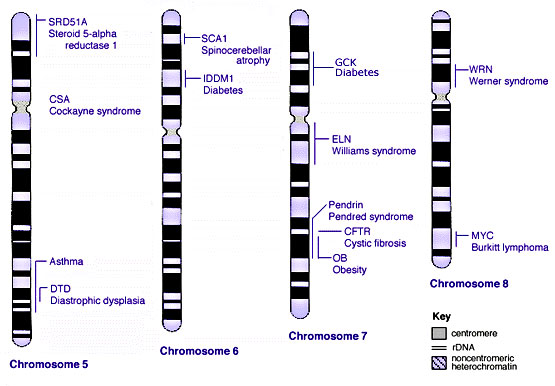
Source: Embryology Med - UNSW — Molecular Development - Genetics - Embryology · embryology.med.unsw.edu.au
Key trap: 'ALL human diseases' in Statement 2 — the word 'ALL' makes it wrong because many diseases aren't genetic
Common mistake: Thinking gene mapping explains cancer, heart disease completely — these are multifactorial
UPSC loves: Testing the difference between genetic diseases (mappable) vs infectious diseases (not mappable)
Remember: Gene mapping works for inherited disorders, not acquired diseases
Biotechnology Applications & Methods
Science And Technology
Biotechnology Tools: From Gene Mapping to Practical Applications
DNA sequencing and gene mapping are foundation tools of modern biotechnology
Marker-assisted selection improves crop and livestock breeding efficiency
Genetic engineering can transfer specific genes between organisms
Applications span medicine, agriculture, and industry
From Basic Research to Applications
Biotechnology uses biological systems and organisms to develop useful products. Gene mapping provides the foundation knowledge that enables practical applications in medicine, agriculture, and industry.
Biotechnology Application Areas
# Biotechnology Applications
## Medical Biotechnology
- Gene therapy
- Diagnostic tests
- Personalized medicine
- Vaccine development
## Agricultural Biotechnology
- GM crops
- Disease-resistant varieties
- Improved nutrition
- Pest control
## Animal Biotechnology
- Livestock breeding
- Disease resistance
- Pharmaceutical production
- Conservation genetics
## Industrial Biotechnology
- Enzyme production
- Biofuels
- Biomaterials
- Environmental cleanup
Biotechnology Methods & Tools
Method | What It Does | Key Applications | Limitations |
|---|---|---|---|
DNA Sequencing | Reads genetic code | Gene mapping, disease diagnosis | Expensive, requires expertise |
PCR (Polymerase Chain Reaction) | Amplifies DNA samples | Forensics, medical diagnosis | Can amplify contamination |
Genetic Engineering | Transfers genes between organisms | GM crops, insulin production | Ethical concerns, regulation |
Marker-Assisted Selection | Selects organisms with desired genes | Crop breeding, livestock improvement | Limited to known genes |
Gene Therapy | Replaces faulty genes | Treatment of genetic disorders | Delivery challenges, safety |
India's Biotechnology Initiatives
Department of Biotechnology (DBT): Nodal agency for biotechnology development and regulation in India
Genome India Project: Aims to sequence 10,000 Indian genomes to understand genetic diversity
National Biotechnology Development Strategy: Focus on agriculture, healthcare, and industrial applications
GM crop regulation: Genetic Engineering Appraisal Committee (GEAC) oversees GM crop approvals