Consider the following pairs:
Contents19
Consider the following pairs:
| Objects in space | Description | |
|---|---|---|
| 1. | Cepheids | Giant clouds of dust and gas in space |
| 2. | Nebulae | Stars which brighten and dim periodically |
| 3. | Pulsars | Neutron stars that are formed when massive stars run out of fuel and collapse |
How many of the above pairs are correctly matched?
- AOnly one
- BOnly two
- CAll three
- DNone
Show answer
Answer: (A) Only one
Pair 1 is incorrectly matched:
Cepheids are a class of variable stars that have played a crucial role in measuring astronomical distances and advancing our understanding of the universe.
Cepheids are characterised by their regular and predictable variations in brightness.
The primary factor that causes their variability is pulsation - the expansion and contraction of the star's outer layers.
Pair 2 is incorrectly matched:
Nebulae are vast clouds of gas, dust, and other interstellar material scattered throughout galaxies.
These beautiful and often intricate structures can be found in various shapes, sizes, and colours.
Nebulae play a fundamental role in the formation and evolution of stars and galaxies.
Pair 3 is correctly matched:
Pulsars are a specific type of neutron star that emits beams of radiation, typically in the form of radio waves, but also in other parts of the electromagnetic spectrum.
As the neutron star rotates rapidly, the emission beams sweep across space, resembling the sweeping motion of a lighthouse beam.
Space phenomena like Cepheids, nebulae, and pulsars are fundamental astronomical objects that help scientists measure cosmic distances and understand stellar evolution.
UPSC tests definitional precision in astronomy by mixing up characteristics of different stellar objects - students must know that Cepheids are variable stars, not clouds, and pulsars are rotating neutron stars, not collapsing massive stars.
Cepheid Variable Stars
Science And Technology Cepheids
Cepheid Variable Stars: Properties & Astronomical Importance
Cepheids are variable stars that brighten and dim in regular cycles
Used as standard candles to measure cosmic distances
Named after Delta Cephei constellation star
Pulsation period relates directly to intrinsic brightness
What Are Cepheids
Cepheid variables are stars that pulsate regularly, causing their brightness to increase and decrease in predictable cycles. These are massive, evolved stars that have exhausted hydrogen in their cores and entered an unstable phase where they alternately expand and contract.
Cepheid Characteristics
Property | Details | Significance |
|---|---|---|
Type | Variable stars | Brightness changes periodically |
Pulsation Period | 1-70 days typically | Longer period = brighter star |
Mass | 4-20 times solar mass | Much larger than our Sun |
Temperature | 5,000-6,500K during cycle | Surface temperature varies with pulsation |
Distance Range | Up to millions of light years | Visible in other galaxies |
Astronomical Importance
Standard candles for measuring distances to nearby galaxies
Helped discover the expansion of the universe (Edwin Hubble's work)
Used to calibrate the cosmic distance ladder
Period-luminosity relationship discovered by Henrietta Leavitt
Trap: Confusing Cepheids with nebulae (clouds) - Cepheids are stars, not gas clouds
Trap: Mixing up with pulsars - Cepheids pulse in brightness, pulsars emit radiation pulses
Common error: Thinking all variable stars are Cepheids - many types of variable stars exist
Nebulae
Science And Technology Nebulae
Nebulae: Giant Cosmic Clouds of Dust and Gas
Nebulae are giant clouds of dust and gas in space
Serve as stellar nurseries where new stars are born
Visible due to light emission, reflection, or absorption
Can span hundreds of light years across
Definition
Nebulae are vast interstellar clouds composed primarily of hydrogen gas and cosmic dust. They are the raw material from which stars and planetary systems form, and also represent the final resting place of material ejected by dying stars.
Types of Nebulae
Type | Appearance | Formation | Example |
|---|---|---|---|
Emission Nebulae | Red/pink glow | Hot stars ionize nearby gas | Orion Nebula |
Reflection Nebulae | Blue scattered light | Dust reflects starlight | Pleiades cluster |
Dark Nebulae | Dark silhouettes | Dense dust blocks background light | Horsehead Nebula |
Planetary Nebulae | Ring-like structures | Dying stars eject outer layers | Ring Nebula |
Supernova Remnants | Expanding shells | Stellar explosions create shockwaves | Crab Nebula |
Role in Stellar Evolution
Star formation: Gravity causes gas clouds to collapse and form protostars
Stellar death: Dying stars return material to space, enriching nebulae
Element recycling: Heavier elements created in stars spread through nebulae
Galactic evolution: Nebulae drive the ongoing cycle of stellar birth and death
Famous Nebulae

Source: Cosgrove's Cosmos — B33: The Horsehead and The Flame Nebula (NGC 2024) in LHaRGB ... · cosgrovescosmos.com
Correct match: The question correctly pairs nebulae with giant clouds of dust and gas
Trap: Don't confuse nebulae with galaxies - nebulae are within galaxies
Trap: Nebulae are not stars - they are the birthplaces of stars
Pulsars
Science And Technology Pulsars
Pulsars: Rotating Neutron Stars with Regular Pulses
Pulsars are rapidly rotating neutron stars that emit regular radiation pulses
Formed when massive stars collapse after running out of fuel
Emit beams of radiation from magnetic poles like a lighthouse
Pulse periods range from milliseconds to seconds
Formation Process
When a massive star (8+ solar masses) exhausts its nuclear fuel, its core collapses catastrophically in a supernova explosion. The core gets compressed into an extremely dense neutron star - a city-sized object with the mass of our Sun.
From Star to Pulsar
%%{init: {"flowchart": {"wrappingWidth": 460}}}%%
flowchart TD
  s1["`**Massive Star**
Star with 8+ solar masses burns nuclear fuel`"]
  s2["`**Fuel Exhaustion**
Core runs out of nuclear fuel to maintain pressure`"]
  s3["`**Core Collapse**
Gravity overwhelms pressure, core implodes in <1 second`"]
  s4["`**Neutron Star Forms**
Core compressed to neutron density (10^15 g/cm³)`"]
  s5["`**Rapid Rotation**
Conservation of angular momentum spins neutron star rapidly`"]
  s6["`**Pulsar Emissions**
Magnetic field channels radiation into beams from poles`"]
  s1 --> s2
  s2 --> s3
  s3 --> s4
  s4 --> s5
  s5 --> s6
Pulsar Properties
Property | Typical Values | Extreme Cases |
|---|---|---|
Mass | 1.4 solar masses | Up to 2.17 solar masses |
Diameter | 20-25 km | Varies slightly with mass |
Rotation Period | 0.1-10 seconds | Millisecond pulsars: 1-10 ms |
Magnetic Field | 10^8-10^12 times Earth's | Magnetars: 10^14-10^15 times |
Density | 10^15 g/cm³ | Nuclear density |
Surface Gravity | 10^11 times Earth's | Crushing gravitational pull |
Lighthouse Mechanism
Misaligned axes: Magnetic axis differs from rotation axis
Focused beams: Magnetic field channels radiation into narrow cones
Sweeping motion: As pulsar rotates, beams sweep across space like lighthouse
Pulse detection: We detect pulses only when beam points toward Earth
Precise timing: Pulses arrive with atomic clock precision
Pulsar Structure
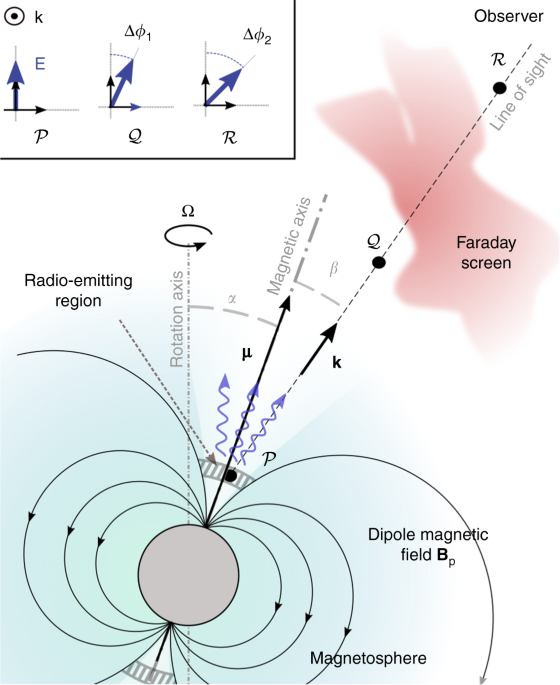
Source: Nature — Determining the rotation direction in pulsars | Nature ... · www.nature.com
Key trap: Question wrongly describes pulsars as neutron stars formed when massive stars collapse - pulsars are rotating neutron stars that emit pulses
Trap: Don't confuse neutron stars (the object) with pulsars (neutron stars we can detect via pulses)
Trap: Pulsars don't pulse in brightness like Cepheids - they pulse in radio/X-ray radiation
Memory aid: PULsar = PULses of radiation, not visible light changes
Stellar Objects Classification
Science And Technology Objects in space
Classification of Major Stellar Objects & Space Phenomena
Stars: Self-luminous objects powered by nuclear fusion
Stellar remnants: End products of stellar evolution (neutron stars, black holes)
Interstellar medium: Gas and dust between stars (nebulae)
Each category has distinct formation, properties, and observational signatures
Space Objects Hierarchy
# Space Objects
## Active Stars
- Main Sequence Stars
- Red Giants
- White Dwarfs
- Variable Stars (Cepheids)
## Stellar Remnants
- Neutron Stars
- Pulsars
- Black Holes
- White Dwarfs
## Interstellar Matter
- Emission Nebulae
- Dark Nebulae
- Planetary Nebulae
- Supernova Remnants
## Stellar Systems
- Binary Stars
- Star Clusters
- Globular Clusters
- Stellar Associations
Key Distinguishing Features
Object Type | Primary Characteristic | Energy Source | Observational Signature |
|---|---|---|---|
Variable Stars | Brightness changes periodically | Nuclear fusion (unstable) | Light curves, brightness cycles |
Nebulae | Extended clouds of gas/dust | Reflected/emitted light | Emission/absorption spectra |
Pulsars | Regular radiation pulses | Rotational energy | Radio/X-ray pulses |
Black Holes | Extreme gravitational field | Accretion disk heating | X-ray emissions, gravitational effects |
Binary Systems | Two stars orbiting together | Nuclear fusion + orbital dynamics | Doppler shifts, eclipses |
UPSC Exam Focus
Formation processes: How different objects form from stellar evolution
Observable properties: What makes each type detectable and distinctive
Size scales: From individual stars to galactic structures
Recent discoveries: New classes like magnetars, exoplanets, gravitational waves
Classification errors: Mixing up what objects are vs how they behave
Formation confusion: Not all dense objects are formed the same way
Observation vs reality: What we observe may not represent the object's true nature
Scale confusion: Stellar objects vs galactic objects vs cosmological phenomena